|
|



This is an Archived News page of ICARE.TO
We regret to inform you that the co-founders of ICARE.TO, Suzette Bronkhorst and Ronald Eissens, both passed away in 2021.
You can visit the stichtingmagenta.nl website for more information.
Headlines 16 October, 2015
Headlines 16 October, 2015
Bulgaria: UNHCR Condemns Incident with Migrant near Border
16/10/2015- The UN Refugee Agency UNHCR has strongly condemned the shooting which resulted in the death of a migrant near Bulgaria's border with Turkey, its local spokesperson, Boris Cheshirkov, has announced. "We condemn the fact that the death of an asylum seeker from Afghanistan occurred and that it happened while he was trying to reach safety in Bulgaria and to exert his universal right to seeking asylum," Cheshirkov told the Bulgarian National Radio, also urging an "immediate, thorough, transparent, and independent" investigation into the tragic event. Earlier, the Bulgarian Interior Ministry's Chief Secretary, Georgi Kostov, warned that migrants from Afghanistan (such as the total of 54 people of which the victim's group consisted) arrested at the borders are to be extradited to their homeland under FRONTEX regulations.
© Novinite
Finland: Parliament condemns racism, mulls over its definition
15/10/2015- All parliamentary parties signed on Wednesday a declaration against racism and demonstrated the same solidarity while engaging in a topical discussion initiated by Member of Parliament Nasima Razmyar (SDP). The impetus for the discussion stemmed from the budding climate of intolerance and increasing incidence of hate speech. “We've witnessed too many times how few steps there are from hate speech to hate acts,” Razmyar stated. She urged her fellow Members of Parliament in her emotional speech to send out a clearly-worded message: “There is no room for racism and hate speech in Finland.” Her colleagues embraced the message but also emphasised that whipping up solidarity in the session hall is not enough without appropriate actions. Each and every one of us can demonstrate by ourselves that tolerance can overcome hate, Razmyar summarised, stirring up an emotional response even from veteran lawmaker Eero Heinäluoma (SDP).
While the session hall was full to bursting with goodwill, Members of Parliament also examined the definition of racism. Sampo Terho, the chairperson of the Finns Party Parliamentary Group, reminded that the EU Charter of Fundamental Rights defines racism as discrimination based on race, colour, birthplace or national or ethnic origin. Petteri Orpo (NCP), the Minister of the Interior, estimated that some have been too eager to brand their fellow citizens racists. “You can be critical of the immigration policy or concerned about how Finland can cope with the high number of immigrants without being one bit racist,” he said. “It's tolerance to appreciate the concerns and different opinions of people under such difficult circumstances. Branding someone a racist is a harsh accusation.”
Tarja Filatov (SDP) defined racism as the subjugation of another population group. “You consider your own group of people superior to the other group.” Some make racist statements, while others advocate “an open-door policy,” said Peter Östman (Christian Democrats). “The Christian Democrats don't like either line. We don't tolerate racism, but we don't like decisions that include coercion [such as the obligatory re-settlement of asylum seekers].” Certain members of the opposition took the opportunity to criticise the spending cuts proposed by the Government. Outi Alanko-Kahiluoto (Greens) warned that the cuts in education funding will hinder the integration of immigrants. The chairperson of the Left Alliance, Paavo Arhinmäki, estimated that people have a just reason to feel disoriented and anxious about their jobs, homes and livelihood.
“However, this is not because of immigrants but because of the spending cuts and economic policy pursued by the Government that were drawn up before the number of asylum seekers arriving in Finland started to grow,” said Arhinmäki. Razmyar estimated that it is also time to update the assessment of the risks posed by extremist movements and determine carefully how the legislation can be improved to prevent violent acts by extremist groups. Estimates drawn up by the Finnish Security Intelligence Service (Supo) suggest according to Orpo that a few hundred people are currently affiliated with extremist groups. Finland, he added, has beefed up the monitoring of extremist groups and is currently updating the national action plan for preventing violent extremism.
© The Helsinki Times.
Belgium charges French comedian over racist remarks
15/10/2015- The Belga press agency reports that controversial French comedian Dieudonné has been charged with using anti-Semitic, discriminatory speech during a performance in Belgium and faces prison time of up to six months without parole should he be convicted. "His performance is full of so many defamatory, offensive expressions that it makes one want to vomit," said Damien Leboutte, the prosecutor in Liège, when reading the indictment. Leboutte is also seeking to fine the comedian EUR 5 000. The verdict is expected on 25 November. According to the Belgian authorities, Dieudonné, a 49-year-old whose full name is Dieudonné Mbala Mbala, committed his offense during a performance in March 2012 in Liège. His words allegedly incited racial intolerance and expressed negativistic, revisionist ideas. Belgian daily Le Soir reports, for example, that the comedian called Adolf Hitler a "good-hearted braggart". Dieudonné is the son of a Cameroonian man and a Frenchwoman and was actively against racism during the 1990s, when he became famous as part of a duo with the Jewish humorist Elie Semoun. Later, however, he began to spend time with representatives of the French ultra-right and doing solo performances featuring speech that primarily took heavy swipes at Jewish people. He has faced several prosecutions, his performances have been cancelled, and the doors of the mainstream media have gradually been closed to him.
© Romea.
EU Countries Not Meeting Commitments on Migrant Redistribution, Official Says
14/10/2015- European governments are failing to live up to their commitments to tackle the continent’s migration crisis, a top European Union official said on the eve of a summit on Thursday here where leaders will debate the issue anew. Thousands of people continue to arrive every day in Greece, even as temperatures drop, adding to the 710,000 refugees and other migrants that the EU border agency Frontex says have arrived in the bloc this year. Last month, after vitriolic debate, EU governments approved the redistribution of 160,000 asylum seekers across the bloc. But so far, only a handful of capitals have given precise indications of how many people they will take in and when.
Governments in September also pledged to donate more money to aid organizations dealing with refugees, but have so far done little, Jean-Claude Juncker, president of the European Commission, told the European Parliament on Wednesday. “The European institutions have delivered quickly, all we were supposed to do, we did. But member states have not done it to the same extent,” he said. Mr. Juncker said the commission, the bloc’s executive, has cobbled together a total of €9.2 billion to cope with the refugee crisis, a sum that national governments last month pledged to match. Out of that, so far only the U.K. has come forward with €225 million for the United Nations refugee agency.
Governments have also failed to live up to their pledges to dispatch border guards, asylum officers and translators to Italy and Greece to help with registration and fingerprinting of migrants. Out of the more 1,000 staff needed, only 130 have been put forward so far by member states. “I would have liked to see that what was promised in September will be delivered tomorrow. It is not enough to make promises; deeds are what count,” Mr. Juncker said. Thursday’s summit will discuss revamping the bloc’s asylum policies, improving control over the bloc’s external borders and relations with Turkey, the main transit country for refugees.
Mr. Juncker, who was the architect of the controversial refugee redistribution plans, admitted to shortcomings in making the program work. Among the challenges is finding people who are willing to go to countries they have never heard of. “It seems hard enough to find people in Greece willing to come to Luxembourg, even though it is one of the richest countries in the EU,” Mr. Juncker said. “Still, I don’t think it is outrageous to invite people fleeing from war to come to Luxembourg.” Greece—which has seen 450,000 migrants arrive this year—aims to transfer just 30 refugees to Luxembourg sometime this month. But “it was hard to find them,” a Greek official said.
Last week, Italy struggled to find the 19 Eritreans it eventually sent to Sweden, say officials and migrant aid groups involved in the process. Another problem is convincing migrants to remain in the country they are sent to. Most want to reach Germany or Scandinavia, but tens of thousands are earmarked for other countries where they may not want to settle. Indeed, France and Belgium last month tried to help Germany by taking 1,250 refugees from German reception centers. But many of them soon returned to Germany on their own. “This plan may have been too hopeful [in expecting] that people will go and stay where they’re told. But it’s early stages; it may still work,” one senior EU official said.
Securing the bloc’s external borders is another area in which nearly no progress has been made, as Athens opposes an idea floated by Mr. Juncker to set up joint Turkish-Greek border patrols. “I proposed joint Turkish-Greek patrols in the Mediterranean. Turkey was fine with it, but Greece rejected the idea,” Mr. Juncker said. “This is about Europe, not bilateral relations. I ask Greece to revise its position.” Konstantinos Koutras, a spokesman for the Greek foreign ministry, said this week that Greece had never considered using its navy to confront war refugees “nor can it even discuss the novel ideas expressed lately, such as that of joint Greek-Turkish patrolling of maritime borders.” Mr. Juncker added that the Turkish route—where more than 450,000 people have come this year, according to the International Organization for Migration—needs to be closed “in a reasonable manner.”
But convincing Turkey to stem the migration flow in exchange for visa-free travel and other EU incentives is still a distant project. Mr. Juncker dispatched two of his deputies to Ankara on Wednesday to continue talks on the matter. Diplomats in Brussels say they are skeptical this will succeed. “Turks don’t feel treated very well by the EU. This has been an issue for years and has not changed. I have no illusions that there will be a very difficult bargain with Turkey on that,” said one official familiar with the discussions.
© The Wall Street Journal*
Switzerland: Populist right seen boosting number of MPs
The Swiss head to the polls Sunday to vote in a new parliament, with the populist right seen as likely to strengthen its already dominant position amid concerns over migrants and asylum rules.
14/10/2015- The surging numbers of migrants and refugees moving through Europe have heightened the focus on the issue in Switzerland, even though the wealthy Alpine nation has yet to be significantly affected by the crisis. The last poll from the gfs.bern polling institute showed that 48 percent of those questioned thought migration was the most important issue facing the country. Power-sharing and consensus rule are the norm in Switzerland and elections rarely lead to major shifts in parliament or the makeup of the government, which does not directly reflect the power balance in the house. But the latest polls suggest the scale is tilting from the centre-left towards a centre-right majority in parliament, which has 200 seats in its lower chamber and 46 in the upper chamber.
"That could clearly impact future decisions," Andreas Ladner, a political scientist at Lausanne University, told AFP, suggesting a centre-right tilt in parliament could lead to "stricter immigration policies." About a quarter of Switzerland's eight million inhabitants are foreign nationals, and immigration and asylum policies tend to figure among voters' top concerns. Pollster gfs.bern said the country had not seen a campaign so dominated by a single issue for decades, with only nine percent choosing the runner-up issue — Switzerland's relationship with the neighbouring European Union — as the most important. Ties with the EU were badly hit by a narrow Swiss popular vote in February 2014 in favour of restricting immigration from the bloc.
Migration crisis boosts right
Switzerland's largest party, the populist rightwing anti-immigration Swiss People's Party (SVP), appears to be benefiting from the increased focus on its pet issue, mainly at the expense of the Greens and other smaller parties. The latest poll handed SVP nearly 28 percent support — up from the 26.6 percent it managed in the 2011 election and close to the record high 28.9 percent it won in 2007. "SVP is clearly benefiting from the European crisis," Ladner said. Pascal Sciarini, a political scientist at Geneva University, however noted a heightened feeling of solidarity towards the migrants moving through Europe, which "may not benefit SVP".
He suggested the party, which in 2007 sparked outcry with posters of three white sheep kicking a black sheep off the Swiss flag, had toned down some of its anti-immigrant rhetoric. The SVP, which championed the vote to restrict immigration from the EU, has demanded a new referendum aimed at tightening Switzerland's already strict asylum laws. The centre-right Liberal Party, Switzerland's third largest party, holds a very different view. The party, which has also seen a significant hike in support in the latest polls to 16.7 percent and which could help push the overall balance of parliament rightwards, stresses instead the need for more immigration to keep Switzerland's economy strong.
Lack of qualified labour
"There is no migration problem . . . the main problem facing Switzerland today is economic," Liberal parliamentarian Fathi Derder told AFP, warning the country, where unemployment stands at just over three percent, "is facing "a dire lack of qualified labour." The Socialists, Switzerland's second largest party, which in the last poll inched up slightly from the 18.7 percent of the vote they won in 2011, also want to broaden the debate to include cleaning up the Swiss banking sector and improving ties with the EU. Socialist vice-president Roger Nordmann warned a shift to the right in parliament could have dire consequences, especially if it hands more influence to SVP, who he accused of "playing to xenophobia". And politicians may have a hard time convincing voters that Sunday's vote is important — with major shifts in power a rarity, Switzerland's parliamentary elections generally fail to inspire much enthusiasm and turnout has not passed 50 percent since 1975.
Moreover the Swiss can have a more direct impact in referendums held every three months on different issues as part of the country's direct democratic system. But experts insist the stakes are high this time. In December the new parliament will elect Switzerland's Federal Council, or government, with the seven posts traditionally shared among the major parties from right to left under a tacit decades-old agreement dubbed "the magic formula". Despite being the largest party, SVP currently holds just one government post, but has its sights set on securing a second seat. "One out of seven seats may not seem important, but it is in fact, since that will determine the balance of power," Sciarini said.
© The Local - Switzerland
Spanish archbishop warns against 'Trojan horse' threat from refugees
A Spanish archbishop has called into question whether Spain should be welcoming refugees, asking "are they completely trustworthy?"
14/10/2015- The Archbishop of Valencia, Cardinal Antonio Cañizares, sparked controversy on Wednesday when he questioned whether welcoming refugees to Spain from Syria was such a good idea. "What’s happening in Europe?" the Catholic bishop asked. "This invasion of immigrants... are they completely trustworthy? Where will it leave Spain in a few years?" Cañizares was speaking during a forum on Europe and the Mediterranean organized by the New Economic Forum. He also raised the question of whether refugees were coming to Spain "because they were being persecuted" arguing that "many are not". He called for "clarity" and to see "who is behind all this". "We must be clear headed and not let everyone in, because today it could be someone who gets along very well, but it is in fact the Trojan horse for European societies and specifically Spain." Cañizares is so stranger to controversy and was criticised in 2009 for claiming abortion was worse than child abuse when he said:
"What happened in some schools cannot be compared with the millions of lives that have been destroyed by abortion. It has legally destroyed 40 million human lives."
Poverty in Spain
The Spanish archbishop also played down reports of increased poverty in Spain, arguing that "you don’t see any more people than before on the streets or living under bridges." He said claims were "exaggerated" and that Spaniards needed to "recognize the economic recovery" in Spain. The cardinal's words contradict those of his boss. Pope Francis recently urged "every Catholic parish in Europe" to take in a refugee family, setting the ultimate example by putting up a Syrian refugee family in a Vatican apartment.
© The Local - Spain
Almeria Province political parties are urging councils to declare their towns ‘refugees welcome’ zones.
14/10/2015- Nijar and Almeria City have already done so and they are now joined by Mojacar, where a plenary session voted unanimously to assist refugees from war zones. “Conscious of the grave situation, the town of Mojacar should remain true to its tradition as a meeting place where different nationalities and cultures live in harmony as well as its tradition of unquestionable humanitarian goodwill and international cooperation,” the council declared. The town hall will create a register of families who wish to take refugees into their homes or other properties that they own and support them during the time they are in Mojacar. Residents interested in collaborating are asked to contact the town hall’s Social Services department. Nijar Town Hall voted in September to become part of the network of ‘refugees-welcome’ towns. The motion proposed by Alexis Pineda, Deputy Mayor and IU party spokesman, was approved by all parties on the council. “This is least we can do when faced with the destabilisation and destruction of prosperous countries like Syria or Libya,” Pineda said at the time.
© Euro Weekly News
New reports on combating racism and intolerance: AUSTRIA, CZECH REPUBLIC and ESTONIA
13/10/2015- The European Commission against Racism and Intolerance (ECRI) today published monitoring reports on Austria, the Czech Republic and Estonia, analysing recent developments and outstanding issues and providing recommendations to the authorities. Despite certain positive developments, ECRI notes, there are challenges ahead.
AUSTRIA
ECRI reports, among the main problems, antipathy towards migrants and online hate speech at worrying levels, despite integration policies and awareness raising.
Fifth report on Austria
CZECH REPUBLIC
ECRI expresses serious concern over the lack of progress in eradicating segregation of Roma children in schools and the prevalence of anti-Roma hate speech in political discourse.
Fifth report on the Czech Republic
ESTONIA
Concerns remain, such as higher unemployment in regions which are predominantly Russian-speaking, or the unsatisfactory implementation of the new linguistic policy in the upper secondary school
Fifth report on Estonia
© The Council of Europe - ECRI.
EU Commission concerned by Hungary's migration laws
The EU Commission has expressed concerns over Hungary's new and amended migration laws in a letter sent last week which asked for clarification.
13/10/2015- The letter, published earlier by Hungarian media and now on Statewatch, a non-profit organisation committed to transparency, was sent on 7 October and was signed by the Commission's director general for migration and justice. The letter challenges recent Hungarian legislation that seems to fast-track people seeking refuge back to Serbia with a ban on entering the EU for a year. "Applications for international protection made at the border in a border procedure are systematically declared inadmissible on the basis of the fact that applicants have transited through Serbia," the letter states. It asks the Hungarian authorities to explain how the new border management is compatible with EU law, as reportedly only around 100 people are registered at the transit zone daily along the Serbian border and a decision dismissing their request can be made within an hour.
The Commission is concerned that asylum seekers are not interviewed by the authorities, their story is not being heard and they have no means to challenge the concept of Serbia being a "safe country". The EU executive is also worried about reports that people are not given proper information free of charge and have difficult access to free legal assistance, or interpretation. It also questions the circumstances of detention for asylum seekers, who are not told why they are being detained and how can they appeal against their detention. The Commission expresses serious concerns over how asylum seekers can fully exercise their right to challenge the rejection of their application, given the lack of information, legal assistance and short deadlines. The letter also asks for figures on how many requests for international protection were dismissed, how many of them were appealed, and how many concern children and other vulnerable asylum seekers.
The Hungarian authorities have two weeks to reply, and further communication is expected before the Commission could open an official investigation into whether the Hungarian legislation is in line with EU law. The Commission is concerned about the lack any specific procedure or safeguards for children, and whether illegal border crossings are not dealt with unproportionally, with the possibility of up to eight years prison sentence for damaging the border fence. The Commission is also concerned about the use of military in managing the borders and says that their conduct must respect EU rules. Hungary's government tweaked legislation in July and September to set up and protect the border fence along the Serbian frontier, sped up asylum procedures and gave extra rights to police and military in border management.
More than 320,000 people fleeing war and persecution have crossed into Hungary so far this year, with most headed to Austria and Germany. Since Hungary put up the razor fence in August, hundreds continued to climb over or crawl under it even after the new legislation came into force on September 15. There have been more than 400 fast-track trials of migrants since then, mostly Syrians and Iraqis, charged with the crime.
© The EUobserver
European Parliament Set to Lift Immunity of Hungarian MEP
12/10/2015- The European Parliament on Wednesday is set to take an unprecedented step and lift the immunity of one of its members accused of spying for Russia. Hungarian prosecutors over a year ago asked the European Union’s parliament to waive the immunity of far-right politician Béla Kovács, so he can be put on trial for espionage, facing up to eight years in prison if found guilty. At a parliamentary hearing behind closed doors on Monday, members in the legal affairs committee overwhelmingly voted in favor of lifting Mr. Kovács’ immunity. The full assembly of the 751-strong European Parliament on Wednesday is expected to endorse that decision.
Mr. Kovács, 55, hails from the far right Jobbik party in Hungary and was re-elected last May as member of the European Parliament. A Hungarian parliamentary committee in May 2014 found there was “solid” evidence he spied for Russia, an accusation which he strongly denies. Hungarian security services tracked Mr. Kovacs for four years, Hungarian government officials say, during which time they said he met covertly with Russian diplomats and traveled to Moscow on a monthly basis. Following Russia’s annexation of Crimea last year, Mr. Kovács was one of a handful of MEPs who traveled to Crimea, at the invitation of local pro-Russian authorities, to observe the so-called independence referendum. The U.S., the EU and the United Nations condemned the vote as illegitimate.
Péter Krekó, director at the Political Capital Institute, a Budapest-based research center looking at party funding, says Mr. Kovács made his fortune in Russia and Japan and was instrumental in turning Jobbik into a pro-Russia party. “In its early days, Jobbik was quite anti-Russian. But after Mr. Kovács joined, in 2005, and became one of the main donors, the party gradually shifted in favor of Russia,” Mr. Krekó says. Mr. Kovács has not hidden his pro-Russia sympathies throughout his political career, but says they are benign, not a sign of spying activities. “The least we can say is that he was a strong lobbyist for Russia and possibly brought Russian money into Jobbik… But I am not sure he is a real spy, because as an MEP you do not have access to important information,” Mr. Krekó says.
Political machinations by the conservative government of Viktor Orban also complicate the matter further. The timing of Mr. Kovács’ being exposed as a spy, just before the EU elections last year, “had certainly political motives, to cause some reputational damage to Jobbik,” says Mr. Krekó. Kremlin’s ties with the far right are not a Hungary-specific phenomenon. Similar suspicions of Russian money bankrolling the anti-EU, xenophobic parties exist in several EU countries, notably in France where Marine Le Pen’s Front National is being investigated about its party funding. None of its MEPs — neither Ms. Le Pen nor her father, Jean-Marie Le Pen — have been accused of spying for Russia, however.
© Wall Street Journal - Real Time Brussels Blog
Archive, 2005

Special News Edition: Protect freedom of speech and human rights in Poland
Headlines 9 December, 2005
Headlines 2 December, 2005
Special News Edition: French riots
Headlines 25 November, 2005
|
EUROPE NEEDS TO REACT IMMEDIATELY ON DISCRIMINATION AND HOMOPHOBIA IN POLAND(Press Release)
21/11/2005- On 19 November 2005, another peaceful demonstration in
support of equality and tolerance was banned in a Polish city of
Poznan. The march was organised by a number of Polish women’s and
lesbian, gay, bisexual and transgender rights organisations.
Despite
the ban the march went ahead but was blocked by the police, the
participants were arrested and interrogated. ILGA-Europe is deeply
disappointed and concerned about the level of continuing and blatant
discrimination by the Polish authorities. ILGA14
Europe calls upon
European organisations and the European states to immediately denounce
such intolerable actions by the Polish authorities. By joining the
European Union (EU), the Council of Europe (CoE) and the Organisation
for Security and Cooperation of Europe (OSCE), Poland agreed on the
principles of nondiscrimination, equality and freedom of peaceful
assembly. ILGA-Europe calls upon European organisations and the members
of the EU, CoE and OSCE to voice their protest and take immediate
actions to urge Poland to comply with its international obligations.
Patricia Prendiville, Executive Director of ILGA-Europe said:
“We
are deeply concerned with the development is Poland for the last few
months. Such discriminatory acts by the Polish authorities as banning
peaceful demonstrations in Warsaw earlier this year and in Poznan last
weekend, closing down the Poland’s equality body are sending very
worrying messages that Poland completely disregards its obligations it
agreed to implement by joining various European organisations. It is
time for the European organisations and states to send their firm
message to the Polish authorities that such behaviour is not tolerable
and contradicts European agreement and values.”
© ILGA Europe
EUROPARLIAMENT’S GAY AND LESBIAN RIGHTS INTERGROUP ON THE SITUATION IN POLAND
New Kind of Totalitarianism descends on Poland
24/11/2005- The President and Officers of the Lesbian and Gay Rights
Intergroup are shocked by the passed week's events in Poland. They are
deeply concerned about the breach of Human Rights and Fundamental
Freedoms within the EU Member State. Despite the Mayor of Poznan and
the Regional Authorities banning the Equality March, on Saturday 19
November 2005, the Equality March took place in Poznan in the light of
the celebrations of the International Day of Tolerance. "We believe
that the celebration and March create a space for discussion on
tolerance, solidarity and anti-discrimination through several cultural,
social and educational activities.". The event was incorrectly called
"Gay Pride" and argued as a danger to public safety and property. The
peaceful March only tried to promote the values of tolerance,
antidiscrimination and human rights. During the March several extreme
right protestors
attacked
the peaceful Marchers, the Police decided to arrest around 60 of the
marchers. It is unacceptable to see that the practice of such
discriminatory behaviour, and comments by politicians and authorities
of EU Member States, is tolerated within the EU. Preaching only one way
of thinking and excluding minorities is a step backwards. Poland as
signatory of the EU Charter of Fundamental Rights should respect its
obligations under the Charter, which enshrines the non-discrimination
principle in the national laws.
Michael Cashman, President, European Parliament's Intergroup on Gay and Lesbian Rights
Sophie in 't Veld , Raúl Romeva, Alexander Stubb Vice Presidents, European Parliament's Intergroup on Gay and Lesbian Rights
© ILGA Europe
ILGA-EUROPE’S LETTER TO EU OFFICIALS REGARDING THE SITUATION IN POLAND
Following letter has been sent to the President of EU Commission
Barroso, President of the European Parliament Fontelles, EU
Commissioners Spidla and Frattini:
22/11/2005- We are witting to you to express our deep disappointment
and serious concerns regarding the continuing and blatant homophobia
and discrimination against lesbian, gay, bisexual and transgender
(LGBT) people in Poland. We understand that you are to meet the Prime
Minister of Poland this week and urge you to immediately denounce such
intolerable actions and take concrete actions against the
discriminatory acts and homophobic attitudes by the Polish authorities.
For the last few months LGBT people in Poland have been subjected to
unacceptable expressions of hate by the leading Polish politicians,
including Poland’s Prime Minister. On 19 November 2005, another
peaceful demonstration in support of equality and tolerance was banned
in the Polish city of Poznan. The march was organised by a number of
Polish women’s and LGBT organisations. Despite the ban the march went
ahead but was blocked by the police, many of participants were arrested
and interrogated.
By joining the European Union Poland agreed to the principles of
non-discrimination, equality and freedom of peaceful assembly.
Eliminating various forms of discrimination, including on the grounds
of sexual orientation, is one of the fundamental principles of the
European Union. Article 21 of the Charter on the Fundamental Rights of
the European Union provides that discrimination on the grounds of
sexual orientation will be prohibited in the EU. The 2000 EU Employment
Equality Directive 2000/78/EC specifically requires EU member states to
ban sexual orientation discrimination in employment. Moreover, Article
12 of the Charter on the Fundamental Rights of the European Union
guarantees everyone the freedom of peaceful assembly.
Article 11 of the European Convention on Human Rights guarantees
everyone the right to peaceful assembly and the European Court of Human
Rights on many occasions declared that discrimination on the grounds of
sexual orientation is in breach of the Convention’s provisions.
Moreover, the Court confirmed that there is a positive duty and
obligation on a state to protect those exercising their right of
freedom of peaceful assembly from violent disturbance by
counter-demonstrators.
We urge you to raise the issue of homophobia and
discrimination against LGBT people in Poland during your meeting with
the Polish Prime Minister and to send a firm message to the Polish
authorities that such behaviour is not tolerable and contradicts
European agreements and values. We urge you to remind Poland’s Prime
Minister and the Polish authorities that as a member of the European
Union and according to the Article 6 of the Treaty of Nice, Poland is
under obligation to respect and protect minority rights. Paradoxically,
just a few days ago the Polish Prime Minister announced the closure of
the country’s equality body which dealt with the issues of
discrimination on the grounds 16 of gender, disability, race and sexual
orientation. Given the extremely high level of
discrimination
and hateful comments against LGBT people, we find this decision
unhelpful, to say the least. From our experience, national equality
bodies dealing with protection of minority rights are an extremely
useful tool to eliminating various forms of
discrimination and increasing respect towards and understanding of minority groups.
Therefore we urge you to raise the issue of re-instalment of the
equality body to ensure the country effectively deals with various
forms of discrimination, including on the grounds of sexual
orientation. We would be very happy to meet to discuss this matter in
greater details or provide more background information.
Sincerely yours,
Patricia Prendiville
Executive Director of ILGA-Europe
© ILGA Europe
POLISH DISCRIMINATION CONTRAVENES EU LAW
25/11/2005- As the Catholic fundamentalist prime minister of Poland
Kazimierz Macinkiewicz visited the UK, Liberal Democrat European
Justice spokeswoman and London MEP Baroness Sarah Ludford pressed the
European Commission to take firm action against the increasingly
homophobic attitudes being fostered in Poland under the new right-wing
government. A peaceful equalities march last weekend in the city of
Poznan was violently broken up by police and marchers arrested, while
Mr Macinkiewicz, who believes that homosexuality is unnatural,
apparently intends to abolish the equalities enforcement body the
'Office of the Plenipotentiary for Equal Status' which enforces
equality for women and gay people, a body required under EU law. Sarah
Ludford, a member of the European Parliament' Gay & Lesbian Rights
intergroup, said:
"Repressive
and intolerant behaviour is quite rightly condemned when it takes place
in a country seeking EU membership, but when it occurs in an existing
member state, a blind eye seems to be turned. This is gutless
hypocrisy."
When Sarah along with other members of the
intergroup asked the Commission in June to say whether the ban on an
Equality Pride march in Warsaw in by the then Mayor of Warsaw Mr Lech
Kaczynski breached EU human rights principles, the Commission said it
was a matter for national law. The Council of Ministers, representing
EU governments, said 'The Council has never discussed this matter which
is not within the competence of the EU institutions." Worryingly, Mr
Kaczynski is now President of Poland.
Sarah Ludford commented:
"The
Polish situation shows the need for 3 things: wider EU gay equality
laws going beyond the current coverage of employment rights; a
political willingness from Brussels to treat homophobic speech and
actions as a severe breach of EU human rights principles; and
infringement proceedings for failure to implement specific EU laws on
workplace equality."
© Sarah Ludford
NEWSFLASH DEMONSTRATIONS IN POZNAÑ & KRAKÓW ON SATURDAY 26/11/2005
Colected and translated by Rafal from witnesses's accounts on the Internet
Poznañ
In Poznañ there are about 300-400
people. There are banners saying: "Democracy - freedom of speech and
freedom to gather", "Tolerance yes, discrimination no", "Freedom of
speech, freedom to love", "Free women, free men". Statements were made
by the Anarchist Federation, the Greens, the Konsola association, and
by Patyczak. Jaros³aw Urbañski of the ZZIP (Workers' Initiative Trade
Union) talked about excessive policing and workers' rights, flyers from
the Anarchist Black Cross (ACK) about demonstrators' rights are being
distributed. The demonstrators called out: "The streets of Poznañ are
ours", "Freedom, equality, mutual aid", "Everyone different, all
equal", "Every authority kills freedom", "Freedom of speech, freedom to
gather". Despite some negotiations, the police did not permit a march
to take place. There are a few "football-hooligans", but they are just
observing from some way away from the demonstration.
Kraków
In Kraków, the solidarity
demonstration with the Poznañ Equality March: There are about 300
people, accompanied by the city security guards. The weather's not so
good, there's some light rain. Some people from political parties gave
speeches as well as people from women's organisations and those
supporting LGBT rights.
© I CARE News
PHOTO'S GDANSK DEMONSTRATION
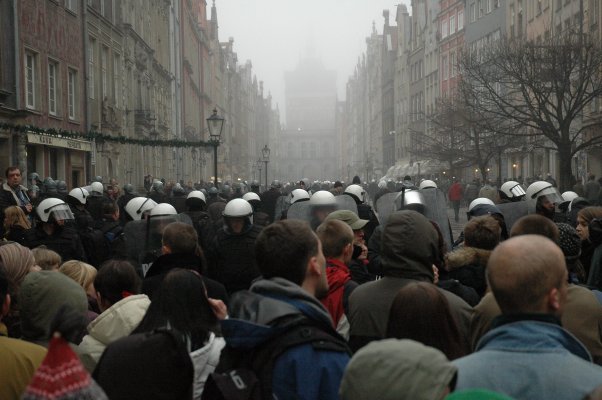 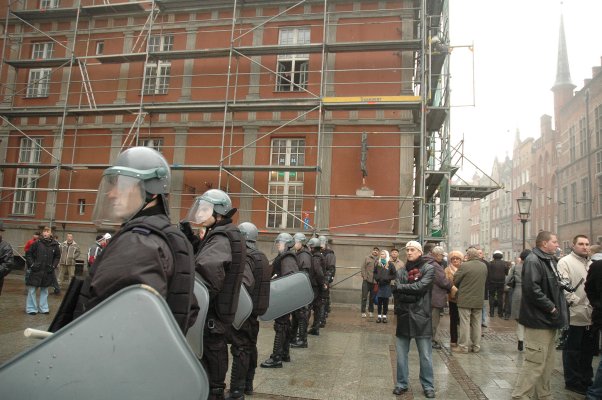 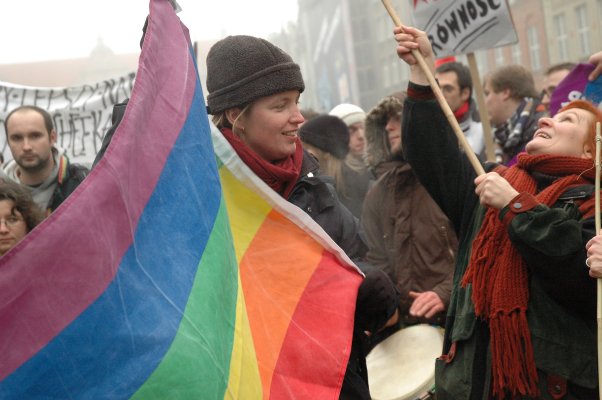 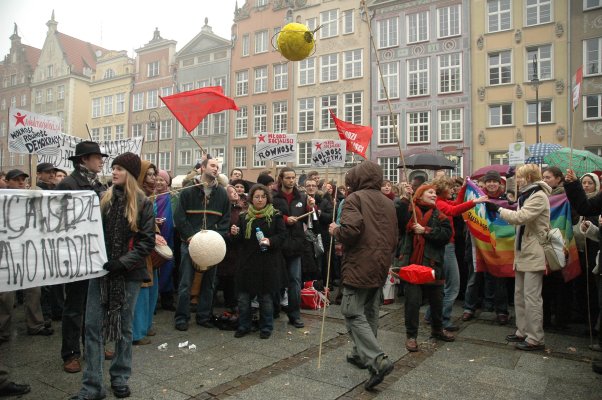 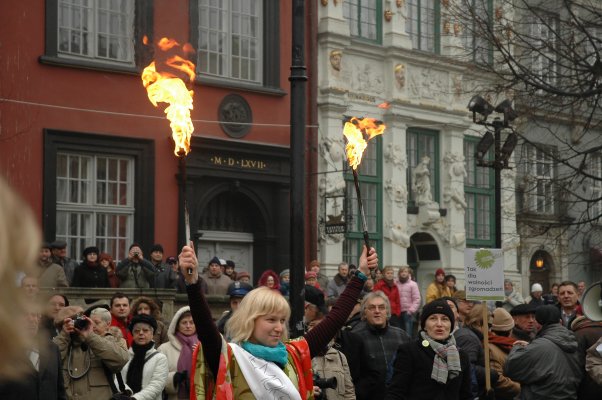 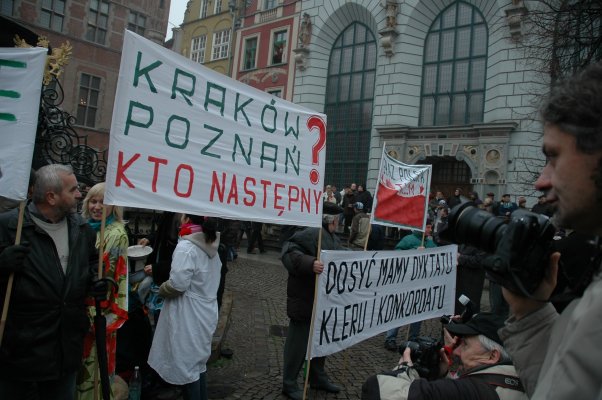 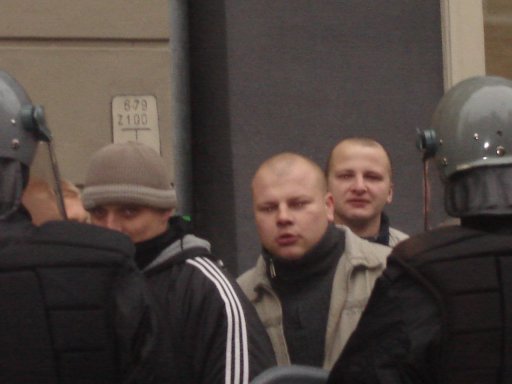 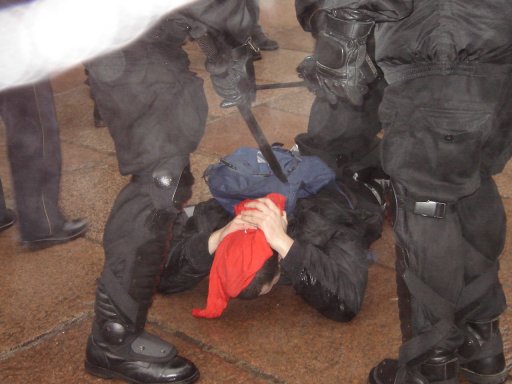 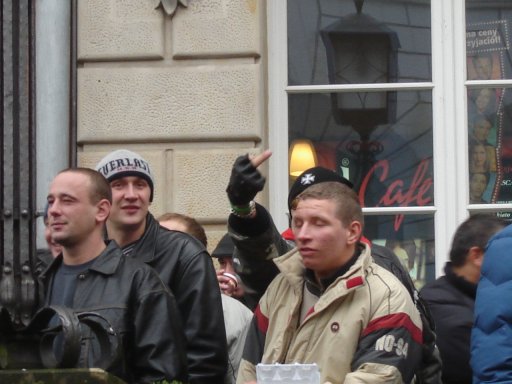
More photo's from Gdansk here and here
© I CARE News
MEP PUSHES FOR LEGAL ACTION ON POLAND
28/11/2005- Liberal Democrat European Justice spokeswoman and MEP
Baroness Sarah Ludford has called on the EU to take legal action
against Poland and press for it to drop its homophobic practices. The
move comes after a violent clash between protestors and police last
week in the city of Poznan, when officers broke up a peaceful march and
reportedly failed to offer adequate protection from far right counter
demonstrators. Another march was held over the weekend in cities across
the country, with hundreds of campaigners calling for more equality.
They fear a rise in homophobia after a series of apparent anti-gay acts
in the government. These have included the banning of a series of gay
demonstrations in the country, the use of anti-gay language by senior
politicians and the closing of the government office responsible for
promotion of equal treatment for sexual minorities. This comes despite
the EU warning Poland about its stance on LGBT issues both before its
accession to the bloc and since a Pride event was barred in Warsaw.
However, Baroness Ludford says more needs to be done. “Repressive and
intolerant behaviour is quite rightly condemned when it takes place in
a country seeking EU membership, but when it occurs in an existing
member state, a blind eye seems to be turned,” she said today.
“This is gutless hypocrisy.”
She called
for the EU to show an active concern on homophobia in order to stamp
out anti-gay sentiment in member states. As part of the European
Parliament’ Gay & Lesbian Rights intergroup, she was told earlier
this year that the decision by the then Mayor of Warsaw Mr Lech
Kaczynski to bar the Pride parade was a matter of national law. Now
that Kaczynski has been elected as President, she said more concrete
action needs to be taken. Her comments have been echoed by global human
rights group Amnesty International, which has also voiced its “concern
about a climate of intolerance in Poland”. “Amnesty International calls
on the Polish authorities to fulfil their obligations under
international human rights law, including by explicitly prohibiting
discrimination against sexual minorities, and investigating and
penalising all public expressions of incitement of hatred and
intolerance against sexual minorities,” the group said in a statement.
The EU has already warned that Poland could be stripped of its voting
rights if it makes no moves to protect its LGBT citizens in the coming
months. The country has yet to respond to the criticism.
© UK Gay News
PHOTOS WARSAW DEMONSTRATION
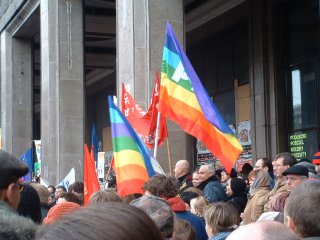 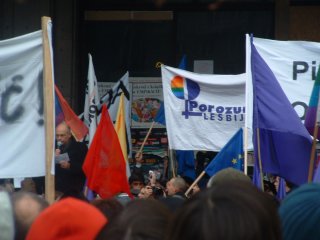 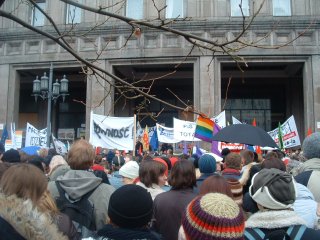 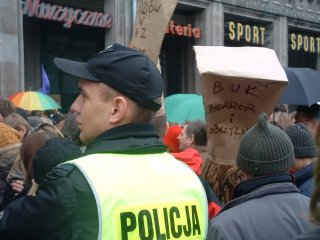 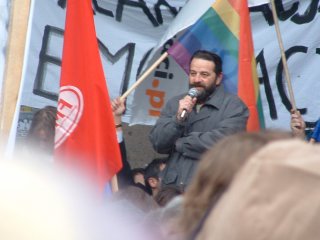 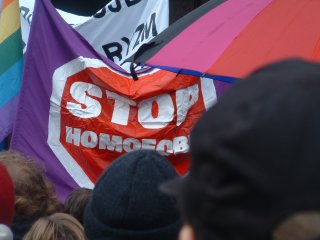 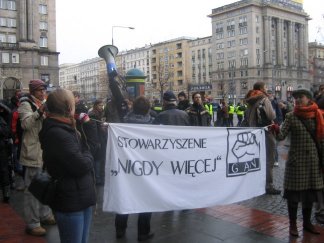 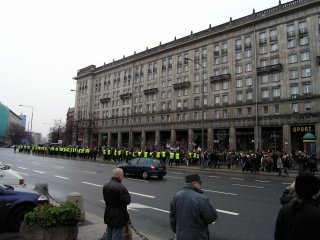 © photographs "Never Again" Association, Warsaw, 2005. © photographs "Never Again" Association, Warsaw, 2005.
© ICARE
STOP PROMOTING FASCISM - FROM A CO-ORGANISER OF THE WARSAW DEMONSTRATION
By Alicja Kowalska
27/11/2005- Very interesting is the fact that a significant role in
organizing the mass meeting in Warsaw was played by activists of
women’s unofficial groups, such as Women’s Coalition 8 March and
Lesbian Coalition (LBT). In cooperation with LGBT, left-wing and human
rights organizations they arranged all necessary acoustic equipments
and painted banners with slogans calling for reanimation of democracy.
Special badges with “Equality March goes on”, “Article 57 of the
Constitution - freedom of assembly” and “Stop promoting Fascism” have
been prepared and sold on the Square of Constitution. Many journalists,
artists and politicians have been invited to give a speech during the
event. The Lesbian Coalition (LBT) brought its violet flags and a huge
banner “Stop homophobia”. One thousand leaflets explaining what
homophobia is and urging to fight it have been given out. At
the end of the meeting the words “Article 57” was formed
in candles and people were singing “The Wall”, a very popular song
during the fight against communist repression.
© I CARE News
PHOTOS DEMONSTRATION LODZ
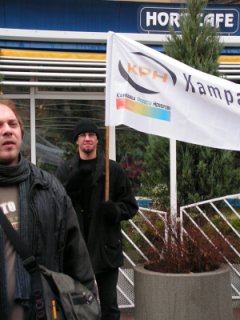 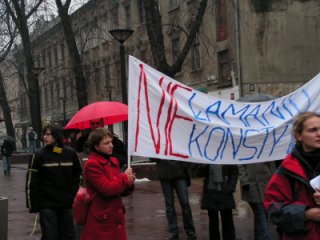
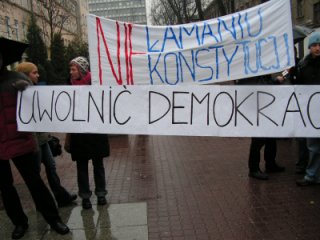
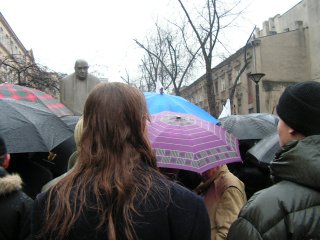 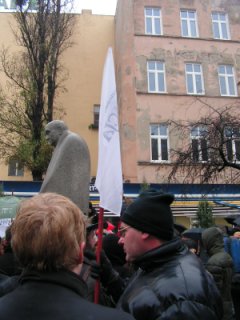
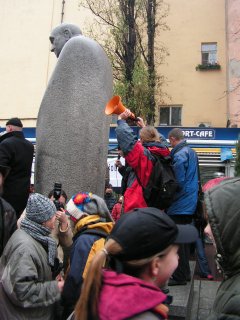
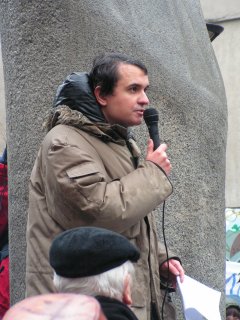 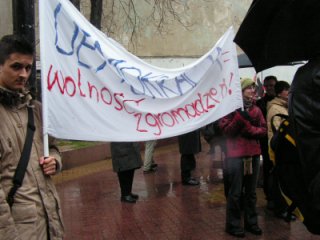
© Copyright photos: Lodz Branch of the Campaign against Homophobia, 2005
© ICARE
EVENTS IN POLAND TO PROTECT FREEDOM OF SPEECH AND HUMAN RIGHTS
Reports from manifestations and demonstrations on Sunday 27 November all around Poland.
19:30 Elblag - Reporter Michal
Events in
Elblag really got out of control. Immediately after the protesters
started to gather for the demonstration, the neo-nazis attacked them.
Police on the scene didn't do anything to stop the attack and seemed
afraid themselves. Everybody fled in different directions, chased by
the extremists. Michal is safe for now, but can not reach any of the
other demonstrators. We're afraid something has happened to them. Will
keep you posted on what's going on.
14:30 Gdansk - Reporter Tomas
Initially
the demonstration in Gdansk didn't get a permit, organisers managed to
get a permit for a manifestation. The neo-nazis have organised
themselves very well to try and stop the pro human right demonstrators.
At this time the situation in Gdansk is unclear. We called our reporter
Tomas at 14:10 he told us that the demo went very well, lots of people.
Most people didn't want to leave and could we call back in a while
because he had to talk to the police...
Called back 14:25. Tomas
told us 'things are heating up again' 'my god' and then we were
disconnected. We have not been able to connect to Tomas again, but will
keep on trying.
15.30 Connected to Tomas
again! He is alright. After the manifestation ended, police escorted
demonstrators to the station. All the streets around the station were
blocked by groups of extremists. Tomas was in a group of about 30
people without police protection, this group was attacked by neo-nazis,
that started throwing bricks and explosive devices. The police did show
up after a while and and managed to bring the human rights
activists into the station, however at the train platforms again
neo-nazis were waiting. Finally Tomas managed to get a
taxi to get away safely. So far it is not known if and how
many people have been hurt. In the centre of Gdansk there is still
rioting going on as the police is trying to arrest the neo-nazis.
Listen to the soundfile from Gdansk
14:00 Lodz - Reporter Tom
In
Lodz the organisors choose to hold a one hour manifestation and not to
march. This because they couldn't get permission from the authorities
in time to be allowed to march. The organisers are very happy with
around 200 people that participated, they had expected only about 50
people to come.
Listen to the soundfile from Lodz
13:00 Warsaw - Reporter Rafal Pankowski
Around
500 people gathered in the city centre to demonstrate. Although
the police was keeping an eye on the demonstration, they didn't try to
stop it or break the gathering up. Neo-nazi groups were also seen, 1
report of violence from neo-nazis against somebody on his way to the
demonstration.
Listen to the soundfile from Warsaw
© I CARE News
EQUAL RIGHTS PROTEST SUPPRESSED (Poland)
By Brian Dixon and Alex Nowacki
25/11/2005- Police arrested 85 protesters in Poznan on Saturday as the
new government showed its will to quash a series of pro-equal rights
marches by Poland’s environmentalist, feminist and gay rights groups.
Police expertly hemmed in the group of around 250 demonstrators outside
the city’s Stary Browar shopping mall, before forcibly breaking up the
protest, making media headlines and drawing wide criticism from the
country’s left wing. They worry the police’s behaviour and treatment of
the protesters – given little
protection
from dung and eggs thrown by a rival far-right and skinhead protest –
is evidence that the government will do whatever it must to suppress
protests that do not fit its Catholic-inspired agenda. “I was beaten in
the kidneys with a baton by police,” one protestor told NWE. “When they
were taking us away we could hear dozens chanting ‘faggots, faggots,’
outside and they did nothing.” In Warsaw’s Equality March in June,
police concentrated on protecting the peaceful protestors from
skinheads and the far-right All Polish Youth (Mlodziez Wszechpolska).
“I think the ban was definitely a political decision. The mayor of
Poznan and the
police were under pressure from some higher
authority, such as the Interior Ministry or maybe even the prime
minister,” organiser Monika Serkowska said. A wave of similar protests
will now take place this weekend in Poznan, Warsaw, Krakow, Lodz,
Gdansk and Elblag. The government argues that ordinary Poles do not
accept homosexuality and do not want gay rights promoted in public.
Ministers have drawn fire from the European Union for saying gays
should not be allowed to teach in Polish schools. Protesters also point
to the European Court of Justice’s ruling that says the chance of
violent counter-demonstrations cannot be used to deny the right to
demonstrate – an argument used by Poznan mayor Ryszard Grobelny to ban
the march. “Poznan today became a city with no
democracy,” said
Greens leader Darek Szwed as riot police began taking protesters’
details and horse dung and eggs fell around him. Media reports say some
protesters may face short prison sentences.
© New Warsaw Express
POLISH GAYS MARCH FOR CIVIL RIGHTS
27/11/2005- For a second day Polish gays and lesbians demonstrated in
several cities on Sunday demanding that the government abide by
European civil rights laws. The marchers denounced last weekend's mass
arrests of gays in the city of Poznan, where riot police detailed 65
gays and lesbians who refused to disband when they attempted to hold a
gay pride march. Protestors are concerned that the country's new
Parliament, dominated by the far right Law and Justice party is
embarking on a major crackdown on gay rights.
During
September's election campaign Kazimierz Marcinkiewicz, the new Prime
Minister, said that if gays try to "infect others with their
homosexuality, then the state must intervene in this violation of
freedom." Warsaw mayor Lech Kaczynski elected this fall as Poland's
President under the Law and Justice banner also has a long history of
homophobia. In June, he refused to grant permission for a gay pride
parade in the capital. Nevertheless, more than 2,500 people ignored the
order and marched anyway. Opponents threw eggs and stones at the
marchers, and police detained 29 people. Kaczynski is still the mayor
until December 22 and there were concerns he would attempt to have
police break up today's protest. As police looked on, hundreds of gay
rights activists, human rights groups from across Europe, left-wing
political parties and others marched under the slogan "The
resuscitation of democracy - The Equality March goes on." About a dozen
far-right counter-demonstrators briefly taunted participants with
insults, but there were no reports of the violence that marred the June
rally. Smaller demonstrations were reported in Gdansk, Lodz and Torun.
Gdansk was the birthplace of the Solidarity trade union movement that
led to the downfall of Communism in Poland. The local Solidarity
chapter backed backed today's protest. Yesterday, dozens of gay rights
activists braved near freezing temperatures and heavy rain to march
through the streets of Krakow. The worsening situation for gays in
Poland has led the European Union to issue a stern warning to the
government. Last month the European Commission said that if the
government continues to oppose gay rights Poland risks losing its
voting rights in the EU. Last week Marcinkiewicz went to Brussels and
London to try to ease EU concerns. In London, he was met with
protestors when he arrived for a meeting with British Prime Minister
Tony Blair.
© 365Gay.com
LONDON PROTEST DURING POLAND'S PM VISIT(uk)
24/11/2005- Poland’s homophobic Prime Minister, Kazimierz
Marcinkiewicz, made an undignified entrance via a side street to avoid
gay rights protesters picketing his lecture at Chatham House in London
this afternoon (24 November). Instead of entering Chatham House via the
grand entrance in St James’s Square, Mr Marcinkiewicz was bundled in
via a side entrance in a nearby backstreet, Duke of York Street.
Outside Chatham House, London-based Poles joined a picket organised by
LGBT human rights group, OutRage!, with the support of the European
Region of the International Lesbian & Gay Association. Martin
Canerai and Swietlana, from Warsaw, were among the Poles who took part
in the protest. They expressed their horror and fear at the rise of Mr
Marcinkiewicz and his homophobic, right-wing Law and Justice party:
"We appreciate this protest in London," said Swietlana. "Polish lesbians and gays need international solidarity."
Shortly
after being named Prime Minister, Mr Marcinkiewicz declared
homosexuality "unnatural," adding: "The family is natural, and the
state must stand guard over the family." Mr Marcinkiewicz, a Catholic
fundamentalist, went on to say that if a homosexual "tries to infect
others with their homosexuality, then the state must intervene in this
violation of freedom." "This protest was very necessary, especially
following last weekend’s violent police arrests of gay marchers in the
Polish city of Poznan," said David Allison of the LGBT human rights
group OutRage!. "We want the Polish Prime Minister to know that
homophobes are not welcome in the UK," said Mr Allison.
© ILGA Europe
POLAND: LGBT RIGHTS UNDER ATTACK(Press Release)
25/11/2005- Amnesty International is concerned about a climate of
intolerance in Poland against the lesbian, gay, bisexual and
transgender (LGBT) community, characterised by the banning of public
events organized by the LBGT community, openly homophobic language used
by some highly placed politicians, and incitement of homophobic hatred
by some right-wing groupings. Against this backdrop, Amnesty
International also notes with concern the recent abolition of the
government office responsible for promotion of equal treatment for
sexual minorities.
On
15 November 2005, the mayor of the city of Poznañ, Ryszard Grobelny,
banned a public event known as the Equality March which had been
organized by a number of Polish feminist and LGBT organizations and was
set to take place on 19 November. According to the organizers, the
Equality March was intended to provide a platform for discussion about
tolerance, anti-discrimination and respect for the rights of sexual
minorities.
The mayor issued the banning order due to
"security concerns" and an alleged "threat to the Poznañ residents".
However, it has been reported that security issues, including changing
the route of the march in order to comply with security requirements,
had already been agreed between the municipality and the march
organizers. Amnesty International is concerned that the decision to ban
this march, as with other previous instances, was dictated by
intolerance towards the members of the LGBT community in Poland rather
than purely security considerations.
Despite the ban, a few
hundred people gathered together on 20 November for a demonstration.
They were reportedly harassed and intimidated by members of a
right-wing grouping known as All Polish Youth (Mlodziez Wszechpolska),
who allegedly shouted "Let's gas the fags" and "We'll do to you what
Hitler did with Jews". The police intervened towards the end of the
march in order to disperse it, reportedly roughly handling several
individuals, and arrested and interrogated over 65 people, who were
later released.
Amnesty International is concerned that the
events in Poznañ are not a one-off event, but part of a series of bans
on events by the LGBT community. The Equality March in Poznañ in
November 2004 was also banned, as was Equality Parade in the capital,
Warsaw, in June 2004 and again May 2005.
When he refused for
the second year running to authorize the Equality Parade in Warsaw in
May 2005, the then mayor of the city, Lech Kaczyñski of the Law and
Justice (Prawo i Sprawiedliwo¶c) party - who was later elected the
President of Poland - held that such an event would be "sexually
obscene" and offensive to other people's religious feelings. The
improvised parade still took place on 10 June, gathering more than
2,500 participants. Less than a week after that, the mayor authorized
the so-called 'normality' parade, during which members of the All
Polish Youth reportedly demonstrated on the streets of Warsaw and
shouted slogans inciting intolerance and homophobia. In September 2005,
a Warsaw court ruled that the mayor's decision to ban the Equality
Parade was illegal.
During the year other political figures
were also reported to have made openly homophobic statements, including
that that if a homosexual "tries to infect others with their
homosexuality, then the state must intervene in this violation of
freedom", calling for "no tolerance for homosexuals and deviants" and:
"Let's not mistake the brutal propaganda of homosexual attitudes for
calls for tolerance. For them our rule will indeed mean a dark night."
Given
this climate with regard to the LGBT community in Poland, Amnesty
International is concerned about the recent abolition of the Office of
the Government Plenipotentiary for the Equality of Men and Women, which
was responsible for promotion of equal treatment of sexual minorities.
The abolition of the Office makes Poland the only European Union (EU)
country without a statutory equality watchdog and puts into question
its compliance with the EU legislation on prohibition of
discrimination. In 2004, the UN
Human Rights Committee had
welcomed the appointment of the Plenipotentiary and "the extension of
the Plenipotentiary's competence to issues relating not only to
discrimination on the basis of sex but also on grounds of [.] sexual
orientation." This was in the context of the Human Rights Committee's
concern that the right of sexual minorities not to be discriminated
against was not fully recognized in Poland, and that discriminatory
acts and attitudes against people on the ground of sexual orientation
were not being adequately investigated and punished. The Committee
recommended providing adequate training to law enforcement and judicial
officials in order to sensitize them to the rights of sexual minorities
and called for explicit prohibition of discrimination on the basis of
sexual orientation in the Polish law.
International law
prohibits discrimination on any grounds and encourages states to
introduce legislation that protects individuals from incitement to
hatred. In particular, both the International Covenant on Civil and
Political Rights (ICCPR) and the European Convention for the Protection
of Human Rights and Fundamental Freedoms oblige states parties to
guarantee all individuals the enjoyment of their human rights without
discrimination on the basis of sexual orientation. Poland is a
signatory to both these instruments and is fully bound by their
provisions.
Amnesty International calls on the Polish
authorities to fulfil these obligations under international human
rights law, including by explicitly prohibiting discrimination against
sexual minorities, and investigating and penalizing all public
expressions of incitement of hatred and intolerance against sexual
minorities. Members of the government and other leading politicians
should not only refrain from public homophobic remarks, but exercise
leadership to ensure that the fundamental rights to freedom from
discrimination, freedom of expression and freedom of association are
actively promoted, and work to build a society where they can be
enjoyed by all.
© Amnesty International
REANIMATION OF DEMORACY THE MARCH OF EQUALITY GOES ON!(press release National Committee "Solidarity with Poznan")
Demonstrations of solidarity with the city of Poznan all over Poland
November 26th (Saturday) and 27th (Sunday) 2005 Elblag, Gdansk, Krakow, Lodz, Poznan, Rzeszow, Warsaw
24/11/2004- The "Poznan events" - first the cancellation of the March
of Equality by Poznan authorities and then the brutal pacification of
the peaceful demonstration by the police - have shown that Poland is
definitely not a place where law is fully respected. Public authorities
have proved their disregard for constitution and the citizen rights. In
this case, the decision-making bodies have been clearly motivated by
ideological criteria and vested political interests. This way, not only
are citizens deprived of the possibility to express their beliefs and
ideas, but the authorities let the fascist groups and the police get
away with attacking innocent people. If the authorities have not broken
the right to organize public assemblies, the attack on the participants
of the peaceful demonstration would never have happened. Let us remind
you, that on the 11th of November, an aggressive demonstration of a
Neo-Nazi Radical and National Camp was legal and protected by the
police. If you take into account the participants of the cancelled
Poznan march
who got beaten up, there the police definitely was not interested in protecting anybody at all.
Polish
democracy requires resuscitation. On the next weekend - November 26th
(Saturday) and 27th (Sunday), in some Polish cities - among others, in
Elblag, Gdansk, Krakow, Lodz and Warsaw peaceful demonstrations as a
sign of solidarity with Poznan will take place. Those demonstrations
are happening because we want to protest against an escalating process
of limiting and violating human rights in Poland.
This is the
very moment to show the newly elected government that we do not agree
to the new restrictions that reserve freedom only for the chosen
citizens who represent right wing ideas.
In Poznan, exactly
one week after the cancelled demonstration, at the same place, we are
organizing a march in defense of democracy and freedom to demonstrate.
The March of Equality goes on!
The March of Equality did not
just get stopped at Polwiejska street in Poznan, the site of November
19th demonstration. The March of Equality goes on and spreads democracy
all over Poland.
We say NO to discrimination based on age, gender, disability, sexual orientation, skin color, religious or political beliefs
We say NO to the violation of basic human and citizen rights.
We say NO to the ban on peaceful demonstrations and the possibility to express our beliefs freely.
We say YES to democracy, tolerance and solidarity with discriminated groups.
We say YES to the freedom of assembly.
We say YES to the freedom of speech.
******************************************
The
National Committee "Solidarity with Poznan" is comprised by the
following organizations: Democratic Union of Women (Gdansk), The
Anarchist Federation (Gdansk), The Youth Federation of Labour Union
(Gdansk), eFKa Foundation (Krakow), Culture for Tolerance Foundation
(Krakow), Spaces for Dialogue Foundation (Gdansk), Campaign Against
Homophobia, Academic Association of Gender Studies, Gdansk University,
informal group Lodz Gender (Lodz), Women's Rights Centre (Lodz), Young
Centre (Gda?sk), Democratic Party (Gda?sk), The Alliance of Women of
March 8th (Warsaw), Lesbian (LBT) Coalition, The New Regeneration
Movement, Polish Social Democrats (Gdansk), Young Socialists (Gdansk,
Rzeszow), The Leftist Union (Gdansk), The Greens 2004.
© Campaign Against Homophobia
"POLAND'S NEW GOVERNMENT CRACKS DOWN ON THE POWERLESS"
By Szymon Niemiec
20/11/2005- A demonstration held in the city of Poznan today
disintegrated into violence as police moved in on peaceful protesters.
According to organizers including civil rights, LGBT and other
left-wing organizations, the demonstration was held to protest Poznan
Mayor Ryszard Grobelny's decision to ban organizers from holding an
Equality march, and to demonstrate against discrimination based on
sexual orientation, gender, race, and disability. The police initially
surrounded the demonstrators to separate them from opponents of the
march and militiamen, who outnumbered the activists approximately ten
to one. After about two hours of peaceful protest, one activist was
dragged out of the circle by the police while his companions cried
"We're in Poland, not in Belarus" and his fellow activists sat down to
protest his removal. Police thereupon began detaining marchers, only
stopping when police cars grew too full.According to witnesses and
protesters, those detained were dragged face-down along the pavement;
some were bludgeoned by police or struck open-handed on the kidneys. In
all, some 80 activists were detained for questioning, while those from
the opposition crowd who were heckling and assaulting protesters were
allowed to continue their activities unmolested. In a slogan
reminiscent of Nazi era propaganda, one placard carried by the
opposition group proclaimed "One leader, one faith, one truth."
Facing
aggression from far-right militia, Poland's fledgling LGBT community
has stopped organizing gay pride events and switched to Equality
Parades, bringing minorities together under the rainbow flag.
Feminists, gays and lesbians, the handicapped, and ethnic and national
minorities of this Eastern European country have attempted to champion
tolerance and equality on the streets of Polish cities. However, in
this 99% Roman Catholic nation, home of the late Pope John Paul II, the
idea of loving thy neighbor appears once again to be confined within
the walls of its numerous churches. In 2004 the mayor of Warsaw, the
nation's capital, banned the Equality March, which in previous years
had come under repeated attacks from counter-protesters and right-wing
militia. The same year in Poznan and Cracow, participants were pelted
with eggs, stones and glass bottles while the police, unable to deal
with aggressive youths, simply stopped the march. In 2005 ten thousand
supporters of tolerance and equality marched peacefully — though
illegally — through the center of Warsaw while police provided equally
illegal protection. Minor incidents occurred only after the event, as
the those opposed to the march chose passive methods of interrupting
the parade and sat on intersections rather than resorting to violence.
The mayor of Warsaw expressed his extreme displeasure at the actions of
law enforcers; two weeks later he allowed far-right groups to organize
a "Normalcy Parade", which brought approximately 300 shaven-headed
youths and far-right politicians to Warsaw.
© The Interactivist Network
NEW ANTI-GAY REGIME IN POLAND
Catholic ultra-conservatives bash their way to victory.
10/11/2005- Poland has hit the homophobic jackpot: the new President,
the new Prime Minister and the boss of the conservative Catholic party
which now controls a big chunk of Parliament, are all virulent,
card-carrying queer-haters. And for the first time in Polish history,
the "gay question" was a centerpiece of an electoral campaign.
Right-wing candidates, pandering to a traditionally homophobic
electorate, openly used insulting terms such as "pederasta" and
"pedal." These words, which not too long ago would have been deemed
unsuitable to utter in polite company, are now heard in parliamentary
debates and even on television. During the electoral campaign, and in
the months leading up to it, lesbians and gay men were often depicted
in the Polish media as abnormal, asocial and abject. They were accused
of being a cultural and even biological threat to the Polish nation,
lowering the birth-rate, and imperiling what ultra-conservatives
lovingly call "natural law marriage and family." Poland's Catholic
fundamentalist Radio Maryja dubbed recent developments in Spain and
Poland "homosexual terror" "sodomitical unions" and "totalitarianism of
sin." The Radio station, which also has an anti-Semitic bent, has an
audience of three million. It supported the Kaczynski brothers' party,
Law and Justice, in the recent electoral campaign. Homophobia works. On
October 23, Lech Kaczynski captured the presidency in the second round
of an election marked by massive abstention (49 percent of voters
stayed home). A month earlier, the Kaczynskis' Law and Justice party,
with 27 percent of the votes, managed to secure the biggest single bloc
of seats in parliament (155 out of a total of 460 seats).
A Family Affair
The
new President and the new governing party boss are as close
politically, ideologically, and genetically, as anyone can get: they
are identical twins (the French daily Le Figaro recently called Poland
the first monozygotic republic). They are also both former, and famous,
child actors. There seems to be only one difference between them: Lech
Kaczynski, the President, is married, with one child; at 56, brother
Jaroslaw, the Law and Justice party boss, has never married and lives
with their mother. The word in the gay street here is that Jaroslaw
Kaczynski is a closet case whose homophobia is fueled by fear. The
Kaczynski twins gay-hating credentials are impressive. As mayor of
Warsaw, now President Lech banned the gay pride parade in 2004 and
2005, while this year allowing a homophobic, far-right
counter-demostration, the "Parade of Normality." Not to be surpassed by
his twin brother, Party boss and presumed closet case Jaroslaw recently
announced that "homosexuals should not be allowed to teach." Earlier he
had told the weekly Ozon: "The affirmation of homosexuality will lead
to the downfall of civilization. We can't agree to it." The twins have
quickly installed a faithful crony, Kazimierz Marcinkiewicz, as their
Prime Minister. He is the guy who recently told Newsweek (Polish
edition) that homosexuality is "unnatural" and also threatened lesbians
and gay men with "state intervention" if they tried to "infect others
with their homosexuality." It was a "violation of freedom" to "infect"
others with homosexuality, he explained, adding, "The family is
natural, and the state must stand guard over the family." Homophobia is
just one of the reasons Poland ended up in the Kaczynskis' lap.
Fear and Loathing
With
an 18 percent unemployment rate, the highest in the European Union,
crumbling health and education systems, widespread corruption and a
growing underclass of "new poor," Polish voters were frightened by the
austerity measures espoused by the moderate conservative Donald Tusk
and his Civic Platform, who ran a lackluster campaign. The Kaczynski
twins promised voters to protect whatever is left of the welfare state
and to save them from all the evils, real or imaginary, that besiege
Poland: corrupt former Communists, German, Russian and European Union
meddling, crime (they support the death penalty, which is outlawed in
the European Union), and queers. Their mix of nationalism, populism,
and militant Catholic conservatism proved irresistible to voters,
particularly those in rural areas. Although defeated, Donald Tusk and
his Civic Platform hold 133 seats in parliament, the second largest
bloc. They have refused to form a coalition government with the
victorious twins, who need a 2/3 majority to govern effectively. The
Kaczynskis have turned even further to their right, to the rabidly
extremist League of Polish Families and to the conservative populist
party Samoobrona (Self-Defense), both of which are going to demand
their pound of flesh, particularly on social issues. On the eve of
Warsaw's pro-gay Equality Parade, on June 10, the League of Polish
Families ran a prime-time election ad on the government-owned State TV
featuring a young male supporter who intoned: "I have the courage to
say that two 'pederasts' (sic) are not man and wife." A week later, on
the eve of the homophobic "Parade of Normality," an All-Polish Youth
activist said, also on State TV, that homosexuality is a disease that
can and should be cured. All Polish-Youth, a militia of the League of
Polish Families, organized the "Parade."
Tyranny of the Majority
The
current Polish trend of seizing on queers as scapegoats is more than a
cultural or religious question: it is also a symptom of Poland's
difficulty in making a transition from Communist single-party rule to
democracy in the midst of social and economic ills. Instead of
embracing democracy, and respecting the rights of everyone equally,
Poland is rapidly developing as a tyranny of the majority. Political
scientist Jon Elster's analysis of Eastern Europe accurately describes
what is happening in Poland today: "In this region, majority rule is
being adopted across the board. At the same time, individual rights
have a precarious existence. To exaggerate somewhat, there has been a
shift from the despotism of the [Communist] Party to the despotism of
the majority, both inimical to the protection of minority rights.
Although there has been progress of a sort, since the Party did not
care for the rights of the majority either, the achievements are
decidedly limited. In most countries, constitutional democracy is still
in the future." Poland is also in the throes of a nationalist backlash,
after joining the EU last year. The far-right equates EU membership
with a loss of national identity. Nation, faith, and family in danger!
Queers are regarded as part and parcel of Western "degeneracy" and
"moral relativism." In these circumstances, queers, decidedly not in
the majority, are seen as a real social and political threat.
Stealing Minority Thunder
Ironically,
the tyrannical majority, in Poland and elsewhere, has learned to make
its homophobic case using the argument of minorities. Conservatives
construct a state of siege, feel their ideas threatened, and entrench
themselves. Discrimination, in their minds, is not against lesbians and
gays, but against themselves. Christian fundamentalists and neo-cons in
the U.S. have written the definitive book on the subject. Their
power-grabbing success is a source of awe and inspiration to others
worldwide, including the Polish right. Take Rocco Butiglione, an
Italian politician whose candidacy as EU commissioner was dropped
because of his overt homophobia. He regularly calls Christians an
endangered minority, and along with other far-right Europeans uses the
arguments of human rights, freedom of expression, and tolerance to
defend his right to oppress queers. Unsurprisingly, Buttiglione was
feted in Poland; his heterosexist lecture at the Catholic University of
Lublin was interrupted with bursts of enthusiastic applause. Swedish
pastor Ake Green, who was convicted in his country of inciting hatred
of gays after he delivered a graphic homophobic sermon, was also warmly
welcomed in Poland.
Resist!
Queer
activists are resisting the right's growing strategy of queer-baiting
and oppression. Defying then mayor Lech Kaczynski's two-year ban on gay
pride, 2500 lesbians, gay men, and their straight supporters marched in
Warsaw's Equality Parade on June 11. "Let us be seen!" they shouted,
evoking a 2003 visibility campaign in which lesbian and gay couples
were portrayed on billboards. Banners read, "No to homophobia!" "Right
to love" and "Gays are no pedophiles." Counter demonstrators responded
by pelting banners with eggs and crying, "Deviants!" In the midst of
the overheated electoral battle, the sixth Queer Studies Conference
took place in Poland in September. The Campaign against Homophobia,
Poland's main LGBT rights organization, has tried to widen support for
the beleaguered community. In a statement signed with a few other
groups, it recently declared: "We are afraid. Anguished by the
escalation of hatred toward homosexual persons by right-wing parties,
we call on all who hold dear the values of democracy, freedom of
thought, and tolerance to take a firm stand and take concrete and
effective action." On September 20, a hitherto unknown group that
identified itself as Gay Power reacted to the Kacsynskis' imminent
victory by planting thirteen dummy bombs in the heart of Warsaw.
Poland's capital was paralyzed for several hours. The Campaign Against
Homophobia distanced itself from this action. The bomb scare made
headline news in Poland and abroad, where some journalists wondered if
it was an act of agents provocateurs. Either way, the bombs are the
perfect metaphor for Poland's increasingly embattled gay community, and
the explosive impact of the queer issue here.
© The Gully
EXTREME-RIGHT GRABS SEATS IN POLISH PARLIAMENT
This article by Rafal Pankowski was written in november and will be published by Searchlight Magazine in December 2005.
The extreme-right wing League of Polish Families (LPR) won 8 per cent
of the vote and 34 seats in parliamentary elections on 25 September. In
addition, it won 7 seats in the Senate. Though this result fell short
of the party’s expectations, it proves the League is well established
on the political landscape. With the left almost completely wiped out,
the new parliament represents mostly different shades of the right. The
LPR’s parliamentary faction today is much different from last term. In
recent years, the majority of the old guard’s elderly leaders have
fallen out with Roman Giertych, the 34-year-old de facto party leader.
Also, the new contingent of MPs is packed with young and disciplined
20-something activists of the All-Polish Youth (Mlodziez Wszechpolska),
the largely skinhead dominated nationalist organisation set up by
Giertych in 1989 and modelled on a same-name antisemitic youth
organisation which existed in the 1920s and 1930s. In early November,
after coming under media fire, the LPR considered replacing the MW with
a new youth organisation. The MW has been a source of organisational
strength for the LPR, but also a constant embarrassment because of
frequent exposés by anti-fascists and the mass media of its dishonest
recruitment of children, racism, violence, and heavy drinking among its
leaders. The most recent blow came in November when national newspapers
published a series of photos of senior MW members giving the well-known
stretched-arm “Sieg Heil” salute.
Another
curiosity in the newly elected parliament is debutant MP Mateusz
Piskorski – a nazi-black-metal-pagan activist turned politician –
elected in Szczecin on the slate of the populist Self-Defence
(Samoobrona) party which won 11 per cent of the national vote.
Piskorski has been known to anti-fascists for years, not least as a
regional leader of the pagan New Right association Niklot. Niklot’s
leader Tomasz Szczepanski lost a court case that he had launched
against Searchlight’s sister magazine Nigdy Wiecej for calling his
activities antisemitic and chauvinistic. The resprayed, rebranded, LPR
has proved it can exist even without the backing of Radio Maryja, the
mass-audience Catholic nationalist radio station which switched its
support in the elections to the conservative Law and Justice (PiS)
party. The PiS, campaigning largely on law and order issues including
support for death penalty, won the election with 27 per cent of the
vote. In a surprise victory, the PiS leader, Lech Kaczynski emerged as
the winner of the presidential race, too, narrowly beating the liberal
Donald Tusk in a run-off on 23 October. It is widely believed that
Kaczynski owes his success to the last minute backing of Radio Maryja
and Andrzej Lepper, the leader of Samoobrona. Though Kaczynski is not
an ultra-rightist himself, earlier this year he achieved international
notoriety because of his anti-gay position as mayor of Warsaw.
Gay-bashing
and nationalistic rhetoric helped the PiS outdo the LPR on the right.
It should be noted that a number of politicians in the PiS leadership
circle, for example two PiS MEPs, Michal Kaminski and Marcin Libicki,
have long-standing connections with the extreme-right. At the time of
writing it seems the new Polish government will be formed by the PiS
with support of the LPR and Samoobrona. The leader of the liberal Civic
Platform party, Donald Tusk – 24 per cent of the parliamentary vote –
has vowed to oppose “the extreme right-wing coalition of Kaczynski,
Lepper and Giertych”.
© Searchlight
EQUALITY MARCH CAUSES CONTROVERSY
25/11/2005- Ludwik Dorn, Minister of Internal Affairs and
Administration, said the police acted properly in breaking up an
Equality March in Poznan. He expressed hope that the police will act
similarly in the future. Nationalists and skinheads were separated by
police from demonstrators calling for equal rights for all, regardless
of sexual orientation, religion or ethnicity. Dorn said a few arrests
were made, but the police did not use force against either group. Dorn
also said that Poznan government officials were right in not giving
March organizers a permit, citing it was an issue of public safety and
not discrimination against free speech rights. Dorn added that 253
people were stopped by police, 75 for participating in an unlawful
demonstration. March organizers accuse police of rough treatment of
peaceful demonstrators. The EU has expressed concern that Poland is not
doing enough to protect the rights of homosexuals.
© The Warsaw Voice
A FIRST-HAND ACCOUNT OF AN OFFICIAL GAY-BASHING
[On
November 19 in the Polish city of Poznan, an entirely peaceful March
for Equality organized by gays and lesbians and left-wing groups, which
had been banned, took place anyway -- but it was brutally broken up by
the police, who arrrested 68 of the marchers. Demonstrators protested
against discrimination based on sexual orientation, gender, race, and
disability. In banning the march, the mayor of Poznan, Ryszard
Grobelny, surrendered to the demands of far-right parties (including
the ruling Law and Justice Party and the League of Polish Families) and
the Catholic clergy, who believed the demonstration was "immoral," the
independent Radio Polonia reported. On October 23, Poland had elected a
virulently homophobic new president -- the Law and Justice party's Lech
Kacyzynski, who in his previous job as Mayor of Warsaw had banned that
city's Gay Pride march. The 68 arrested marchers could face fines of up
to 5,000 zlotys (US$1500) or up to one month in prison, according to
Miroslaw Adamski, spokesman for the district prosecutor's office in
Poznan. Poznan's repression of this gay-organized march signals that
the gloves are off under the new homophobic government, and provides a
frightening picture of the climate in Poland today. What follows is a
first-hand account of the repression of the Poznan march by Tomasz Szypula, Secretary-General of the Polish Campaign Against Homophobia (KPH), which the KPH e-mailed me this morning -- Doug Ireland.]
21/11/2005-
I'm 25. I was born four months before the Solidarity began its
revolution in August 1980. The only Poland I can remember is time after
1989. The time of democracy. At least until last Saturday. In the '
conference and the Equality March. Already on Friday I learned that the
leftist voivode [A voivode is one of Poland's 16 regional governments--D.I.],
or a central government representative, had agreed with the mayor of
Poznan and upheld his ban of the march. But I had confidence in the
Constitution, the EU laws -- for sure the police would protect us.
There were some 100 people at the conference, university students,
mainly girls. Most of them had no affiliation, while the rest were
feminists from the Konsola Women Association, the Greens 2004
activists, several people from gay organizations from all over Poland.
We're talking about exclusion of not only gays and lesbians, but news
media and politicians referred to the Days of Equality as 'the Gay
Parade.'
At 3 p.m., we're walking out of the Bookarest
bookstore and we're going down the Polwiejska Street. We're just
several hundred meters away from the Old Market Square. There may be
several hundred of us. Maybe three, maybe five hundred. After just
several minutes the police stand in our way, both in front of us and
behind us as well. We're surrounded and can't move. We're shouting:
"Let us through! Freedom! Equality! Tolerance!" The people behind the
police officers yell: 'Faggot! Perverts!' Eggs begin to fly. I get one
on the ear. I wipe it off. The ear hurts a little, but it's nothing --
I continue: 'Tolerance!' After a moment we realize that the police will
not let us go anywhere. So we begin walking around between the police
cordons and shout: 'Democracy all around!'
After half an hour
of walking like that, waving rainbow flags, and shouting 'Equal, but
Different,' we take out candles and light them. Several hundred people
hold the candles and shout: "This is a funeral of democracy." After a
moment, the girls who lead this demonstration enter a podium and begin
thanking people for coming to the march. We're all wondering how to get
out. And that's when it began.
I turn around and see disguised
police offices with shields, running to get us. I grab my friends and
we all sit on the street. The policeman tries to pull a girl out of the
crowd. She's screaming, but the guy is two meters tall and she gives
up. I'm holding on to the other people and then a disguised police guy
grabs my leg. Someone's holding me' but he's trying to pull me out.
He's shoving me around on the street and I say: "Let me go!' When I get
up, the police office grabs my hands, takes them behind me, and pushes
me in the direction of a car. I'm scared. There's some eight people at
the prison van. 'Name!' the police officer wants to know. 'Szypula,'
I'm trying to answer. The girl next to me is weeping. Another one is
vomiting. The crying one bursts out in tears. I hold her, her name is
Dabrowka. 'Don't worry, they won't do anything to us,' I say. Dabrowka
is 20 and she was at the march with her sister, who was also detained.
They're both college students who came to show their solidarity with
the march.
They're speeding us to the police station, the
siren's on. There are some nine people in the van. I call my boyfriend
and say: 'They're driving me to a police station. Love you, call you
later.' A dread-haired guy turns pale. We stop, the door opens. The
police officer reads out our names. We're taken to the third floor.
There are 22 people in the room, including us. I don't know where I am.
Somebody from Poznan looks out the window and says that it's the
Poznan-New City police station. The pale dread-haired guy asks for
water.
During the interrogation, I learn I'm suspected of
breaking Article 50 of the Misdemeanors Code. I reply that I don't
understand. The policewoman answers: 'taking part in an illegal
concourse.' She's asking me how I plead to the charge. I can't stand it
any longer: 'What about the Constitution, what about the EU laws, what
about the freedom of gathering?' She replies that it's her job. A phone
interrupts the interrogation, it's her boyfriend on the phone. 'Honey,
we won't make it to the movies -- I still need to hear from six of
them," she says. I'm angry. I plead not guilty. I'm starting a speech
about the Constitution blah blah, the EU blah blah, citizens' rights.
She writes it all down unemotionally.
I sign in the box that
states 'Suspect.' I get out of the station. I feel horrible. I wonder
what is less horrible -- to be beaten by a far-right fanatic All-Polish
Youth [the attack-dog militia of the League of Polish Families party--
D.I.] or to go through the police procedure. I think I prefer to get a
beating.I get back to the Old Town. At Cafe Miesna, there's a concert
going on as part of the Days of Equality. We share our stories with
other demonstrators. My friends were taken to a different station. We
try to calm down.
Seven brave girls my age organized this
march. It wasn't a gay demo, and there were more girls there. But the
mayor, the voivode, and bishop concluded that we pose a threat. The
police treated us like they treat football hooligans. If that's the
beginning of the 'New Republic' as Law and Justice' Party politicians
say, then yes, we're a big danger to it. Because we believe in
democracy.
© Direland
PHOTOS EQUALITY MARCH IN POZNAÑ
Photos taken by Jarek Marek Spychala, Ewa Aleksandrzak and Beata Ziemowska
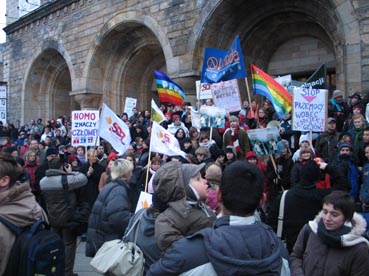
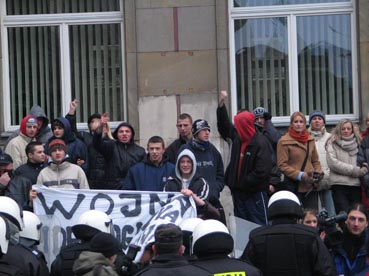
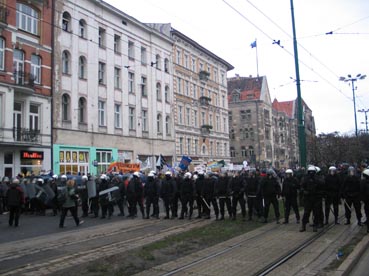
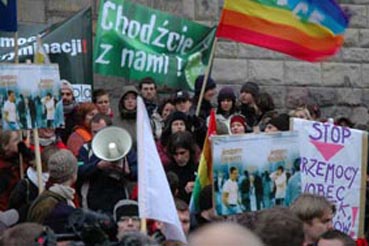
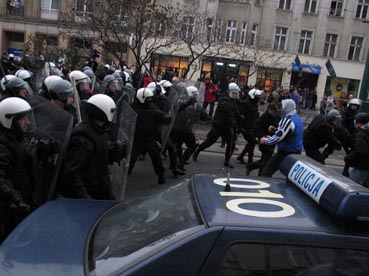

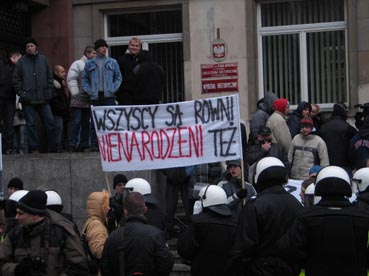
© Women's Association KONSOLA
WOMEN ACTIVISTS DETAINED
19/11/2005- Several dozens of people, participants of Equality March in
Poznan, were detained by the police. Despite the decision of the mayor
of Poznan, who banned the Equality March, several hundred people
gathered at 3 p.m. on Saturday, Nov.19 to demonstrate against
descrimination based on sexual orientation, gender, race, and
disability. The police surrounded the demonstrators with a double
cordon. At 4.15 the police units headed for the demonstrators. The
policemen beastly pulled sitting demonstartors from the group and
dragged them along the sidewalk."Gestapo" - shouted demonstrators.
Several dozens of people-participants of the demonstration- were
detained by the police . Among them are Agata Teutsch and Iza
Kowalczyk- organizors of Tolerance and Equality Days and women
activists.
© NEWW Polska
POLISH OPPOSITION IN THE EUROPEAN PARLIAMENT
22/11/2005- On Wednesday there was a violent dispute between two
socialist Member of the European Parliament Veronique De Keyser
(Belgium) and Ana Gomes (Portugal) and anti choice MEPs over an
exhibition against abortion ‘Life and Children in Europe’. The League
of Polish Families/ Liga Polskich Rodzin (LPR), a nationalist ultra
right wing populist party, organized a photo exhibition in the European
Parliament in Strasbourg. A poster in display compared abortion to the
Holocaust. The two Socialist MEPs urged the organisers to take off the
pictures and after a heated discussion started taking down the photos
themselves. This led to a violent confrontation that ended with the
intervention of the security. Among the controversial images that upset
the socialist parliamentarians there was a picture of a child in a Nazi
extermination camp and another child in a Albanian camp with the
emotional slogan: ‘If a mother can kill her own child, how can one
avoid that men don’t kill each others?’ After the row Mr GIERTYCH, the
vice chair of the LPR organised a press conference calling for freedom
of speech in the parliament and complaining about the censorship of the
photo exhibition by the EP authorities because it caused "controversy".
© NEWW Polska
EQUALITY DAYS ‘DIFFERENT, BUT EQUAL’ (Report)
Between the 17th and the 21st of November the Equality and
Tolerance Days took place in Poznan. They were organised in connection
to the International Tolerance Day (16.11) by the Orgainising Committee
which was made up of the Women’s Association KONSOLA, Lambda
Association Poznan, Zieloni 2004 (Polish Greens 2004), Nowa Lewica (New
Left) The program included lectures, equality workshops, an evening
screening of films in Kisielice, an academic conference and the already
famous Equality March, which however de facto only managed to march
about 100-200
metres.
Written by: Agata Teutsch, Agnieszka Kozłowska, Zofia Stanecka and Izabela Kowalczyk transl.: Milka Stępień
17.11. – The mechanisms of discrimination in the form of a course: “Introduction to Gender Studies.”
About
100 people came to the meeting concerning the mechanisms of
discrimination and exclusion. The lecture hall was filled to the brim.
After showing fragments of a very moving documentary “Niebieskoocy”
(“The Blueeyed”), a heated discussion erupted. There was talk of what
discrimination and exclusion mean in terms of gender, sexual
orientation, age, ethnicity, race, being disabled and others and also
about what examples of discrimination and exclusion we encounter in our
society. The words of Jane Elliott were extremely important for the
course and discussion. Jane Elliott created one of the best
anti-discrimination workshps and her words were: “We learn how to be a
racist, which means we can also learn how not to be one. Rascism is not
genetic. It is only a question of power.” . A lot of people who are
involved in working for the equal treatment of women and men, working
in organisations which deal with issues of human rights, women’s
rights, gay and lesbian rights are convinced that they are free from
prejudice and do not discriminate against others. However, we are never
free from prejudice and stereotypes as we have been brought up in a
culture which is strongly discriminatory (sexism, racism, heterosexism,
ageism, etc.). The most important thing is to be aware of this and to
accept the responsibility of working against discrimination. The
message to be sent accross, in Elliott’s terms, is that those who
remain indifferent to discrimination are also agreeing to such a state
of affairs.
18.11 – Evening screening of films, “Kisielice”
During
the evening screening in Kisielice two documentaries were shown: One
Nation Under God (dir. Francine M. Rzeźnik i Teodoro Maniaci, USA 1993)
and The Amazons 2000 (dir. Florence Fradelizi, France 2000). Many
people attended, the films made a huge impression on the audience and
after the screenings people were fervently discussing their contents.
19, 20.11 – conference: ‘Democracy in Poland and the Problem of the Minorities’
In
the course of the two-day conference, which took place in the Centre of
Culture ‘Zamek’ (Castle), we were attempting to establish what
democracy looks like in contemporary Poland and to what degree the
constitutional rights to individual freedom are being respected: the
right to freedom of belief and religion, the right to be treated
equally by the law and also the freedom to express ones beliefs.
Questions were also raised about how we percieve words and ideals 15
years after liberation from a totalitarian regime; ideals, which we
fought to achieve not so long ago. We also discussed what has been done
with this suddenly gained ‘freedom’ and what conclusions we can extract
from our past. Dr Krzysztof Podemski (UAM – University of Adam
Mickiewicz in Poznan) and Lech Mergler (Zieloni 2004 – Polish Greens
2004) discussed what minorities we have in Poland and how they are
defined. Marta Abramowicz (Campaign Against Homophobia) talked about
the mechanisms which lead to crime in a presentation entitled:
‘Euthanasia for gays, work camps for lesbians and Jews into soap.’ She
described the process of learning to hate and the mechanisms which lead
from prejudice to committing crimes.
During the panel on minorities in culture, Bartosz Żurawiecki discussed
the negative reception by some social groups of Almodovar’s ‘Bad
Education,’ while dr Tomasz Sikora talked about the need for a more
sensitive approach to the problems of minorities in school teaching
programs. We considered also what the approach of politicians was to
the problems of minorities (however only representatives of the “left
side” of the Polish political scene came: Unia Pracy – the Labour
Union: Karolina Kaczmarek, Nowa Lewica – New Left: Maciej Roszak, APP
Racja: Szymon Niemiec and Zieloni 2004 – Polish Greens 2004: Magda
Mosiewicz and Darek Szwed). Next, there took place a discussion panel
concerning the external and internalised discrimination of women and
this topic was discussed by: dr Sławomira Walczewska, Małgorzata
Tarasiewicz, dr Izabela Desperak and Agnieszka Gajewska.
Another discussion panel was concerned with anti-semitism and the
following people took part in it: dr. Aliny Całej from the Jewish
Historical Institute, Jan Beryt from the Martyrology Museum in Żabikow,
Jan Gebert from the Polish Union of Jewish Students and Andrzej Bałys
from Zieloni 2004 (Polish Greens 2004). Some of the topics discussed
were the following: the increase of anti-semitism both on the left and
right side of the political scene in connection to the events of the II
World War, Jedwabne and the conflict in the Middle East.
To end the conference, Izabela Kowalczyk presented a paper about Artur
Żmijewski’s film “The Art. Of Loving,” in which she discussed the
rejection of the Other in our psyche and also she talked about how, in
order to open ourselves up the the Other, we must first learn to love
the Other in ouselves. During the discussion, we talked about the
mechanisms of discrimination and about how closely they are connected
to each other in terms of all minorities. These minorities do not have
their own representation, their own strong voice, are weaker and are
more prone to have their rights violated. We noted that it is very
necessary that different minority groups cooperate with each
other.During the second day of the conference, professor Roman Kubicki
of the University of Adam Mickiewicz presented some philosophical
thoughts about why we need minorities and what the genesis of
establishing gender roles is in the evolutionary process on the basis
of ‘The World of God” according to St. Augustine. Marzena Lizurej
explained the assumptions of Queer theory, while dr Maria Solarska from
UAM discussed the processes of constructing minorities, stigmatisation
and acquiring “difference”. Activists of the Lambda Association in
Warsaw –Michał Pawlęga, Yga Kostrzewa, Adrian Szatkowski and Agata
Anacik discussed the difficult creation in Poland of legal regulations
concerning the estalishment of legal homosexual relationships and the
activities of the European Union in terms of acting against
discrimination. The last topic which was discussed during the
conference was Antoni Adamowicz’s campaign entitled “T-shirt for
freedom.” The author presented the course of the campaign, its
assumptions and the ideals behind it and invited the participants of
the conference to purchase the t-shirts, which were being shown at an
exhibition in the Centre of Culture “Zamek” throughout the two days of
the conference.
Equality March
The
academic conference was an attempt at a theoretical approach to the
problem of minorities and their rights in Poland. In practical terms,
these issues became apparent half an hour after the conference ended,
when eggs, stones and insults were thrown in the direction of the
participants of a peaceful march (meant to be a show of solidarity with
people discriminated against for various reasons). The march moved out
from under the centre of Culture “Zamek” at 3 p.m. and about 500 people
participated in it. The main slogans were: “Different, but Equal,”
“Everyone Belongs to a Minority,” “Enough Discrimination!.” After
moving foward about 100-200 metres the March was stopped by a group of
aggressive pseudo-footballfans, while the police asked us to dissolve
the demonstration. We agreed to return to our starting point and also
to change the demonstration into a picket. We had to face the reality
that today in Poland ignorance, bllindness and hate are more powerful
than knowledge, learning and culture.
21. 11 – Difference Workshops
To
end the Equality and Tolerance Days, a 6-hour long workshop on
difference took place in the Centre of Culture ‘Zamek.’ 20 women and 2
men participated in the workshop (we are mentioning this as it is
meaningful, especially since the workshops did not only discuss the
subject of gender discrimination) Participants took part in exercises
and discussions pertaining to their identity, the perception of others,
human differentiation, stereotypes and discrimination. At the end, we
all discussed what each of us can do to fight against discrimination,
we exchanged ideas and specific plans of action were created. Preparing
and leading: Monika Serkowska, Agata Teutsch.
© Women's Association KONSOLA
NEW GAY PRIDE BATTLE ERUPTS IN POLAND
15/11/2005- Authorities in the city of Poznan have banned a gay pride
parade that had been scheduled for Saturday. The move comes as members
of Poland's LGBT community come under increasing discrimination.
Poznan's city administrator said that the parade would “be a serious
danger to social order and property.” He said that the Gay and Lesbian
Equality Parade could only be held in a remote area of the city, marked
by warehouses. The offer was rejected. Organizers of the parade said
that the city administration had bowed to pressure from the ruling Law
and Justice Party and from the League of Polish Families and Poznan's
Roman Catholic Archbishop. Last year's parade was disrupted by
skinheads and members of the All-Polish Youth, an extreme right
organization connected to the League of Polish Families. In June,
Warsaw mayor Lech Kaczynski refused to grant permission for a gay pride
parade in the capital. Nevertheless, more than 2,500 people ignored the
order and marched anyway. Opponents threw eggs and stones at the
marchers, and police detained 29 people. Last month Kaczynski was
elected Poland's President. In September his ultra conservative Law and
Justice Party, controlled by his twin brother, won control of
Parliament. The election was marked by frequent homophobic attacks,
prompting the European Union to issue a stern warning to the government
not to try to limit the rights of gays and lesbians. The European
Commission said that if the government continues to oppose gay rights
Poland risks losing its voting rights in the EU. The commission in a
strongly worded letter reminded Kaczynski that all member states must
abide by European Union regulations which protect minorities. If,
Poland refuses, the letter said, the EU would invoke the Treaty of Nice
which deprives member states of their voting rights for refusal to
comply with the Union's constitution.
© 365Gay.com
EQUALITY MARCH BANNED IN POZNAN (Poland, open letter)
Statement of The Committee of Days of Equality and
Tolerance in Poznan in reference to the decision of President of Poznan
to stop the Equality March.
15/11/2005- To
celebrate International Day of Tolerance (16th November), as last year,
Days of Equality and Tolerance will take place in Poznan (16-20
November 2005). Days of Equality and Tolerance are a initiative of
several people who formed The Committee. The idea of Days of Equality
and Tolerance is to create a space for discussion on tolerance,
solidarity, and ani-discrimination. The Days consist of movies
projection and discussions, conference, workshop, beneficial party and
Equality March. Unfortunately today we were informed that the President
of Poznan decided that the March can not take place.
The
representative of the Committee delivered the appropriate information
about our plans to organize the March to the City Council on 21th
October 2005. Then the rumors against our initiative started.
Politicians, representatives of the Catholic Church and others started
to protest against the March as they called it "Gay Pride". They
arguments were that homosexuality is immoral and should not be
demonstrated in the street. Others said they do not want the fights as
it happened last year. Our arguments that we do not organize "Gay
pride", but the Equality March, that homosexuality is not forbidden by
law, that we have rights to demonstrate and that it was not us, who
caused the fights last year but our opponents, were not heard.
On
18th November our representatives were called for a meeting to the City
Council were they were pushed to change the planned rout of the March
and they say that it is possible. On 21th November our representatives
met the Poznan Police officers (the meeting was set for our request)
where the safety of the March was discussed. At first officers tried to
convince us to give up the whole idea of the March, when we did not
agree they tried to convince us to change March into stationary
demonstration, when we did not agree to that also they tried to
convince us to shorten the route and we actually agreed. At the end of
the meeting officer assured us that they accept the agreement and that
the Police will protect us the best they can.
On 22th November
the media brought the news that President of Poznan decided that the
March can not take place as it puts public safety and property into
danger. The President also mentioned that The Committee did not agree
to the changes in the March route. It is not true, as mentioned above
on the meeting on 18th November at the City Council our representatives
said that it is possible.
In our opinion the President took
his decision under the pressure of politicians from right wing parties
like Law and Justice and Polish
Families League, organizations
like All-Polish Youth and The Catholic Church whose ideas and opinions
are completely against tolerance and equality. We consider this
decision as illegal according to the constitutional law of free
demonstration.
We are going to appeal against this decision as we consider it as a danger to the Human Rights in Poland.
The Committee of 'Days of Equality and Tolerance in Poznan'
Campaign against Homophobia Appeal on the International Day of Tolerance (open letter)
Warsaw, November 16, 2005
Speaking for all members of the Campaign Against Homophobia,
we wish to protest against the decision of Ryszard Grobelny, the mayor
of the city of Poznan, who issued a ban of the peaceful March of
Equality. The right to gather is a fundamental right of every citizen.
The Polish Constitution leaves no doubt about this.
Its Article 32 reads: "All
are equal before the law. All have the right to equal treatment by
public authorities. Nobody can be discriminated against in the
political, social, or economic life for any reason."
Unfortunately,
the Mayor of Poznan followed in the footsteps of the current Mayor of
Warsaw, who banned demonstrations staged by gays and lesbians. The
Warsaw Mayor, who is Poland's future President, a defender of the
Constitution, said he would never agree to a march of gays and lesbians
even before the organizers of the Warsaw's Equality Parade began the
process of registering the demonstration.
In Poznan, a year
ago already politicians of the Law and Justice (PiS) party objected to
the March of Equality. The chairperson of the City Council of Poznan,
PiS councilor Przemyslaw Alexandrowicz, said at that time: "I don't
want Poznan to see manifestations of different sexual orientations,
that is homosexuality, pedophilia, necrophilia, or zoophilia." A
prosecutorial procedure against those remarks is still pending. In the
spring of 2005, another PiS politician Kazimierz Michal Ujazdowski, who
now is the Minister of Culture, said during an election meeting in
Torun: "Let's not mistake the brutal propaganda of homosexual attitudes
for calls for tolerance. For them, our rule will indeed mean a dark
night." Today, PiS, with the support of the far-right League of Polish
Families (LPR) and the ultra-catholic media of Father Tadeusz Rydzyk,
have their president, prime minister, and the speaker of the lower
house of Parliament. Is there any place in their Fourth Republic for
people who think differently than the ruling party?
Yesterday,
on the day when the Mayor of Poznan was banning a peaceful
demonstration, a very important anniversary for Polish gays and
lesbians has passed. Exactly 20 years ago, on November 15, 1985, on the
orders of General Czeslaw Kiszczak, the communist Minister of Internal
Affair, the communist police began the Hyacinth action. For two years,
the militsiya registered thousands of homosexuals. That action was
designed to infiltrate and destroy the gay and lesbian movement,
emerging at that time, and intimidating potential supporters of that
movement. Until this day, the National Remembrance Institute holds
11,000 files on Polish homosexuals in its archives.
On this
special day, the International Day of Tolerance created by the General
Assembly of the United Nations on December 12, 1996, we appeal to the
Mayor of Poznan and the politicians of the ruling Law and Justice party
to observe the rules of democracy, to offer equal treatment for all
citizens of Poland regardless of their sexual orientation or their
beliefs. The freedom of expression and gathering is a fundamental human
right.
The Board of the Campaign against Homophobia
© STOP DISCRIMINATION
| |
|
THE PRESIDENT IS GETTING WORRIED BY THE ANTI-SEMITISM CASES(Ukraine)
6/12/2005- The President Viktor Yushchenko expressed his anxiety with
the cases of anti-semitism in Ukraine and called upon the public,
cultural, journalist circles and creative intelligentsia for their
solidarity in condemnation of any manifestations of anti-semitism and
xenophobia, and stated that the state will stay on the very tough
positions in this matter. URA-Inform was informed of that by the
President’s press service. In particular, the President condemned the
policy of the Kiev-based Inter-regional Personnel Management Academy
(MAUP) as the institution that systematically allows itself
publications that can be valued as the ones of the anti-semitic
contents. Yushchenko stressed that some time ago protesting against
MAUP’s inhuman policy he left the supervisory board of their
publication, Personnel. The President called upon the MAUP management
urging them to respect the rights of citizens of all nationalities and
faiths and to stop fomentation of inter-ethic discord. The President of
Ukraine stressed that the authority’s obligation is to defend the
rights of citizens of any nationality and faith. Therefore, the
Ukrainian authority, according to his words, will further be consistent
in its position of struggle towards any manifestations of
discrimination of people on ethnic, racial or religious grounds. “A
European country should not have any ethnic problems,” noted the
President. To remind you, Ukraine aspires to join EU as soon as
possible. According to Yushchenko, the process of European integration
started 7 months ago looks today “as clear as never before”. “There is
the clear Ukraine-EU action plan aimed for three years. On its basis
the “road map” is outlined that schedules the nearest 15 months of
co-operation between Ukraine and the EU. First of all, this “road map”
includes granting the Market Economy Status for Ukraine and joining
WTO,” Yushchenko previously noted.
© URA
COUNCIL OFFERS DELAY FOR DETENTION CENTRE (Netherlands)
5/12/2005- Haarlemmermeer Municipality is willing to give the Ministry
for Justice a month to move all detainees out of the cell complex at
Schiphol. This was the local authority's opening offer as it entered
negotiations with the ministry in Haarlem on Monday morning. "This
month is one of the possibilities that we can offer the ministry," a
spokesperson for the council said. "The time limit cannot be extended
after that". The council is insisting that extra personnel are assigned
to the complex until it shuts down to guarantee safety. Last week, the
council, which has responsibility for the Schiphol area, demanded that
the cell complex close by Wednesday this week at the latest. Eleven
illegal immigrants awaiting deportation died in a fire at the cell
complex in late October. Justice Minister Piet Hein Donner wanted to
keep the undamaged wings of the centre in operation, but Fire
Department inspectors reported that the complex still did not meet the
required safety standards. Harry Borghouts, the Queen's Commissioner
for Noord Holland Province, is mediating between the council and the
ministry. The executive council of Haarlemmermeer Municipality on
Thursday demanded the closure of the detention centre at Schiphol
within 36 hours. Mayor Fons Hertog wanted to give the national
government the opportunity to improve the complex first. But the
executive council - consisting of the Hertog and the aldermen - sent a
letter to the councillors on Thursday to say the complex must close
within 36 hours. This followed discussions with Justice Minister Piet
Hein Donner. The executive council said Donner had failed to convince
it that the ministry would implement the necessary safety improvements
in a timely fashion. Previous agreements on safety measures were only
implemented by the ministry after repeated inspections and the threat
of financial penalties. "This has damaged our confidence in the manner
in which the ministry deals with safety at the cell complex," the
letter said. Donner insisted that the detention centre meets safety
standards and should remain open at least until the finding of the
investigation into the fire are published. The executive council said
it is not prepared to change the temporary licence for the centre into
a permanent one. The licence runs until April. Haarlemmermeer is
prepared, however, to discuss moving the centre to another location in
the area.
© Expatica News
RACISTS’ TARGETS FIGHTING BACK(Italy)
The unprecedented attempt by a black player to stop a match after
being abused by visiting fans in Italy highlights the rising tide of
racism in football
4/12/2005- Football matches in Italy this weekend are starting five
minutes late. Leaving aside the observation that in a country which
sometimes struggles to begin its season within a fortnight of the
scheduled start, the gesture may pass unnoticed, the hope is that a
portion of those attending games will use the time to reflect on why a
professional in Italy’s top division decided to break one of the
sport’s more widespread omertas last weekend, to make a spectacle out
of racist abuse. His name is Marc Zoro, he comes from Ivory Coast and
lives in Sicily. He earns a living there with Messina as a full-back,
tough and popular with supporters. Seven days ago Messina were visited
in their neat stadium by one of the country’s giants, Internazionale.
After 67 minutes Zoro went to retrieve the ball from in front of the
away section. The monkey noises some of them had directed at him
throughout the match became louder, so he picked up the ball and
marched towards the players’ entrance with the idea of asking the
fourth official to halt the match. He was visibly emotional, and it
required some persuasion from two of Inter’s players to make him change
his mind. The game continued. By the next day Zoro regretted some
aspects of his action. “If I could go back, I would do and say
everything differently, but I’d like to be sure that one day racism
will be beaten. With these chants you feel horrible, like your humanity
has been offended.” It was a courageous thing to say.
Professional athletes are trained to imagine they can close off the
peripheral sounds of their work, to believe their concentration can be
impermeable, or at least to give that impression to their peers, to
their managers, to their opponents, to the fans. The experience was not
new to Zoro, but he had reached breaking point: “I couldn’t accept
people coming to my home stadium to abuse me.”
The
groups that monitor racism in football suggest that it is on the rise
across Europe. Certainly it gets more noticed. Television shows more
matches from different places, and although the medium has a tendency
to under-represent the individual sounds audible from the grandstand
and the pitch, its pictures talk. What Zoro did has been seen
worldwide. So has what Samuel Eto’o, the Barcelona forward, had done
the previous weekend. Eto’o, who is from Cameroon, had been subjected
to sporadic monkey chants from around Real Madrid’s stadium, where they
often turn the south end into an ape-house, during the most widely
broadcast club match of the year. Eto’o scored a goal and, celebrating
it, assumed an iconic posture, his right arm raised, hand clenched into
a fist, his left hand in a fist at the small of his back, like the
American sprinters Tommie Smith and John Carlos on the medal podium
after the men’s 200m at the 1968 Olympic Games. Eto’o has made a
spectacle out of racism before. In a match at Real Zaragoza he
celebrated a goal by jumping up and down, curling his arms under his
armpits and making an “Uuh, Uuh, Uuh” noise, like a cartoon monkey. He
would appreciate a little more solidarity. A few Sundays ago, after an
evening of sustained abuse at the Madrid club Getafe, he overheard an
opposition player telling reporters he hadn’t thought the chants too
bad. “Thanks, brother,” said Eto’o.
There is an argument that
to make a spectacle of racism is an unproductive way of combating the
problem, that ignoring the offenders is more likely to convince abusers
of their impotence. It is followed, with tiresome frequency in southern
Europe, by the argument that to call a black footballer a monkey is no
different from asking a portly one who’s eaten all the pies. The
Manchester City player Kiki Musampa has an answer. When he played in
Spain, he broke the omerta that says you don’t report what opponents
say on the pitch. He named a player who abused him on the basis of his
colour. Musampa admits he’s capable of calling people names when he’s
angry, but racist abuse disarms. “What can you say back to a white
person?” he asks. “‘Whitey’?”
© The Times Online
WALK TO FIGHT RACISM AND DISCRIMINATION(Malta)
4/12/2005- A clear message needs to be broadcast – that discrimination and racism will no longer be tolerated. Integra Foundation
announced yesterday at a press conference that it is organising a walk
called “Together against Hatred and Discrimination” next week. It will
be held in Valletta on Monday 12 December and will start from near the
statue of Christ the King at 7pm. The objective of the walk is to bring
together all marginalised sectors of society including refugees and
asylum seekers, gays, people with a disability, the elderly and people
suffering from mental illness. Representatives from the three political
parties, several NGOs and local personalities were also present at the
press conference. All individuals and organisations are invited to
participate in order to deliver the message that hatred and
discrimination, and the organisations expressing these sentiments, will
not be tolerated. Shaun Grech, co-founder of Integra Foundation, said
that after the walk, Integra Foundation will start lobbying to
introduce provisions in Maltese legislation against hate crime and hate
speech. A set of proposals related to these will be forwarded to
Members of Parliament for any form of hate-related speech or crime to
be punishable by law. All forms of hate speech in public should be
monitored especially if it incites prejudice against any individual or
group. Unfortunately, hate speech is widely disseminated through
various sources of information, Mr Grech said. “Hate speech is
extensively propagated through the print media, television and public
addresses. The Internet is also used extensively and no one is trying
to stop it.” Racism and xenophobia rear their ugly heads because there
is lack of knowledge, he explained.
The aim of the walk is to
emphasise that differences should not separate but bring people
together, said Mario Gerada from Integra Foundation. “However, this
often has the opposite effect. People are afraid of diversity when
there is nothing to be afraid of,” Mr Gerada said. A possible way of
fighting discrimination is changing the education system in Malta which
still encourages certain prejudice, according to TV presenter Peppi
Azzopardi. He mentioned last week’s programme on Xarabank, which was
not broadcast in the afternoon because it discussed gay couples. “This
is not reality,” he said. “ We are not showing children that there are
other types of families apart from the traditional one.” Labour MP
Marie Louise Coleiro agreed, adding that training should be offered to
student teachers at university not to label people. Education needs to
start in the home, said Nationalist MP Clyde Puli. More coordination is
needed between all the different sectors so the final result will be a
more knowledgeable and less prejudiced society. However, sometimes
education at home is not enough said Maria Pisani, coordinator of
Integra Foundation. “While children are taught to be open-minded about
diversity, these beliefs are challenged when they mix with other
children – at school for example.” If stereotypes and stigmas are not
eradicated through education, the school syllabus or through ignorance,
the affected people are marginalised and isolated from society. No
effort is being made to teach children that there are different ways of
life to their own.
Another popular TV presenter, Alfred Zammit
spoke out against the growing hatred against irregular immigrants and
asylum seekers. “Instead of tackling the issue and problem of
immigration in Malta, many people are attacking the immigrants using
hate speech,” he said. Mr Azzopardi pointed out that in this year’s
edition of Istrina, a small percentage of the collected funds will be
donated to help the refugees in Malta. “I know this decision probably
means that less funds will be collected, but I still think the right
decision was taken by the committee.” Fear must not be used as a tool
to use people for their own ends said Ralph Cassar from the Green Party
(Alternattiva Demokratika).
© Malta Independent
FAILED JOB APPLICANTS WIN RACISM APPEAL VICTORY(uk)
6/12/2005- Two Glasgow council managers who won race discrimination
claims when they were turned down for promotion have had tribunal
rulings confirmed by the Court of Session. The Employment Appeal
Tribunal had found in favour of Glasgow council on appeal, but now the
inner house of the Court of Session has quashed that ruling and
confirmed the decisions of the original Glasgow tribunals, that Kuldip
Dhesi, 44, and Clarence Bvunzai, 56, were discriminated against on the
grounds of race. Glasgow-born Mr Dhesi, who is of Indian origin,
accused the council of racism and victimisation after he failed to get
a key post with the asylum seeker's project in the city, claiming he
was better qualified and the most experienced. The Glasgow tribunal
found he was treated unfairly and the council fell seriously below the
standard to be expected of it. In another ruling, Lord Hamilton ruled
that the Employment Appeal Tribunal had erred in law in interfering
with the original tribunal's decision and found Clarence Bvunzai's
non-selection for a job was influenced by racial factors. Zimbabwe-born
Mr Bvunzai had accused his employers of discrimination after he failed
to get a job as unit manager at a residential care home for the
elderly. Last night equality campaigners demanded that the city review
its employment procedures. Ali Jarvis, interim director of the
Commission for Racial Equality Scotland, said: "The court's findings
should be a wake-up call to every public authority in Scotland. "In not
one but two cases, Glasgow city council, which covers the most
ethnically diverse region of Scotland, has been found to have
discriminated against potential employees on the grounds of race." He
said the council should undertake a full review of its employment
procedures "to reassure people that, regardless of their ethnicity,
they will get fair treatment".
© The Scotsman
IDENTITY: YOUNG MUSLIMS SPEAK (uk)
6/12/2005- Who
speaks for young British Muslims? This is the question the BBC News
website put to eight young Muslims living in cities and towns across
the UK. We asked whether they felt they were being accurately
represented by Muslim organisations, what they felt about media
coverage of their religion and how it feels to live as a young Muslim
in the UK today.
Amran Majid, Birmingham, IT manager, 28
I
don't feel that any of the organisations I know represent me, for
several reasons. Firstly, they are all low key, they do not say "we're
making a stand". It's also difficult to see how something like the
Muslim Council of Britain represents me. The spokespeople are older and
not in touch with the issues we face. They project an older generation
which, at the time, was new to the UK. We have a different view. My
parents are Pakistani but I was born and brought up here. I was brought
up on Spiderman and the Teenage Mutant Hero Turtles. I have a different
education and different interests to my parents. They represent an old
way of life. In a way it is our fault, we should stand up more. The
people I see in the media who supposedly represent us younger people
are not particularly eloquent or do not come from a professional
background. This suggests we are all ill-educated or extremist. But it
is the way the media grabs people's attention. It would be nice to see
more informative programming on what Muslims do and how they live their
lives. When was the last time Muslims were shown in a positive light on
the BBC or another channel? There is also, I think, a general
defensiveness from Muslims who feel anything they say will be taken out
of context. They are scared of holding an opinion. We need to take
ownership of issues and deal with this problem. We need to see more
positive things about ourselves. Young Muslims feel disenfranchised,
but as more and more get a better education they can integrate and be
valued.
Nejim Gakenyi, Leeds, IT consultant, 23
After
the terror attacks in London there was a knee jerk reaction. There was
this emphasis on Muslim community leaders to expose extremism within
communities. But you cannot paint every Muslim with the same brush. I
have friends of all ethnic backgrounds. I think the big problem is
affiliation in people's minds. If they think of someone Muslim, they
assume someone is Pakistani or Bangladeshi or whatever. But, of course,
the people of Pakistan are of a very different origin to people from
Bosnia, where my family are from. I think education would help - people
should be able to learn about other religions from various sources. But
what certain extreme minorities do should not be put down to Islam or
Islamic beliefs. I'm a young Muslim and I have strong opinions. But
no-one represents me and no-one has ever spoken to me. I disagree with
US foreign policy and UK policy. I'm against the Iraq war and I feel
for the Palestinians - but that does not make me an extremist. My own
family were persecuted, driven out from their homes and taken to
concentration camps just for having a Muslim name. But I could not put
my religion before my nationality, because my faith has nothing to do
with my nationality. The two cannot be compared and there should not be
a relationship between the two. Now, the government and the media are
fuelling problems by using phrases such as "Islamophobia" or
"extremists" without any context. By talking to specific community
leaders, just because they lived near where the bombers came from, they
presume that everyone who lives there is of the same background. It
puts the blame on everyone who lives there. But if the families did not
know, how can the community know?
Sima Ajam, London, Solicitor, 25
The
majority of Muslim people in the UK are immigrants from Asia, from
countries such as Pakistan and India. They have a different way of life
to someone like myself, who is of Syrian, Armenian and Turkish descent.
Cultural traditions infiltrate into religion. It is a different way of
life to those with a Middle Eastern background. I feel that some of the
people who speak under the banner of Islam do not represent me. We may
follow the same religion, but sometimes cultural issues overtake this.
Sometimes, I do feel there is prejudice between Muslim people, that if
you do not practice certain elements, they look down on you. My parents
are from Syria and are liberal about many issues. But when I was at
school, some of the Pakistani children in my class would be confused
and ask "why aren't you covered up? Why aren't you wearing a skirt?"
But then, when I am in Syria, people assume I am Christian because I
look Westernised. It is not really a problem, but they have stereotyped
me. We complain about being stereotyped by whites but we stereotype
each other, too. When the media make programmes about Muslims, they
invariably go to socially deprived areas. A new generation came here in
the mid-1980s and early 1990s to seek education and go into respected
professions. However, we are portrayed solely as unemployed, working
class poor. People need to see that a new generation of teachers,
doctors and lawyers is contributing to British society. Education is
the most important thing. Our community leaders need to be more
encouraging to Muslim youth. At the moment they just make them
hard-hearted, when the imams should teach them to know about the
importance of achieving.
Shahed Alam, Oldham, Trainee auditor/volunteer worker, 26
In
a nutshell, the media do not represent us. The problem is that we have
a minor section of young Muslims with extreme views, of whom some are
taking drastic action. People talk of improving integration - but the
July bombers were British with good jobs. So, how do we make sure these
people do not get captured by extremists? The first thing would be to
treat everyone as individuals. We cannot blame all Muslims in this
country for what a minority think. Also, every time a bombing occurs,
the media ask us about what happened. It does not matter how hard we
work, we are always branded as different. As a Muslim - of Bangladeshi
descent - I always feel a sense of belonging to the Muslim brotherhood.
So, when injustice is done - for example the riots in France - you feel
it.
But at the same time, when David Beckham broke his foot before
the World Cup, I worried as much as any other British person did. All
these loyalties - religious and cultural - run parallel and I think
that is good. Two years ago, I would have said I felt no affiliation
with Muslim groups, but this has improved. Many young Muslim
organisations are now affiliating themselves with the Muslim Council of
Britain to present their viewpoints. But there is still a long way to
go. Young Muslim people need to be seen on the frontline of British
politics. Society needs to help but the younger generation need to take
the initiative, too. We have to wake up and make our voices
heard.
Saima Hanif, London, Barrister, 25
I
think we do have a voice, after all many of us are young professionals
and are articulate. However, there are too many individuals doing their
own thing. We have no central organisation to represent the views I was
taught, as a more liberal and progressive Muslim. We need a third voice
who can say: "We're in the 21st Century - this is what it means to be a
Muslim today." But this progressive body of thought is not represented
in mainstream media. Whenever the media wants a Muslim representative
they talk to an elderly cleric in Birmingham. What mandate does he have
to speak for us? There are several complicated reasons for why this
representation has not happened. Some are historical reasons. In Bolton
- where I am from originally - we have a large Pakistani Muslim
community. They came from rural backgrounds and they came here to work
in the textile industries. They were not educated, they came over to
work. Then all the factories closed down, socio-economic problems
developed and they became frustrated. Now there is a group of people
who cannot articulate what they want to say and the situation makes it
worse. But it is a two way street. We have to ask why we are not
represented in the mainstream press and how we address this ourselves,
on a grass roots level. We tend to get overly simplified views, when
Islam is much more sophisticated than people think. It frustrates me
people think all Muslim woman have to wear the hijab - if I do not it
does not mean I'm not a Muslim. We also have to show that there is
nothing inconsistent between being Muslim and British. The two work
together. This "clash of values" idea is nonsense.
Shahban Aziz, Manchester, University student, 19
I
think as Muslims we have been a very united community. The media makes
out we are having problems with fanaticism but I think we have just
been misrepresented. The main community leaders are moderate and blend
in. But all we hear about are the radical clerics. We have one of the
largest mosques in the UK here in Manchester and our cleric is very
learned. He says Muslims should have an education. Yet you never see
the media listening to him. At university, I have met people from all
over the world. It is much better than having a single-minded view. If
you are not educated, you probably do not realise that everyone's views
are different. You have to take on board that most people are not out
to get you. I think the media has actually worsened issues by taking
things out of context. As a result, people I know have had comments. I
know of a Muslim girl who wears a headscarf here who got called a
terrorist. It creates bad feeling, a sense of persecution, that people
are out to get you. I was born in Britain and I will always feel
British, but I feel my Pakistani origins and traditions. If asked
whether I consider myself Muslim, well, I am Muslim. But my generation
were born here - we all support the England football team and all the
young lads here cheer for David Beckham. Recently, in politics, we are
getting more Muslim MPs and we are beginning to realise we can have a
real say. It will help put Muslims in a better light and stop us being
pushed to the edges.
Arfan, Bradford, Analyst, 23
I
come from a multicultural society but the 9/11 attacks damaged us
severely. I feel discrimination. You know what other people think of
you. It's like bullying, all these negative attitudes we get. I am not
extreme - I am educated and have done a degree. But since 9/11 I have
begun to realise who I really am. If I see myself as British I would
not see myself as discriminated against. But once I see myself as
Muslim, I can see the pain. People used to respect us here in Bradford.
Now, they think, "he goes to a mosque, I don't trust him." I understand
those who take it to the extreme. If you came to a typical street in
Bradford, you would be amazed at the hatred many people feel now. Maybe
there is a war against Muslims here, with the incidents and arrests
going on nowadays. There is a way out, and that is when Muslims leave
this country and take their money with them so the economy goes down.
That is when the government will wake up and realise: "We pushed them
out." We helped make this country - we came over as labour and we
worked hard. I'm from Bradford, I remember the riots, when the [far
right group] National Front came we stood up for ourselves. People came
from the outside to cause trouble in Asian areas - but the media never
reported that. When I went to university I woke up. People had an
attitude about us. They thought we were gangsters. I had a lot of white
friends, but after the riots most of them did not want to know. They
felt all Asians caused trouble.
Mediehah Bashir, Glasgow, University student, 20
We
have to integrate, to get more involved in events and politics. Young
Muslims need to involve themselves more to get their message across. I
think it is definitely possible to be both British and Muslim. If you
are living in a country, you have to comply with its laws to integrate
and be beneficial to society. You cannot alienate yourself. Ultimately,
the underlying values of both concepts are very similar. Being British
and Muslim does not mean two opposing things. Personally, I try to
dispel the negative images many Muslims have, especially as women.
Often people think we are subjugated or patronised. They think we are
dictated to by male members of the community or made to wear the veil.
But we wear it out of choice. It is just ignorance. I am also a member
of the Glasgow University Muslim Students Association. It is a main
port of call for other Muslim students, helping them to know where
local mosques are, where prayer rooms are on campus and where to meet
other Muslims. Many first year students and internationals feel out of
place. By helping them through fundraising and raising issues relevant
to us we can make a difference for us and the entire community. I think
the media creates negativity because of ignorance. Education is needed
on both sides. The situation is fairly positive in Glasgow. I grew up
here and people are perhaps more understanding than in London,
especially after the bombings. I have not experienced a change in
atmosphere, other than the occasional feeling that I'm being treated
differently. I think many Muslims are beginning to work with the media,
involving themselves more in the community and helping to improve the
image of Muslims. Hopefully, in 20 years time, we will be in a better
position, with more of us willing to get involved. That way we can make
a positive change.
A special week of features about Islam in Britain and Europe on the BBC website
© BBC News
'GAY WEDDINGS' BECOME LAW IN UK
Hundreds of gay couples are preparing to form civil partnerships in
the coming weeks as the law changes after decades of campaigning.
5/12/2005- At least 1,200 ceremonies are confirmed as being scheduled
already, according to figures from councils compiled by the BBC News
website. Registrars are preparing for the first ceremonies, with
couples permitted to register from Monday morning. Campaigners says the
law ends inequalities for same-sex couples. The first ceremonies under
the Civil Partnerships Act can take place in Northern Ireland on 19
December, followed by Scotland the next day and England and Wales on 21
December. Under the law, couples who want to form a partnership must
register their intentions with local councils. Unlike marriages, the
signing of the legal partnership papers does not need to happen in
public.
Bookings coming in
Hundreds
of couples are expected to go ahead quickly, with Brighton conducting
198 ceremonies before the end of the year. Overall, the city has taken
510 bookings for the coming months, thought to be the highest in the
country. Other cities which have seen strong interest include London,
Manchester, Birmingham, Newcastle and Edinburgh. Meg Munn, minister for
equality, said the government expected 4,500 couples to get "partnered"
in the first year. "This is an important piece of legislation that
gives legal recognition to relationships which until now were invisible
in the eyes of the law," Ms Munn told the BBC News website. "It accords
people in same-sex relationships the same sort of rights and
responsibilities that are available to married couples. "We know there
are people who have been together maybe 40 years and have been waiting
for the chance to do this kind of thing, because of the important
differences it makes to their lives. "They have the same concerns as
married couples - tenancy, ownership, pensions and inheritance."
Alan Wardle, of gay campaign group Stonewall, said the importance of
the change should not be underestimated. "Our view is that civil
partnerships are transformative for the lives of individual couples and
their rights, but also for society more generally. "Society now legally
recognises gay relationships for the first time. "It's a big day but 21
December, when the first partnerships take place, will be even bigger
because that will see gay and lesbian people removing discrimination."
But a spokesman for the one of the UK's major Christian groups told the
BBC they believed same-sex couples should not get the same rights as
married couples. "If you transport something unique, like marriage,
into a different context, there's always a cost. And the cost here is
in terms of reduction of marriage and the undermining of it," Don
Horrocks of the Evangelical Alliance said.
Reticent councils
Retailers
are already beginning to cash in on the new partnerships. A range of
"Mr and Mr" and "Mrs and Mrs" cards will hit Asda supermarkets this
week. And sets of "Darling, Dearest, Queerest" embroidered towel and
soaps went on sale at Superdrug stores on Friday. Meanwhile, three
short advertisements were published in the Births, Marriages and Deaths
columns under the heading Civil partnerships in Monday's Times
newspaper. The heading is a new addition to the paper, which has
carried family announcements for nearly 221 years. Campaigners have
focused on councils which have been equivocal about the new law.
Bromley in south-east London had initially planned not to offer public
ceremonies. Lisburn in Northern Ireland also overturned a proposed ban.
Ms Munn said any councils dragging their feet needed to comply with the
both the spirit and letter of the law. "The legislation requires that
every authority must offer a civil partnership. The basic level of that
is a simple signing of a register - some couples may just want that
alone. "But if any councils are saying they won't allow [public]
ceremonies, for couples who want that kind of celebration, then it's
time they came into the 21st century."
Provisional bookings
Brighton and Hove: 510
Westminster: 140
Manchester: 88
Newcastle: 80
Birmingham: 70
Leeds: 60
Edinburgh: 76
Sheffield: 58
Nottingham: 50
Glasgow: 30
Cardiff: 24
Belfast: 20
Liverpool 20
Londonderry: 6
Aberdeen: 5
Source: Councils; not all ceremonies booked for December
© BBC News
BISHOP ATTACKS 'INHUMAN' ASYLUM RULES(uk)
4/12/2005- The Archbishop of York yesterday condemned government
policies that leave asylum-seekers homeless and with no financial
support as "inhuman". Dr John Sentamu, Britain's first black
archbishop, who was enthroned last week, led a number of UK religious
leaders in calling for the Government to change policies that they said
"victimise" asylum-seekers. The archbishop and 44 bishops and church
leaders claimed that the threat of destitution was being used as a way
of pressurising refused asylum-seekers to leave the country.
Asylum-seekers are not allowed to work for the first 12 months of their
application and those refused asylum are not entitled to benefits.
Their letter said many asylum-seekers were refused the right to stay in
the UK and had no way of returning home. Others, they say, are
"unfairly denied" asylum. The letter also spoke of our "international,
moral and legal responsibilities to welcome those fleeing adversity
from other parts of the world and provide social security". "All those
within our borders, including people seeking asylum, whatever their
status, should have the opportunity to help themselves and society
through paid employment. Where this is not possible, people seeking
asylum, whatever their status, should be given the necessary rights to
'food, clothing, housing and medical care and necessary social
services' (UN Declaration of Human Rights)," the church leaders wrote.
A Home Office spokesman insisted that there was support available for
failed asylum-seekers who had been left destitute.
© Independent Digital
'RACISM? IT'S ENDEMIC HERE'(uk, comment)
On the streets of Huyton, scene of Anthony Walker's shocking
murder, Mark Townsend discovers a lingering subculture of venom and
violence
4/12/2005- They may never view it as justice. Hours earlier, news had
filtered onto the uncompromising streets of Huyton that two of their
own had been jailed for life. As the first flecks of rain fell upon
east Liverpool's sprawling estates, a young white man spat his fury at
the prison sentences handed to those who had murdered Anthony Walker
with an ice-axe. 'It's a bit fucking heavy,' he scowled, his features
hidden beneath a tracksuit hood. 'People have murdered and got away
with a couple of years.' He glanced up St Johns Road to the bus shelter
where Anthony was called a 'nigger' by 17-year-old Michael Barton on
the night of 29 July. The abuse would precipitate one of the most
high-profile race murders in Britain, one that would open old wounds in
a city with a tangled multicultural history. As with most hate-crime, a
complex meld of causes and entrenched bigotry had been grotesquely
articulated in a single, horrific moment. And such factors do not
disappear overnight. Although Barton and Paul Taylor may be gone from
the bleak streets of St Johns estate, their supporters remain. Among
the huddled, hooded groups there seemed little remorse for Anthony,
murdered at the precise spot in McGoldrick Park where the local
teenagers had once congregated. Today a small pile of flowers on a
narrow footpath marks their favourite hangout.
Beside
the bouquets, the Tarmac seems strangely darker. It was here that the
council poured the chemicals that washed away the word 'nigger' sprayed
there in the hour after Barton and his cousin, Taylor, were found
guilty of murdering Anthony. It is as if the very ground where Anthony
died is stained by racism. 'Racist around here? It's endemic, ground
into the fabric,' said musician Neal while waiting for the 217 bus last
Friday. 'The pro-killer brigade have already been up to where he was
axed to protest with police at the length of the sentence.' He sighed
and jabbed his finger at the Huyton Park, the red-bricked pub from
whose car park Barton unleashed his stream of venom against Anthony
moments before the attack. 'Go in there and you'll find out. But you'll
end up in a plastic bag.' Tony Excell, who has monitored the city's
race relations since the Toxteth riots of 1981, admits a brooding,
malevolent racism exists among a disenfranchised white minority in
Huyton. 'It's a massive problem,' he said. Others believe that Barton
and Taylor would attack anyone they felt was an 'outsider'. At school,
they bullied William Eborall because he was deemed too posh and Lee
Caldwell, confined to a wheelchair during his childhood. Anthony
defended them both. Kneeling at the spot where his best friend Anthony
was murdered, 19-year-old Caldwell nodded to the grass behind where
they had once played in more innocent days - Anthony, his two murderers
and the rest of the lads. To the softly spoken Caldwell, Anthony may
always remain the 'best person I ever met'.
That most people
in Huyton adored the black athlete who dreamt of becoming a lawyer is
no secret. As night fell on Friday, a family entered McGoldrick Park
and stopped in the gloom. Their young daughter ran forward and placed a
statue of the Virgin Mary among the wreaths. It was a fitting gesture.
Anthony's mother, Gee, had turned to God to forgive the murderers of
her child. The killers, in turn, had only believed in a God-given right
to terrorise. Three days before Barton and Taylor were found guilty,
Daniel Taylor had wondered aloud whether Britain's cities could
overcome the culture of violence among their disaffected youth. Exactly
five years had passed since his 10-year-old-son Damilola was killed in
south London. Speaking in the capital's Barbican Centre, Taylor
described how 'Damilola lost his life because of enormous problems in
our society'. Although Damilola's death is not officially classed as
racially motivated, both murders possess striking parallels. Both
victims were young, gifted and black. Both were stabbed in
crime-ridden, poor communities; both families wanted the best for their
sons. In doing so, one had moved from Nigeria to London, the other just
three miles from Toxteth to Huyton.
But long before Taylor
made his speech, experts were warning that Huyton was edging towards a
flashpoint. In the week before Anthony's death, race relation experts
had met Merseyside police and Knowsley Borough Council, which covers
Huyton, warning of a 'serious problem' brewing. Police logs reveal
that, in the weeks around Anthony's death, racially motivated attacks
had doubled in Knowsley compared to the previous summer. In the same
week that Anthony was murdered by a 60cm ice-axe embedded 7cm into his
skull, Angie Ncube was racially abused and stabbed in the eye by a
burglar in her Liverpool home. That both attacks came within a month of
the London bombs surprised no one. Between 7 July and 8 August the
number of racially and religiously motivated attacks quadrupled in
Merseyside with more than 200 calls. During the same period, Merseyside
police reported an 87 per cent increase.
Two months ago the
Liverpool Daily Echo asked readers what they thought of the council's
slogan 'world in one city'. One mother-of-six described how her family
had endured 50 years of racial harassment. Another claimed Liverpool
was more racist than the apartheid South Africa where he was raised. He
had called police more than 180 times in six years as 'marauding,
baying mobs attacked and stoned our home'. Excell is among those who
remain baffled at the faltering progress of integration since the
Toxteth riots. Liverpool's role in the slave trade cannot be
overlooked, he concludes. In the hysterical hours that followed
Anthony's death, Excell decided enough was enough. Within a week the
articulate 40-year-old from Toxteth had helped form the Campaign
Against Racial Terrorism. The idea had been with him for years. 'Every
time I go into the city centre it never ceases to amaze me: I don't see
black faces working in the department stores. I don't see anybody
looking like me,' he said. Other facts support his case. Of Liverpool's
5,500 teachers, fewer than 40 are black. The city has just a single
black councillor; few council workers have key decision-making jobs,
according to Excell.
Securing influential positions in the
civic interest was never likely to have seduced Barton and Taylor, but
what had inspired them to commit such a murder? Although the two must
be viewed as part of an unrepresentative minority, some point to
Huyton's reputation as a white ghetto. Just 2,100 of the 150,600
residents of the Borough of Knowsley are from ethnic minorities. While
that eradicated competition for jobs and housing between the two
communities, those like Anthony became both highly vulnerable and
visible. Deprivation, too, inevitably played its part. Huyton is found
within the third most deprived area of the UK. Unemployment among its
young men stands higher than one in four. Odds are stacked high against
young men from the St Johns estate. Barton was universally considered
slow; Taylor was expelled from school aged 14. Both had accepted theft
as their principal vocation. And they liked a fight. Locals speak of
'Asbo central', where men 'put their title on the line' after a few
bevvies.
Just two miles from McGoldrick Park lie the suburbs
of Gateacre and Woolton. Here, residents talk of a mixed harmonious
community. Sheila Hanlon, 48, smiled: 'We've got no problems around
here. Everyone gets on regardless of colour.' Even on the St Johns
estate, a number of homes have neatly tended flower beds and colourful
hanging baskets. The Butty Box does a roaring trade with its its
clientele of disarming, chatty residents who, though sickened by the
murder, remain too scared to be named. An Irish mother wept so hard her
shoulders began heaving as she tried to describe how she knew Anthony.
The police are roundly praised for their efforts, but tension remains.
Those who scrawled 'nigger' in the park are still at large. For now,
the only words at the murder scene are within a note buried among the
flowers. Its message, delivered in shaky, smudged Biro, says: 'It's not
black, it's not white. A young boy lost his life here. For God's sake
will they understand?'
© The Observer
THE INEQUALITIES THAT BLAZED IN FRANCE WILL SOON SCORCH THE WORLD(Comment)
The tensions between a dispossessed underclass and the comfortable majority have only been repressed, not solved
By Immanuel Wallerstein, senior
research scholar at Yale University and the author of The Decline of
American Power: the US in a Chaotic World.
3/12/2005- Last month France had a rebellion of its underclass that
lasted for about two weeks. Groups of young people, mostly of north
African or sub-Saharan descent, set fire to cars and hurled rocks at
police. In some ways, this was the kind of uprising that has been
occurring throughout the world in recent decades. But it also had
particular French explanations. It emerged violently, like a phoenix.
It has been suppressed by the force of the state. It is far from over.
The immediate story is very simple. Three young men saw police stopping
other youths and asking for identity cards. This happens routinely in
France to young people of colour who live in the de facto segregated
high-rise, dilapidated housing of the banlieues (where France's
ghettoes are located). These housing complexes are home to largely
unemployed, undereducated youths who have few prospects for jobs, for
upward mobility, or even for non-work activity (sport, or cultural
centres). These young people run away from identity checks primarily
because they are often pointlessly taken into custody in police
stations, where they are often harassed, and where they remain for
hours until their parents come to take them home. In this particular
case, the youths jumped a wall and landed in an electricity substation,
where two of them were electrocuted. This was the spark to the
rebellion. It was a rebellion against poverty, joblessness, racist
behaviour by the French police and, above all, lack of acceptance as
the citizens they mostly are and as the cultural minority they feel
they have the right to remain. The French government seemed primarily
concerned with repressing the rebellion, and eventually succeeded in
this. The fact that the prime minister and the minister of the interior
are fierce rivals for the future candidacy for the presidency ensured
that neither was going to seem soft on rebellion and thereby give an
advantage to the other.
It
amazes me that people are surprised when underclasses rebel. The
surprising thing is that they do not do it more often. The combination
of the oppressiveness of poverty and racism and the lack of short-term,
or even medium-term hope is surely a recipe for rebellion. What keeps
rebellion down is fear of repression, which is why repression is
usually swift. But the repression never makes the anger go away.
Dominique de Villepin, the prime minister, says that this uprising was
not as bad as those of Los Angeles in 1992, when 54 people died and
2,000 were hurt. Perhaps not, but that's hardly a basis for boasting.
Throughout the world today, metropolitan areas are filled with people
who match the profile of the rebels in France: poor, jobless, socially
marginalised and defined as "different" - and therefore angry. If they
are teenagers they have the energy to rebel, and lack even the minimal
family responsibilities that might restrain them. Furthermore, the
anger is reciprocated. Those in the more comfortable majority fear
these young people precisely for the characteristics they have. The
better-off feel that the poor youths tend to be lawless and, well,
"different". So, many of the better-off (but perhaps not all) tend to
endorse strong measures to contain these rebellions, including total
exclusion from the society, even from the country. France is in some
ways an exaggerated version of what we find everywhere, not only in
North America and the rest of Europe, but throughout the south in
countries such as Brazil, Mexico, India and South Africa. Indeed, it is
hard to think of a country where this issue does not exist. The problem
with France is that too many of its citizens have long denied to
themselves that this is a French problem as well.
France
defines itself as the country of universal values, where discrimination
cannot exist because everyone can become a French person if they're
ready to integrate fully. The reality is that France has always (yes, I
said always) been a country of immigration. In the days of the ancien
regime, and even in the first half of the 19th century, the non-French
speakers (50% up to the French revolution) migrated to Paris and other
northern cities. Later it was the Italians, the Belgians and the
Corsicans. Then came the Poles, and then the Portuguese and Spaniards.
And in the past 40 years or so, massively, north and sub-Saharan
Africans and immigrants from what was French Indochina. France is a
multicultural country par excellence still living the Jacobin dream of
uniformity. The number of practising Catholics is zooming down while
the number of practising Muslims is increasing daily. The major
consequence of this has been a hallucinatory debate for more than a
decade on what to do about Muslim girls who wish to have their hair
covered when they go to school. The racist right saw the wearing of the
foulard (headscarf) as an affront to Frenchness and, if truth be told,
to Christianity. The classical left (or at least a large part of it)
saw it as a challenge to sacrosanct laïcité. Both sides combined to
outlaw the foulard (and, in order to be balanced, Christian and Jewish
"large" symbols too). So a certain number of Muslim girls were expelled
from school. And the matter was thought to be solved somehow.
What
was remarkable about the rebellion in France this time is that it did
not focus on religious issues. For example, it did not result in
anti-semitic tirades. Because France has a large number of poor Jews
who live in the same housing complexes, there have been Muslim-Jewish,
or rather Palestinian-Israeli, tensions for the past two decades. But
that issue was shelved. The French rebellion was a spontaneous class
uprising. And like most spontaneous uprisings, it could not be
sustained for too long. But also, like most rebellions, the possibility
of recurrence will not disappear unless the gross inequalities are
overcome. And it does not seem that too much effort is being made by
the French authorities (or, for that matter, by authorities elsewhere
in the world) to overcome inequalities. We are in an epoch of
accentuating, not alleviating, inequalities. And therefore we are in an
epoch of increasing, not decreasing, rebellions.
© The Guardian
POLICE SEARCH FOR MAN WHO BARRED ROMANIES FROM OSTRAVA NIGHT CLUB(Czech Rep.)
6/12/2005- An unknown man recently refused to let a group of Romanies
in a club in Ostrava, advised them to seek Gypsy entertainment instead
and grossly offended them over their colour of skin, the local police
told CTK today, adding that the case is being investigated. A group of
Romanies aged between 16 and 23 wanted to visit the Ta Magica club on
Saturday shortly before midnight. At the entrance, however, they faced
a man who refused to let them in and offended them. He called them
"Gypsy dirt" and other swearwords with a racial subtext. The man later
disappeared and the police are searching for him. The police are
investigating the incident on suspicion of defamation of a nation,
ethnic group, race and conviction and of breach of the peace. The
perpetrator faces up to two years if identified and found guilty. If it
turned out that the man worked for the club, the club's owner could
face troubles as well. The Ostrava regional court discussed a similar
case last week. Three Romanies complained about the staff in the local
wine bar Rubin having refused to attend to them in 2001. The court
verdict granted a compensation of 50,000 crowns and a written apology
to each. In another case, the owner of the now defunct Diablo club had
to apologise to three Romanies whom the club staff refused to serve in
March 2004. The club owner also has to pay 30,000 crowns to each of the
complainants and cover their court costs. In January 2003, the Ostrava
regional court ruled that the owner of the Club Vegas restaurant must
apologise in the press to a Romany whom a local waiter refused to
serve. The court, however, did not qualify the incident as
racially-motivated and turned down the Romany's claim for 50,000 crowns
in compensation.
© Prague Daily Monitor
RIGHT-WING EXTREMISTS START PATROLLING IN ORLOVA(Czech Rep.)
About twenty right-wing extremists from the National Resistance
Silesia movement today established patrols to monitor security in the
streets of Orlova- Poruba, a neighbourhood where a large number of
thefts and robberies occurred recently.
3/12/2005- The self-named guards want to monitor the observance of
public peace and hand the possible culprits over to the police. A
higher number of police officers are to monitor the extremists' action
aimed against Romanies, in order to prevent possible violence. "We want
to express our disagreement with the work of the city management and of
the state and municipal police in the neighbourhood," the movement's
representative who would not give his name, told journalists today. He
said that elderly people were attacked in Orlova-Poruba streets and
metal objects were regularly stolen. "Permanent pressure has been
exerted on younger fellow citizens by Romany inhabitants," the
representative said. He said the patrols will remain in the streets
throughout December at least. Orlova Mayor Vladimir Farana said he
disagrees with the extremists' plan. No attack occurred here since the
perpetrators were placed in custody three weeks ago, he said, citing
police statistics. Jirina Kubatova, a Romany adviser at the Orlova Town
Hall, called the planned action unnecessary. "It only foments
unpleasant reactions. We are often in contact with Romanies. The local
Romanies are not the perpetrators," Kubatova told CTK. Romanies would
not comment on the situation.
© Prague Daily Monitor
RUSSIA’S PUTIN ORDERS AMENDMENTS TO BILL LIMITING FOREIGN NGOS
5/12/2005- Vladimir Putin has instructed the head of the Kremlin
administration to prepare amendments to a bill on non-commercial
organizations in five days, RIA Novosti reported Monday. The president
gave the instructions during a meeting with the government and
officials Monday. The amendments should include recommendations from
Europe, and reflect the concerns of the Russian Public Chamber and
non-governmental organizations. Putin said the bill is essential for
ensuring security from the threat of hateful or terrorist ideology.
“Unfortunately, we encounter extreme trends in various directions and
confessions, and this, being like the tip of an iceberg, forces us to
tackle them with forceful means using law enforcement bodies,” Vladimir
Putin said. Putin said he had sent Russian Justice Minister Yury Chaika
to Strasbourg to hold consultations on the issue. The bill, given
preliminary backing by Russia’s lower house of parliament two weeks
ago, would severely restrict all NGOs, and foreign-funded groups in
particular. It would require local branches of foreign NGOs to
reregister as virtual Russian entities, subject to stricter financial
and legal restrictions. The legislation also would give government
officials greater control over the operation of both foreign- and
local-funded groups, allowing authorities to oversee their financial
flows and activities. Critics have said the measure would solidify
Kremlin control of Russian society. Human Rights Watch and Greenpeace
have said they may have to shut their Russian operations if the
legislation becomes law.
© MosNews
INTERNAL PASSPORTS CONFISCATED FROM CHECHEN HR DELEGATION HEADING TO STRASBOURG
4/12/2005- Officials at Russia’s Domodedovo airport have confiscated
the national (internal) passports of 17 Chechen human rights activists
heading to Strasbourg for a European Council summit, Interfax quoted
the head of the delegation as saying Sunday. Officials at the
checkpoint in Domodedovo confiscated the internal passports and
demonstrated disrespect towards the delegation, including women, Nurdi
Nukhazhiyev said. Nukhazhiyev, who heads the Chechen Council of Human
Rights Organizations of Chechnya, said after the incident he considered
canceling the trip, but Chechen authorities asked him to continue the
mission. “Considering the importance of the planned Strasbourg meeting,
the Chechen Republic authorities asked me to continue the trip,” he
said. Nukhazhiyev added he made it clear to officers at the checkpoint
that they were acting against the all-Russian policy of presenting
equal rights to all ethnicities within Russia. He said on arriving in
Strasbourg he would definitely make the incident known to the Council
of Europe.A delegation of 17 Chechen human rights officials has been
invited to Strasburg by Alvaro Gil-Robles, Commissioner for Human
Rights of the Council of Europe. Officials at Domodedovo airport have
not yet commented on the incident.
© MosNews
RODINA, BARRED FROM VOTE, SLAMS KREMLIN(Russia)
5/12/2005- The Supreme Court late Friday upheld a lower court's
decision to bar Rodina from the City Duma elections, a ruling that the
nationalist party denounced as politically motivated and liberal
opposition parties called a mistake. Supreme Court spokesman Vyacheslav
Shulenin said the count had rejected Rodina's appeal of the Moscow City
Court ruling to strike the party off the ballot for a campaign
commercial that likened dark-skinned migrants to garbage. Shulenin said
the decision did not bar Rodina candidates from running in
single-mandate districts. The lawsuit against Rodina was initiated by
the nationalist Liberal Democratic Party and backed by the city
elections committee. Rodina leader Dmitry Rogozin lashed out at the
Supreme Court's decision as "politically motivated" and accused the
Kremlin of being behind it. "The attempt to deprive Rodina voters of
their right to have representatives in the City Duma is a rude
violation of the constitutional rights of Russian citizens," he said,
Interfax reported. He said the ruling was a sign that the authorities
were afraid of Rodina, which is widely seen as a Kremlin-created party
that was set up to steal votes from the Communists in the 2003 State
Duma elections. "A real political opposition was born today in Russia,"
Rogozin said. He urged voters to mark the box next to Rodina's
crossed-out name Sunday. Boris Nadezhdin, deputy leader of the liberal
Union of Right Forces, said Rodina's commercial was "terrible and
incited xenophobia," but it was a mistake to bar Rodina from the
ballot. "This will not help fight against xenophobia, but just make
Rodina more popular," Nadezhdin said. Senior Yabloko official Alexei
Melnikov called the court decision "ridiculous." "We are against that
clip and what Rodina does, but it is ridiculous to bar it because of a
case started by LDPR, a party very similar to Rodina," he said. Opinion
polls had suggested Rodina would take second place in the elections,
after the pro-Kremlin United Russia party. Rodina had 44 people on its
party list, which was headed by City Duma Deputy Yury Popov. Striking
Rodina off the ballot will not help fight growing prejudice toward
ethnic minorities and migrants, said Vladimir Pribylovsky, the head of
the Panorama think tank. "The authorities should have opened a criminal
case against Rodina, and someone should have been held responsible for
that commercial," he said. "They have lost the City Duma elections, but
now they will become very popular," he said.
© The Moscow Times
MOSCOW VOTES, KREMLIN SEEN CEMENTING CONTROL(Russia)
4/12/2005- Muscovites voted on Sunday in a city council election which
polls show is likely to cement the Kremlin‘s control over the capital
and Russian political life. United Russia, which pledges loyalty to
President Vladimir Putin , is expected to take most of the 35 city
council seats. A nationalist party, Rodina (Motherland), which opinion
polls suggested had the most hope of denting United Russia‘s win, was
banned from the race after a campaign advertisement that judges said
incited racism. The problem of illegal immigration has played a key
part in the election campaign with emotive calls to clean up the city,
whose shadow economy is dominated by migrant workers. Mayor Yuri
Luzhkov will step down in 2007 and the city council will have a say in
who will then run Moscow, a city of both ostentatious wealth and
poverty. "Moscow is a whole state in itself and the atmosphere in the
whole country depends on the situation in Moscow," Gennady Zyuganov,
leader of the Communist Party, said after voting, RIA Novosti reported.
Of 35 seats on the council, 20 are elected on party lists. At least 20
percent of the 6.9 million registered voters must take part for the
election to be valid. Polling stations close at 17:00 GMT.
© Reuters
| |
|
NEW DEATH THREATS AGAINST MOHAMMED CARTOONISTS(Denmark)
2/12/2005- Demonstrations in Pakistan have escalated into death threats
against Danish illustrators who drew pictures of the prophet Mohammed.
The Ministry of Foreign Affairs has warned Danish travellers to
Pakistan of increased hazard after a Danish newspaper's decision to
publish cartoons of Muslim prophet Mohammed escalated into a bounty
being placed on the heads of the cartoonists. Daily newspaper
Jyllands-Posten published twelve cartoon drawings of Mohammed in
September, sparking angry reactions from Denmark's Muslim population
and a number of Muslim countries. A bounty of DKK 50,000 had been put
on the head the cartoonist responsible for the drawings, daily
newspaper Berlingske Tidende reported on Friday. The Pakistani group
offering the reward mistakenly believes that the 12 cartoons were
created by just one person. Danish Ambassador to Pakistan Bent Wigotski
said the bounty had been promised by religious party Jamaat-e-Islami
and its youth organisation, which had also demanded Danish
representatives expelled from the country. Danish authorities
immediately informed the Pakistani government about the death threats
and bounty promised by the party, which is described as nationalistic
and fundamentalist. Ever since the demonstrators marched through the
streets of Islamabad, the party has been spreading its message through
the media and flyers. Wigotski said he had no plans to leave Pakistan,
despite hundreds of angry protest letters from Muslims around the
world. 'But the situation is of course serious,' he said. 'They might
want to get to the Danish illustrators, but if they can't reach them,
they could make to with a scapegoat.' That scapegoat could be anybody,
the embassy warned, and the Ministry of Foreign Affairs has issued a
new travel advisory for Pakistan warning Danes not to visit the
country, given that the Jyllands-Posten cartoons were 'seen by many
Muslims as derogatory and blasphemous'. Pakistani Ambassador to Denmark
Javed Qureshi denounced the death threats. 'No Pakistani government
would ever support such a thing, I'm sure that the current government
will take action in the case. I can't imagine that a bounty like that
doesn't violate Pakistani legislation,' said Qureshi, who was one of
the 11 Muslim ambassadors in Denmark to sign a protest letter to Prime
Minister Anders Fogh Rasmussen about the cartoons. Jyllands-Posten had
no comment about the bounty placed on the cartoonists' heads.
© The Copenhagen Post
EU TO BACK SPANISH CRACKOWN ON ILLEGAL MIGRATION
2/12/2005- European Union interior ministers backed an international
plan against illegal immigration being promoted by Spain. But several
nations criticized mass amnesties or "legalizations" such as the one
carried out by Madrid earlier this year. The plan, submitted by Jose
Luis Rodriguez Zapatero and French prime minister Dominique de Villepin
at a recent informal summit in Britain , spelled out concrete measures
and called for increased financing by EU member states. Spanish
interior minister Jose Antonio Alonso proposed that EU nations spend
"no less than 3 percent of the Neighborhood Financial Instrument for
immigration-related expenses". This would amount to roughly EUR 400
million (USD 469m) and represent an increase from the current 1.5
percent. Alonso said at a press conference that, with regard to
immigration plans, "political statements are credible if, in addition
to being intelligent and containing sound analysis of the reality, they
contain financial proposals that make them possible". That money is
necessary to develop concrete measures that are essential to attract
the support of European public opinion, added Alonso. He said if these
measures are not put in place, or if there is a perception among the
public that not enough is being done, intolerance toward immigrants
could rise and their integration into society would be made more
difficult. The plan, which must be approved by EU leaders during their
next meeting between 15-16 December, recommends tightening immigration
controls while simultaneously increasing cooperation with African
immigrants' countries of origin and of transit. In terms of increased
immigration controls, the plan suggests creating a Mediterranean coast
guard, which would be run by the EU's border control agency, Frontex.
This plan is a "first step" toward an EU-wide immigration policy, which
currently does not exist, EU commissioner for security, freedom and
fustice, Franco Frattini, said. However, the member states remain
resistant to the idea of the EU taking charge of border control, or
even acting in a supervisory capacity. During the meeting, the interior
ministers of Germany, Italy, Cypress and France also expressed
opposition to mass amnesties for illegal immigrants and called on their
colleagues to reconsider the negative consequences of these processes.
Mass legalizations, they said, could lead to a increase in illegal
immigration and also encourage the growth of people-smuggling gangs.
Last Spring, Spain "regularized" the residency of some 700,000
undocumented immigrants who were able to demonstrate that they had been
in the country for at least six months, and that they had a job.
© Expatica News
THE EMPEROR'S NEW CLOTHES: CATALAN NATIONALISM(Spain, opinion)
No-one living in Spain can have missed the issue which is dividing
the country: Catalonia's bid to become a 'nation' and gain greater
independence from Madrid. But this nationalist mania is starting to
become ridiculous, says Graham Keeley.
30/11/2005- I was asked the other day by a Spaniard for my opinion of
Catalonia's 'statute'. (If you need any reminding, this is the bid
drawn up by Catalan politicians for 'nation' status and greater control
of their taxes so this rich part of Spain pays less to poorer regions.
To boot, they also want more control over the police, the judiciary,
the prison service, ports and airports. If they get their way
Catalonia, will administer European Union funds and Madrid would have
to ask permission if international issues affected the region.) I was
diplomatic and tried to explain that to most foreigners, even those who
live in Catalonia and are more than aware of nationalist sensibilities,
this region is just another part of Spain, not a nation in itself. What
I really wanted to say, however, was this was to me just the latest
episode in a modern version of Hans Christian Anderson's classic The
Emperor's New Clothes. This is the tale of the vain emperor who is so
obsessed with his appearance that he lets a couple of conmen make him a
suit out of thin air. But no-one has the courage to pipe up and say how
stupid he looks parading through the streets naked in his 'suit'. It
takes a child to point out the obvious.
It
seems the same has happened in Catalonia; the nationalist mania has got
such a hold on the political scene here, that some Catalans cannot see
how ridiculous they appear to the outside world. Just a few examples to
back this up: the linguistic Thought Police of Catalonia's Generalitat
or the regional government have banned star Catalan writers like Carlos
Ruiz Zafon, author of The Shadow of the Wind from appearing at the
Frankfurt book fair – a major literary showcase – because he writes in
Spanish. Yet Zafon's book is about Barcelona and he grew up in the city
himself. Major fashion designers, who for years have put the Barcelona
Fashion Show on the map, like Lydia Delgado, will not be allowed to
exhibit as – wait for it – they do not live in Catalonia. Thousands
upon thousands of Catalan books are produced each year but never
bought, to keep the 'quota' of books up and the language supposedly
alive. Who pays? In many cases, the taxpayers. Perhaps most
importantly, many public sector jobs in Catalonia require applicants to
have Level C in the Catalan language. It is a complex examination which
does not have an obvious equivalent. This seems perfectly sensible when
applicants want jobs in areas where the day-to-day language is Catalan.
But what about the Escuela Official de Idiomas, the excellent public
language school in Barcelona? In one case, a Jordanian Arabic teacher
lost out to another applicant from Tarragona, in Catalonia, because she
did not have good enough Catalan – essential, of course, for teaching
Arabic. Now before you protest, I am all for preserving a national
identity, language and heritage. I should know – my family is from
the West coast of Scotland, where Gaelic and many other traditions
associated with it are fast dying out. And I know very well that there
are sound reasons why Catalan nationalism has been on the rise since
Franco's death almost 30 years ago. The dictator's ban on Catalan and
the region's culture provided the seeds on which today's nationalism
have thrived. But things here have gone from the reasonable to the
ridiculous.
© Expatica News
MINISTERS FACE CRIMINAL COMPLAINT OVER SCHIPHOL BLAZE(Netherlands)
2/12/2005- An asylum seekers group has asked the prosecution service to
launch a criminal investigation into Justice Minister Piet Hein Donner
and Immigration Minister Rita Verdonk in relation to the fire at the
detention centre in Schiphol. The foundation 'Een Royaal Gebaar' (A
Royal Gesture) said on Friday that the fire at the end of October,
which killed 11 deportees, was no mere chance but a logical consequence
of the policies persuaded by the ministers. It has asked the public
prosecutor in Haarlem to launch an investigation into the ministers for
alleged negligence leading to death, inflicting serious bodily injury
and subjecting people to cruel and inhumane treatment. Writer Marion
Bloem is the driving force behind the foundation, which was originally
set up to campaign for pardons for rejected asylum seekers to coincide
with Queen Beatrix's 25th jubilee. The foundation said it is taking the
action against the ministers on behalf of the survivors of the fire,
the relatives of those who died and 8,000 Dutch people who have signed
a petition on its website. Former minister Jan Pronk, cabaret star
Freek de Jonge and writer Geert Mak are among the celebrities who have
signed the petition. Donner and Verdonk, the foundation said, are not
only politically responsible for the deaths. They also refused to
sanction the necessary improvements to the complex despite two requests
to do so, 'Een Royaal Gebaar' claimed. Separately on Friday,
Haarlemmermeer Municipality - which is responsible for the Schiphol
area - said the detention centre must close by Tuesday or Wednesday
next week at the latest. Inmates are still be detained in the wings of
the complex unaffected by the fire and Donner wants the centre to stay
open at least until the results of the investigation into the fire are
made known. But Haarlemmermeer announced on Thursday that it had lost
confidence in the minister's assertions that safety would be improved.
© Expatica News
KOSOVO ROMA TO QUIT TOXIC UN CAMP
2/12/2005- Hundreds of Roma (Gypsy) people who have spent six years in
a makeshift Kosovan camp contaminated with lead are to be relocated and
built new homes. The 560 Roma have lived next to an old lead smelter in
Mitrovica since the Nato bombing campaign in 1999. Sweden is to donate
320,000 euros (£216,000) to help the Roma, with a similar sum donated
by Germany. Officials now hope to move the Roma to a new camp by the
end of the year. They will remain there until work has finished on
rebuilding their original homes in the region around Mitrovica during
2006. The Roma were driven out of their homes in nearby Mahalla at the
end of the 1999 conflict by ethnic Albanians who viewed them as
collaborators with the Serbs.
Medical 'emergency'
"These
people were driven away from their houses and have been living on waste
ground for the last six years and no-one really cares about them," Per
Byman, Sweden's humanitarian director, told the BBC News website. Work
is due to begin next week on temporary homes at a former French
military base, Mr Byman said. The aim is to move the Roma away from the
lead smelter, which they blame for a series of health problems,
especially among children. "Children are being born dysfunctional, with
limbs missing and so on," Mr Byman said. "Now we hope their quality of
life can be improved." Once they have moved, the Roma will have access
to hot water, electricity, job training and medical assistance. Levels
of lead poisoning among Roma in camps at Zitkovac, Kablare and Cesmin
Luq are currently classed as an "acute medical emergency" by US medical
authorities.
© BBC News
ANOTHER ROMA SETTLEMENT IN DANGER OF BEING FENCED IN SLOVAKIA
30/11/2005- Roma press agency Slovakia (RPA) released a report that the
local council of Slovak village Nizna Mysla in the district of Kosice
wants to build fencing surrounding Roma settlement. Around 15 shanty
houses have arisen in the neighbourhood of three housing units that had
been built for Roma citizens by the village council in 1989. The
shanties are occupied by young families with children. Up to fifteen
people are estimated to share one house. „It is a time bomb. The local
council will have to build fencing around the whole Roma settlement
otherwise Roma people will keep expanding their dwellings. They have to
realize they are situated on somebody else’s property,” said the mayor
of the village Jozef Veber for RPA. He added that the village
authorities have already discussed the idea of asking the Ministry for
Construction and Regional Development for funding of 6 million crowns.
The money is to be spent on building extentions to already existing
housing units. However, they have to face the problem of property
settlement’s completion. “ The council is not able to negotiate with
all the owners because there are too many of them. Some of them are
already deceased and their land has been going through inheritance
proceedings for a long time,” the mayor commented. In his opinion the
problem of Roma living in the village has to be tackled as a whole. The
educational level of Roma is very low as there is aparently only one
Roma who has finished secondary school in the village. What is more,
Roma, who according to RPA represent 15% of village poplation, don’t
even have a cultural or community centre.
© Dzeno Association
DISCRIMINATORY DOCUMENTARY RELEASED IN BELARUS
29/11/2005- Nicolas Kalinin, a Roma ctivist and the Head of the
Belarussian Roma Lawyers Group and chairman of the Belarus Roma
Organization Ekhipe (Unity) informed Dzeno Association about a biased
documentary movie entitled "Without a limitation period: The Roma Camp
is going to Prison" that was broadcasted on a Belarussian TV Channel
ONT this month. In November 2005 on the governmental TV channel ONT the
documnetary was shown, which comprises large amounts of the negative
information on representation of Roma people. It seems that the
director of the film, Victor Chamkovsky, intended to collect all
negative information regarding the representatation of Roma people in
order to present it for general viewing. The disclaimer at the
beginning of film states that the journalist does not present a
subjective purpose to discredit all Roma community as a whole, but this
film leads to an exclusively objective result. The film conintues on to
say that all Roma people in Belarus are criminal and that all Roma
children are selling drugs since childhood. The director of this film
tells all the citizens of the Republic Belarus that all Roma people are
enemies of law, although this is far from the truth. We, Roma lawyers,
disagree with this opinion. It is necessary to point out that
Chamkovsky's task has not only been successful , but has also exceeded
it's expectations by 100%. Roma people have not yet seen this film.
Chamkovsky has collected all the negative information about Roma people
which could possibly be found. Film of journalist Chamkovsky contains
all the attributes and stereotypes of discrimination of Roma people. A
person who goes against the status-quo mentality or who dissents in
Belarus runs the risk of receiving an invitation from the Office of the
Public Prosecutor. Roma people also have the right to equally take part
in political life of the country and we shall do it, not without regard
to enormous pressure, we the national diasporas will support further
democracy in Belarus. On November, 17th, 2005 Belarusian Roma Lawyers
Group prepared the reference to the Head of Committee on affairs of
religion and nationalities, and to the Chairman of the Commission of
Human Rights in the parliament of Belarus in which we asked our
authoritites to prosecute the authors of the film who were responsibile.
© Dzeno Association
BELARUS TIGHTENS UP PROTEST LAWS
2/12/2005- The parliament of Belarus has passed a law intended to stop
mass protests - ahead of 2006 presidential elections. The law will make
it a criminal offence to "discredit" the Belarusian state both within
Belarus and abroad - with a three year jail term for offenders. The new
law was passed overwhelmingly by the lower house of the Belarusian
parliament on Friday. Officials say it will help prevent protests
similar to those that led to Ukraine's so-called Orange Revolution. The
new law makes it a criminal offence to deliberately make available to
foreign states or organisations, false information on the political,
economic or military situation in Belarus, or to discredit Belarus or
its government. Anyone found to have done so could face between six
months and three years in prison. The bill broadens the scope of
existing legislation - it is already illegal in Belarus to criticise
the President, Aleksandr Lukashenko, or any top officials. The head of
the Belarusian KGB, Stepan Sukhorenko, said the law was intended to
stop a wave of protests like those in Ukraine last year during the
Orange Revolution. Belarus will have presidential elections in 2006,
when President Lukashenko - who has been in power for 11 years -
intends to stand for re-election. The Belarusian government is accused
by human rights organisations and Western governments of rights
violations, and for preventing freedom of speech. The United States and
the European Union have barred top Belarusian officials from entering
their territories, and threatened tougher sanctions if next year's
election is found to be neither free nor fair.
© BBC News
PORTUGAL IMPROVING ITS RACE RELATIONS RECORD, EU STUDY
2/12/2005- According to a report published Wednesday, Portugal is
improving the way it handles its ethnic minorities. While there is
still room for considerable improvement the progress to date is
encouraging, the report states. However, the report by the European
Monitoring Centre on Racism and Xenophobia (EUMC), which was presented
to the European Parliament in Brussels, says that not all EU countries
are pulling their weight in safeguarding the interests of ethnic
minorities. It also insists that Europe must do more to combat racism
and xenophobia and work to end discrimination in employment, housing
and education. The report, which was par tially based on crime
statistics across the 25-nation bloc during 2004, identifies Roma
gypsies and Muslims as being especially targeted. "This report clearly
shows that much work is still ahead of us", said the chairwoman of the
Vienna-based Centre, Anastasia Crickley, in a statement. The EUMC found
that: "The Roma emerges as the group most vulnerable to racism in the
European Union. They face discrimination in employment, housing and
education as well as being regular victims of racial violence".
"Muslim groups face particularly challenging conditions in many member
states", said the report, which assessed racially motivated crime
developments in 2004 and also took into account race riots in Britain
and France this year. The authors of the report recommend the full
implementation of EU anti-discrimination laws, national employment
strategies to target minorities, more equitable access to education and
state housing schemes as well as a crackdown on racist incidents.
Crickley said a number of EU nations were making good progress and
singled out Portugal, Belgium and Sweden for special mention saying:
"Portugal is improving its race relations record as are Belgium and
Sweden". But she pointed out that: "On the other hand, some member
states are very slow in implementing key directives. We need to speed
up the process of integration of minority communities and we can do
so". The majority of immigrants entering the EU are from Africa, the
Middle East, Asia and Latin America, according to the report. It says
that while most racial abuse is directed at these immigrants there is a
growing tendency of racism against Russian and Ukrainian workers and
their families now domiciled in the EU. The report calls for further
development of legislation, criminal justice initiatives and data
collection of racist incidents to provide a basis for policies that
protect victims and deter perpetrators of racial discrimination.
© The Portugal News
GERMAN FAR-RIGHT LEADER SCHOENHUBER DIES AT 82
29/11/2005- Franz Schoenhuber, a leader of Germany's far right for two
decades, has died at the age of 82, an associate said Monday.
Schoenhuber,
who served in the Waffen SS, the Nazi Party's private army, during
World War II, founded a new far-right party, the Republicans, in 1983.
There was shock worldwide in 1989 when it won German seats in the
European Parliament. The party also secured seats in the parliament of
the city-state of Berlin. It had no further successes and fell into
disarray. Schoenhuber then refused to lead it, leaving the party in
1995. He came to renewed prominence last month when he stood in a
federal parliament by-election in Dresden on behalf of another far-
right group, the Nationalist Democratic Party (NPD), and won a handful
of votes. Schoenhuber had had a distinguished career in journalism
before veering into far-right politics, and his more polished style
stood out in a political neighbourhood where unsophisticated manners
and neo-Nazi jargon usually set the tone. His death Sunday, of a
pulmonary embolism after a respiratory infection, was confirmed by
Johann Gaertner, an associate and state chairman of the Republicans in
Bavaria, southern Germany. Bavarian born, Schoenhuber was editor of a
Munich daily newspaper, TZ, then moved to local broadcaster Bayerischer
Rundfunk as an executive editor. He was fired in 1992 for publishing a
book glorifying his Waffen SS experiences. In 1983, he founded the
Republicans with other right-wingers. After leaving the party, he
vainly attempted to establish a pan- European rightist movement and in
1998 campaigned for another German far-right party, the German People's
Union DVU. The various far-right groups have vainly tried for decades
to win seats in Germany's federal parliament, but have always failed to
achieve the minimum 5 per cent of the vote to qualify.
© Expatica News
MPS APPROVE ADOPTION RIGHTS FOR GAY COUPLES(Belgium)
2/12/2005- The Belgian Parliament approved legislation early on Friday
morning granting gay couples the right to adopt children. The vote — at
12.15am on Friday — followed a tense debate in the Parliament. However,
the final tally of 77 votes for and 62 opposed (with seven abstentions)
was a bigger majority than expected. Every Socialist MP voted in favour
of the proposal, except for Mohammed Boukourna, who abstained despite
repeated attempts by party colleagues to convince him otherwise. Among
the Liberal MPs, there were more votes for the legislation than earlier
expected. Just two VLD MPs abstained. Some 18 Movement Reform Liberals
voted against the proposal, five backed the bill and two abstained. The
entire Democrat Humanist CDH party was opposed to gay adoption rights,
as was the extreme-right Flemish Interest. Among the Flemish Christian
Democrat CD&V, there were two abstentions as expected. The four
green Ecolo MPs voted in favour as did the New Flemish Alliance NV-A
MP, but the only Front National MP voted the other way. There were four
MPs not present for the vote. The legislation has not been officially
passed, but will now head to the Senate for further debate. In the
meantime, the gay and lesbian lobby group Holebifederatie was
exceptionally pleased with the passing of the legislation. "A lot of
gay couples wanting children are now very pleased," federation
spokeswoman Mieke Stessens said. Stessens also said the federation will
continue lobbying to ensure the legislation is not delayed in the
Senate.
© Expatica News
FLEMISH INTEREST RISKS LOSS OF FUNDS OVER 'ISLAM PHOBIA' (Belgium)
30/11/2005- The Council of State is to investigate whether
extreme-right party Flemish Interest still has a right to public
funding following recent inflammatory comments from party leader Filip
Dewinter. The necessary quorum of one-third of the commission of
inquiry for election spending has requested the investigation after
Dewinter said his party was "Islam phobic" in a recent interview with
the US newspaper 'Jewish Week'. The Socialist PS asked Parliament
speaker Herman De Croo on Thursday to examine the possibility of having
the Council of State initiate proceedings to cut a percentage of the
Flemish Interest's finding. The Francophone Socialists were responding
to calls from multicultural youth group Kif Kaf and the French-speaking
anti-racism organisation MRAX. In the election expenses commission of
inquiry, the Socialist SP.A and Spirit have backed the PS demands. The
French-speaking Democrat Humanist CDH had earlier sided with the PS
party also. A head count indicated one-third of the commission supports
the complaint, allowing for the dossier to be handed over to the
Council of State. The council will now investigate whether Dewinter's
comment breached the European Convention of Human Rights. The Flemish
Interest risks losing part of its public funding for a period of three
months to a year, newspaper 'De Tijd' reported on Wednesday. The SP.A
stressed that legislation states that breaches of the European
convention must be assessed by an independent organisation, the Council
of State. It said the same should apply to the current complaint
against the Flemish Interest. However, the Christian Democrat CD&V
and Liberal VLD have refused to back the procedure. They said it would
be better to confront the Flemish Interest in a parliamentary debate.
© Expatica News
LE PEN TO BE SUED OVER GAS CHAMBER STATEMENTS (France)
French anti-racist organizations are planning to sue Jean-Marie Le
Pen, the French extreme-right party leader after he again dismissed the
Nazi gas chambers as “a detail”.
30/11/2005- Le Pen made the renewed comments during an interview on the
BBC’s Hardtalk show which focused on the recent riots in France’s
suburbs. He had originally caused anger amongst Jews and anti-racism
campaigners alike when he first made a similar comment in 1987.
Mere detail
During
the one-on-one interview Stephen Sackur, the show’s host, recalled that
less than a year ago Le Pen “described the Nazi occupation of France as
’not particularly inhuman’" and “the holocaust as a mere detail of
history,” Le Pen jumped to his own defence. "That’s not the same thing.
No, I didn’t say that. I shall tell you exactly what I said. I said the
gas chambers were a detail of the history of the World War," he
replied. "And this is true. None of the leaders - Churchill, Roosevelt,
Stalin or De Gaulle - ever mentioned the gas chambers in their
memoirs," the far right leader added. In 1987, Le Pen stated on RTL
radio that the Nazi gas chambers were "detail of WWII history." At the
time he was condemned by a French court to pay a 183,200 euros fine,
because of the mistake he made in "trivializing" the persecutions
perpetrated by the Nazis.
Racist tendancies
Speaking
about immigrants in France and their difficulties of finding jobs, Le
Pen pointed out that "these people have a reputation for being fairly
incompetent in work, being aggressive, and often being hostile.” Le Pen
added that there was no need of being "surprised to find that employers
tend not to recruit them, in preference to people of French descent."
When Sackur replied to him that when he would "say things like that
it’s not hard to see why a majority in France see you as a racist and
an Anti-Semite."
Scandalised
SOS
Racisme, UEJF, the French Union of Jewish Students, the Licra, the
International League against Racism and Anti-Semitism, and the MRAP,
the Movement against Racism and for Friendship among the peoples sued
Jean-Marie Le Pen for maintening his gas chambers comments being a
"detail of WWII history." "We are scandalized, it is unbelievable that
the leaders of the Front National continue to declare that gas chambers
are just a detail of history," Marilou Jampolsky, SOS Racisme
spokesperson told EJP. "The fact that it is a repeat offence and that
he had been condemned in the past for such statements, this affaire
will go quicker and the condemnation will be heavier," she added. "Le
Pen confirms and validates the anti-Semitic and revisionist nature of
the Front National. These statements are not only extremely grave but
they were held abroad in order to avoid the French legislation and to
send a European message to all the revisionists in Europe," Mouloud
Aounit, the MRAP Chairman said.
BBC response
Bridget
Osborne, Hardtalk producer told EJP that the BBC did not want to do a
sensationalist show, "we interviewed Le Pen because he was the second
most important candidate in France during the 2002 presidential
elections," she said. "I do not see the difference between saying ’the
Holocaust was a detail of history’ and saying that ’gas chambers was a
detail of history’," she added. "Through the interview, Stephen tried
to show the inconsistency of Le Pen rhetoric and I think he has done a
pretty good job." On Tuesday, the French socialist party expressed its
"indignation" in regard to Le Pen’s gas chambers statement. Contacted
by EJP, the CRIF, the French Jewish umbrella organization, refused to
comment on Le Pen statement, "in order not to give him publicity."
© The European Jewish Press
IMMIGRATION MINISTER PREFERS QUALITY TO QUANTITY(Denmark)
Minister of Refugee, Immigration, and Integration Affairs Rikke
Hvilshøj says foreigners get a better welcome after the
Liberal-Conservative government came to power. There are just not as
many welcome as before
29/11/2005- Denmark is not
receiving as many refugees and immigrants as it did before Anders Fogh
Rasmussen's Liberal-Conservative government came to power in 2001. It
is, however, giving them a better welcome than ever before, Immigration
Minister Rikke Hvilshøj believes. Since Rasmussen's government came to
power and closed the door on many of the immgrants that had access
before 2002, the number of annual residence permits granted to asylum
seekers each year fell from 5156 in 2000 to 2447 in 2003. Residence
permits for family reunification fell from 10,021 in 2000 to 4791 in
2003, according to national statistics office Statistics Denmark.
Hvilshøj, whose slight build and girlish voice belie her importance as
the minister in charge of the government's most hotly contested
policies, said there was no doubt in her mind that recent years'
restrictions on immigrant influx to Denmark had proved positive. 'One
of the things we have accepted is that the number of foreigners coming
to the country makes a difference,' she said. 'There is a reverse
correlation between how many come here and how well we can receive the
foreigners that come here.' Hvilshøj said she herself remembered how
the country's towns and cities had fought to accommodate all the
immigrants and refugees let into the country before the Liberal Party
defeated the Social Democrats in the 2001 national election by
announcing 'changing times'. Backed by the immigration-adverse Danish
People's Party, the government implemented stricter rules for who could
receive residence permits, slashed social benefit payments to
newcomers, and introduced ways to force rejected asylum seekers out of
the country, depriving them of benefit payments and granting them only
a box of bare necessities to sustain themselves.
'I often say
that previously, we received many people, but we couldn't give them a
good welcome. Now we can receive new citizens in style, and find a
place for them in Danish society,' she said. Hvilshøj said, however,
that high unemployment rates and low education levels remained the
biggest problem posed to Danish residents with foreign backgrounds.
Only 46 percent of immigrants from third-world countries hold a job,
compared with 73 percent of Danes. Sixty percent of youngsters with
foreign backgrounds drop out of high school. Hvilshøj said the
government was pushing to get more foreign women to leave the sanctity
of their homes and enter the Danish labour market. The best tools to
increase immigrant labour participation included Danish language
courses, increased economic advantages for work, and job training
courses to help newcomers on the labour market qualify for the jobs on
offer. The responsibility, however, could not be placed on immigrants
alone. Employers must also open their doors to foreign workers. 'The
able and willing should not meet a closed door because they have a
foreign-sounding name,' Hvilshøj said. 'We have seen a lot of that in
the past, but I think it has become a smaller problem than it used to
be. We have talked with many companies that say they would like to hire
workers with other ethnic backgrounds, but they never apply for
vacancies.' Hvilshøj added that with Denmark's current economic boom
and low unemployment, the time was ripe for immigrants to seize the
labour market.
Touching on a more sensitive subject than the
matters of fact of the Danish economy, Hvilshøj said integration was
also about convincing newcomers in the country to embrace Danish
values. In some cases, they must discard cultural and political notions
from the countries they left behind. 'In my view, Denmark should be a
country with room for different cultures and religions,' she said.
'Some values, however, are more important than others. We refuse to
question democracy, equal rights, or freedom of expression.'
After
last months' debates about press freedom, sparked by a daily newspaper
raising hell in the Muslim community by printing caricatures of the
prophet Mohammed, Hvilshøj's comments came as a confirmation of the
government's stance that the newspaper was free to provoke the anger of
Muslims around the world. It was simply not the government's business.
Nevertheless, she found it difficult to answer whether the newspaper's
taunting of Muslims contributed to a hateful tone towards immigrants in
the country. 'Speaking for myself, I try to be careful how I say
things,' she said. 'There have been comments in the Danish debate that
I do not like at all. I don't think the tone has been growing more
hostile towards immigrants. On the contrary. Compared with other
European countries, we have come a long way. Talking about some things
can be painful, but keeping our mouths shut doesn't solve any problems.'
© The Copenhagen Post
TRADE UNIONISTS TO GET ANTI-RACISM TRAINING (Italy)
29/11/2005- Trade union representatives in several northern Italian
regions with large immigrant populations are to take part in an pilot
training programme to raise awareness of racism in the Italian
workplace, its causes and remedies. The one-day anti-racism workshops,
organised by Italy's equal opportunities ministry and local trade
unions, are taking place in December in the cities of Trieste, Trento,
Treviso and Verona. "Given the growing number of immigrants living in
Italy, racial discrimination at work is an ever-more topical problem
that now affects the lives of millions of people and their employment
prospects," said Italy's equal opportunities minister, Stefania
Prestigiacomo "Co-operation between the equal opportunties ministry and
Italian workers' and employers' associations is an essential step
towards workplaces where equal treatment for all workers, of whatever
ethnicity, becomes an accepted common value, that prizes diversity and
uses the workforce efficiently and effectively," she emphasised.
Italian factories, workshop and offices have become "multi-ethnic
realities" where people work side by side from all over the world,
Prestigiacomo noted, adding: "Often, language barriers and different
customs make work difficult and adversely affect productivity." The
anti-racism workshops will take participants through Italy's current
anti-racism legislation and tools, the demographic and social dynamics
of immigration, and trade unions' role in preventing racial
discrimination in the Italian labour market, studying the findings of
the International Labour Organization (ILO)'s most recent report. The
workshops commemorate Romanian labourer, Ion Cazacu, whose employer
doused him with petrol and set him on fire on 16 April, 2002, after he
asked to be legally hired rather than working illegally. Cazacu died of
his injuries one month later. His employer, Cosimo Iannece, was
sentenced to 16 years in prison.
© Aki
SOCCER: UEFA THREATENS BAN FOR CLUBS WITH RACISM
30/11/2005- European lawmakers and UEFA, the governing body of European
soccer, warned clubs, players and national associations Wednesday that
they face expulsion from the game if they are found guilty of sustained
racism. The vice president of UEFA, Per Ravn Omdal of Norway, said
clubs should not tolerate racism in any form, and that "clubs, players
and associations who are found guilty will be punished severely and
will be thrown out of the game if necessary." "We are prepared to
implement the necessary sanctions, from fines and closure of stadium,"
he said, "and even to not allow teams to participate at all." UEFA
officials met Wednesday with members of the European Parliament to seek
support of their proposal for firm action against racism. Omdal was to
join five members of Parliament and the former Chelsea defender Paul
Elliot in urging lawmakers to sign a written declaration on racism in
soccer. If at least half of the members of Parliament to sign the
declaration, it will become a binding EU resolution. Said Emine
Bozkurt, a Dutch member of Parliament, in arguing that stadiums are the
prime workplace for soccer players: "European legislation forbids
racism in general and discrimination in the workplace in particular."
Assessing a series of incidents over recent weeks, Omdal said referees
had to be much more aware of taunts and not hesitate to interrupt or
abandon matches. "Those who did not wake up, you have to wake up -
because the referee can do a lot in a specific game," he said.
"Referees will be given the necessary power to abandon or cancel
matches if necessary," Omdal said. "We need referees and match
officials to be tough on this issue."
Soccer in Italy and Spain is particularly affected by racism. On
Sunday, Marc Andre Zoro, a Messina defender from the Ivory Coast, was
subjected to racist chants in a match against Inter Milan. Zoro picked
up the ball and planned to hand it to an official as he walked off, but
Adriano and Obafemi Martins, Inter's Brazilian and Nigerian forwards,
calmed Zoro down and apologized for the fans' behavior. They persuaded
Zoro that to leave the field to the racists was a precedent soccer
could not afford. In response, the Italian Cup match Tuesday at AC
Milan started five minutes late so a "No to Racism" banner could be
unfurled on the field. The Italian soccer federation's message is to be
displayed at all Italian Cup and Serie A matches this week. Players
across Belgium are to wear a black-and-white stripe on their faces this
weekend as part of an antiracism campaign, the Belgian FA said
Wednesday. The initiative, which was postponed last weekend because of
bad weather at most matches, is part of a joint antiracism project by
the King Baudouin Foundation and the Belgian FA. "Football is a
universal language spoken by everyone, regardless of nationality,
religion or social background," a Belgian FA spokesman said. "That is
why we have asked all teams to play with a black-and-white stripe as an
act of solidarity." The Spanish FA was fined last year for racist
chants by home fans directed at two players for England, Shaun
Wright-Phillips and Ashley Cole, during a friendly match. And Spain's
coach, Luis Aragones, was also fined for racist remarks about the
Arsenal striker Thierry Henry during a training camp. The Serbian
striker Nenad Jestrovic became the first player to be dismissed in a
Champions League game for alleged racist remarks he made playing for
Anderlecht against Liverpool last month. UEFA banned him for three
matches.
© Reuters
EUROPEAN PARLIAMENT BACKS DRIVE AGAINST FOOTBALL RACISM AS ITALY TAKES NEW STEPS
29/11/2005- Members of the European Parliament will add their voice to
the drive to tackle racism tomorrow (30th November) as problems in
European football hit the headlines again. MEP’s will launch a
Declaration in Brussels commending the work of the Football Against
Racism in Europe (FARE) network and calling for action by FA’s, Leagues
and Clubs across the continent. The Declaration will achieve the rare
status of a motion if a majority of the 732 MEP’s in the parliament
give their backing. The launch will come as the Italian FA announced
yesterday that all midweek Italian cup fixtures along with next week's
league games, at all levels down to amateur football, would be delayed
by 5 minutes with the players taking to the field holding banners
declaring 'No to Racism'. The decision was sparked by Messina's Ivory
Coast defender Zoro, who picked up the ball in the 66th minute and
headed off the field in protest at monkey chanting from visiting Inter
Milan fans in a Serie A match on Sunday. As part of events in the
parliament the FARE Network will be hosting a public ‘Hearing’ on the
issue later in the day to present the development of the FARE network
over the last five years and identify the challenges and priorities for
future action. The Hearing will feature speakers including former
Chelsea, Bari and Celtic defender, Paul Elliott, and former FC Schalke
04 midfielder, Yves Eigenrauch. They will be joined by leading European
Politicians and prominent campaigners against racism from across the
continent. Piara Powar, Director of UK campaigners Kick It Out, and
prominent members of the FARE network commented, “In the 5 years the
FARE network has been campaigning against racism and discrimination in
football good progress can be reported, but as events at the Messina v
Inter game in Italy this weekend highlighted – we still have a lot of
work ahead of us. “There are no easy solutions to tackling racism
within Europe but we are hopeful the declaration can be a significant
step in moving forward the issue and gaining political support for
campaigners across Europe”.
© Football Against Racism in Europe
FANS' RACISM RETURNS TO TAINT GAMES IN ITALY AND SPAIN
29/11/2005- In case it escaped anyone's attention, the color of
Ronaldinho's skin was irrelevant to the coaches, players, and writers
who have honored the Brazilian as the outstanding player in the world.
Sport is colorblind. History taught us that when Jesse Owens
embarrassed Hitler's racist theories at the 1936 Berlin Olympic Games.
And last week, it surprised nobody when Brian Lara, the West Indian
batsman, eclipsed Allan Border, the Australian, as the all-time leading
run maker in test cricket. Yet still, in soccer, bigotry abounds. In
Italy and Spain last weekend there were two examples of racism in the
stadiums. Marc Zoro, a defender from the Ivory Coast, was reduced to
tears after being subjected to racist chants while playing for Messina
against Inter Milan. Zoro, justifiably proud that he is going to the
World Cup with his nation next summer, took matters into his own hands.
He picked up the ball and planned to hand it to the fourth official,
the reserve referee, as he walked off. He was intercepted by Adriano
and Obefami Martins, the Brazilian and Nigerian forwards for Inter.
They calmed Zoro. They apologized for the foul-mouthed Inter fans. They
persuaded Zoro that to quit the game, to seek to abandon the field to
the racists, was a precedent soccer could ill afford. "I agreed when I
was calm," Zoro said. "But I want respect, only respect." Zoro has
played in Italy for three years. He is 21. He has been abused before.
But previously it was away from Messina, in Sicily. This was a case of
Inter fans traveling down and targeting a player "in my own house," as
Zoro put it. Italy has responded with many decent words from leading
figures in the sport. "The Inter fans have insulted human nature," said
Marcello Lippi, the national team coach. "There is only one race, the
human race." But the Italian soccer federation has decided to respond
with only the most futile of gestures. It announced Monday that all
matches in the Italian league and cup this week will start five minutes
late as a mark of protest against racism.
In
Spain, two Espanyol of Barcelona players, the Cameroon goalkeeper
Carlos Kameni and the Brazilian midfielder Fredson, were subjected to
racist chants in Madrid by Atletico fans. The match ended 1-1, and the
Espanyol coach, Miguel Ángel Lotina, claimed that his goalkeeper's
concentration was broken by the noises behind his goal. Atletico was
fined 600, or about $700, for similar abuse last year. Puny fines and
meaningless five-minute delays to the games will not deter the racists,
but what will? In Brussels on Wednesday, a gathering of legislators,
soccer administrators and representatives of players, clubs and the
group Football Against Racism in Europe united at the European
Parliament to launch a written declaration on tackling racism in the
sport. Unless the declaration has the teeth to impose real sanctions on
racists, it will amount to merely words. Two and a half years ago,
UEFA, the European body governing soccer, held a conference, Unite
Against Racism, in London. A second conference is scheduled for
Barcelona in February. Given Ronaldinho's example on the field, it is
the right place and the right time. Alas, it will be a meeting of like
minds preaching to the converted. The 2003 conference exposed and
emphasized the gulf between governments across Europe. In England, for
example, it is a specific offense to make racial chants at a sporting
ground, punishable by arrest and either fines or jail. In Spain and
Italy, currently the two most troubled places in Western Europe for
black players, the will does not seem nearly so strong, in sport or in
the judiciary. Gifted and black pioneers like John Barnes, the
Jamaican-born winger who played for Liverpool, and another Englishman
of West Indian descent, Laurie Cunningham, who went from England to
Real Madrid 25 years ago, bore the brunt of racist stupidity. They did
not walk off. They changed attitudes by their skill. The applause for
Ronaldinho when Barcelona beat Real in Madrid a week earlier,
contrasted to the jeers for Kameni in the same city, suggest that
society is far from united on basic human responses to the game.
Complaints arise in Hungary
Representatives
of the Jewish community in Hungary asked soccer officials to take
action on Tuesday after anti-Semitic chanting during a match, The
Associated Press reported from Budapest. Ujpest fans chanted the
insults during a 2-0 victory on Saturday over MTK Budapest, a club
founded by and still identified with Hungarian Jews. Ujpest officials
condemned the slurs, saying they were made by "one or two unrestrained
people." Ujpest also criticized MTK fans for responding by calling its
fans Nazis and said it would ban anyone proven to have made
anti-Semitic remarks.
© International Herald Tribune
GAYS IN LATVIA HAVE AN OFFICIAL WATCHDOG
30/11/2005- A new independent department that will keep an eye on
discrimination has been set-up by the government in Latvia. And the
National Human Rights Office will be embracing the gay and lesbian
community as well as other sections of society as well as racism and
other forms of discrimination. The department will oversee national
issues regarding tolerance and will also provide help to individuals
who find themselves victims of discrimination. According to the
department, there no large-scale hatred towards minority groups in
Latvia. However, it is admitted that there are low-tolerance levels
against gays and lesbians. Additionally, the department will have a
“watchdog” role on the government and Parliament and will be able to
initiate inquiries Last July’s Riga Gay Pride saw high levels of
homophobia from a small section of right-wing demonstrators, who were
encouraged by the remarks of political leaders. While homosexuality is
legal in Latvia, politicians are often homophobic in their rhetoric,
saying what the electorate want to hear them say. Tomorrow (December
1), the Latvian Parliament is scheduled to discuss the ‘second reading’
of a bill would change the country’s constitution to include the
banning of same-sex marriage. It is expected that this Bill will pass
through the legislative process, which requires a 75% or better vote in
favour to pass.
© UK Gay News
HATE CRIMES AGAINST GAYS INCREASE(Sweden)
29/11/2005- The number of reported hate crimes against homosexuals in
Sweden soared 117 percent from 2003 to 2004, Swedish intelligence
service Säpo revealed in a report published on Tuesday. Säpo's crime
report for 2004 disclosed that 614 hate crimes against homosexuals were
reported to police last year, up from 326 such crimes reported a year
earlier in Sweden. Most of the crimes against gays consisted of verbal
abuse and threats, closely followed by physical abuse, although only
seven of the cases involved aggravated assault. The report comes on the
day that Sweden's Supreme Court cleared a Pentecostal minister of hate
crimes after he described gays as being "like a cancer". While the
sharp jump in the number of cases can to a large extent be explained by
a change in Säpo's methodology last year and by the fact that gays
increasingly appear willing to report hate crimes, the agency said
there also seemed to be an actual hike in the number of crimes
committed. Statistics show crimes against homosexuals steadily rising
since 2000. "The increase of reports (of hate crimes against
homosexuals) is far greater than the number of reported (crimes) with
xenophobic or anti-Semitic motives," the report stated. Hate crimes
motivated by anti-Semitism rose 44 percent last year to 151 reported
incidents, while xenophobic crimes jumped 27 percent to 2,263 cases,
according to the report, which emphasized that its methodology change,
including computerizing all of its statistics, largely explained the
increases. According to preliminary figures comparing the period
January-September 2004 to the same period in 2005, "the increase is
moderate when it comes to homophobic crimes, weak when it comes to
xenophobic crimes and clearly down when it comes to anti-Semitic
crimes," Säpo said. While the report does not specifically look at hate
crimes against Muslims, a poll published last week by Swedish public
radio revealed that four out of 10 Muslim congregations in the country
had at some point received threats or been subjected to physical
attacks.
© The Local
SWEDISH ANTI-GAY PASTOR ACQUITTED
29/11/2005- Sweden's Supreme Court has acquitted a Pentecostal pastor
accused of inciting hatred against homosexuals. In a sermon two years
ago, Pastor Ake Green told his congregation that homosexuality was a
"deep cancer tumour" on society. He was convicted in 2004 under
Sweden's hate crimes law. But on Tuesday the court upheld an appeals
court verdict that Pastor Green's remarks did not constitute incitement
to hatred. In a 16-page ruling, the Supreme Court said his sermon was
protected by freedom of speech and religion. Mr Green was the first
cleric convicted under Sweden's new hate crimes law, which was amended
two years ago to include homosexuals. He has shown little regret for
his comments when addressing the media. He has also said his comments
referred to a homosexual lifestyle, rather than individuals. But after
his acquittal, he said that everyone now knew what he thought about
homosexuals and he would keep his mouth shut in future. In the sermon,
Mr Green told a congregation on the small south-eastern island of Oland
that homosexuals were "a deep cancer tumour on all of society" and that
gays were more likely than other people to rape children and animals.
He was sentenced to one month in prison in 2004, but was released on
appeal. Pastor Green told Swedish media he was relieved over the
supreme court ruling and that he now would be free to preach the word
of God. His case has fuelled a heated debate in Sweden, a country where
both freedom of speech and tolerance are highly prized virtues, the
BBC's Lars Bevanger reports. The case has also attracted widespread
international attention. Some religious groups have argued that a
conviction would be a threat to freedom of religion and speech. Others
said an acquittal would open the door to fiercer attacks against Jews,
Muslims and gays by right-wing extremists.
© BBC News
VATICAN RENEWS BAN ON GAY PRIESTS
The Vatican has published long-awaited guidelines which reaffirm
that active homosexuals and "supporters of gay culture" may not become
priests.
29/11/2005- But it treats homosexuality as a "tendency", not an
orientation, and says those who have overcome it can begin training to
take holy orders. At least three years must pass between "overcoming
[a] transitory problem" and ordination as a deacon, the rules say. All
Catholic priests take a vow of celibacy, regardless of orientation. The
guidelines make no reference to current priests, but only to men about
to join a seminary. They are the outcome of a review ordered by the
late Pope John Paul II following highly damaging abuse scandals in the
US in which several men accused priests of having abused them as
teenagers. No link has been established between homosexuality and the
abuse of children.
'Duty to dissuade'
The
Vatican document describes homosexual acts as "grave sins" that cannot
be justified under any circumstances. "If a candidate practises
homosexuality, or presents deep-seated homosexual tendencies, his
spiritual director as well as his confessor have the duty to dissuade
him in conscience from proceeding towards ordination," it says. "Such
persons in fact find themselves in a situation that presents a grave
obstacle to a correct relationship with men and women." But the paper
also stresses the Church's deep respect for homosexuals, who, it says,
should by no means be discriminated against. Some Catholic theologians
feel the document is not sufficiently clear, the BBC's Peter Gould
says. That it refers to "tendencies" rather than orientation "has left
many people scratching their heads," Jesuit scholar Father Thomas Reese
told him. The 18-paragraph document was published with little fanfare
on Tuesday morning. The Vatican is not offering further explanation.
Truth
The
chairman of a Roman Catholic evangelical group in Nigeria, Godwin
Ukachi, welcomed the publication as overdue. "I think it is right for
the Church to take a stand on certain issues, especially the issue of
homosexuals. Here in Africa and Nigeria... we are not at home with such
attitudes," he told the BBC's World Today programme. "Something had to
be done. I think they think that the Church is taking a step in the
right direction." Critics have long objected that gay seminarians might
feel they have no choice but to lie about their sexual orientation. The
guidelines specifically address this issue, urging candidates for the
priesthood to tell the truth. "It would be gravely dishonest for a
candidate to hide his own homosexuality," the document says. Observers
say the new rules might lead to a dramatic drop in the number of
priests, especially in the West. The guidelines, "Instruction
Concerning The Criteria of Vocational Discernment Regarding Persons
With Homosexual Tendencies In View Of Their Admission To Seminaries And
Holy Orders", were drafted by the Vatican's Congregation for Catholic
Education and approved by Pope Benedict on 31 August. Canon law experts
note that they were not issued in forma specifica , meaning the Pope
has not officially invested it with his personal authority, according
to the National Catholic Reporter. That might mean there is room for
further interpretation or revision. Homosexuals had already been barred
from priesthood in a 1961 document.
© BBC News
AN OPEN WOUND(Romania)
A bloody clash between Romanians and the Romani minority in 1993
left their common village divided. Now, local people are working to
restore harmony.
By Petru Zoltan,
Bucharest-based journalist and contributor to the national daily
Jurnalul National. He is the nephew of Mircea Zoltan, one of the three
Roma killed in the events in Hadareni.
29/11/2005- In 1993, one of the bloodiest interethnic
conflicts between Romanians and the Romani minority in post-communist
Romania erupted in a village called Hadareni. Twelve years later, legal
cases continue to come before Romania’s courts. The latest, due to open
on 23 November in a local court, is an appeal against a ruling ordering
the seizure of property that would then be sold to compensate the
Romani victims of a night of violence that left three Roma dead and 14
houses burned to the ground. One of those lynched was my uncle, Mircea
Zoltan. I was 10 at the time, and knew only that my father had left by
train that evening to Hadareni after a call to say that his brother had
been killed. Ever since, for more than half my life, legal cases have
slowly passed through local, national, and international courts. Though
the events of that night – 20 September 1993 – now seem clear, the
topic remains highly sensitive and only now are local people truly
beginning to work to build bridges between their communities.
The events
The
events of that evening began when three Roma from Hadareni – Aurel
Lacatus, his brother Rapa Lacatus, and Mircea Zoltan – tried to strike
up a conversation with a young non-Roma woman, Liana Bucur.
Subsequently, in court, Bucur declared that “the remarks of the Gypsies
didn’t annoy me at all … I didn’t even react to them.” But that
seemingly innocuous conversation had been seen by an elderly villager,
Gligor Chetan, who approached the men, spoke with them, and then pulled
out a whip and struck them. They responded, witnesses say, by punching
Chetan in the face. Several ethnic Romanian villagers waiting nearby
for their cattle to return from pasture then intervened. In the ensuing
fracas, my uncle, Mircea Zoltan, and Aurel Lacatus managed to flee.
Surrounded by a clutch of angry villagers, Rapa Lacatus then stabbed
Craciun Chetan (no relative of Gligor). He died the same day in
hospital in the neighboring town of Ludus. At the time, the village of
Hadareni – home to 900 people, of whom 200 were Roma and 130 were
ethnic Hungarians – was not noted for ethnic tensions. But soon after
Chetan’s death was announced, a crowd of 50 villagers gathered and,
carrying clubs, hatchets, pitchforks, and bottles of gasoline, they
then converged on the Roma settlement. The three men were soon found in
a deserted house where they had taken shelter. The police chief of the
neighboring town of Chetani, Ioan Mega, arrived on the scene, but – as
a report by the European Roma Rights Center found – just as the men
were negotiating to be taken into custody in return for police
protection, the house was set alight. Within minutes the three men were
dead: Rapa Lacatus was lynched after he had already been handcuffed by
Mega; Pardalian Lacatus was killed as he tried to flee the burning
house; Zoltan burned to death in the house after he had been attacked
with shovels during an unsuccessful attempt to emerge from the house.
During the night, another 13 houses in the Romani settlement were
torched, and another five were ransacked. This despite the arrival of
more police from the region’s capital, Tirgu Mures, at around 9 p.m.
Later, witnesses would testify in a Tirgu Mures court that the police
had not just failed to intervene to stop the arson, but had even urged
the crowd on to set more houses on fire.
The court cases
A
judicial investigation of the incident began the next day, but progress
was to be slow. The cases against two policemen implicated in the
events – Ioan Moga and Sergeant Alexandru Susca –were, as Romanian law
requires, sent before a military court in October 1994, 13 months after
the events. In 1995, the military prosecutor dropped charges against
them, saying the two policemen had not incited the violence and had
been unable to influence the behavior of the villagers and could not in
that case be considered to have taken part in the events. Eventually,
in 1997, civilian prosecutors in Tirgu Mures indicted five men –
Nicolae Gall, Severius Ioan Precup, and three cousins, Pavel Bucur,
Petru Bucur, and Vasile Dorel Bucur (none of whom are related to Liana
Bucur) – on a charge of “extremely serious murder,” the highest degree
of murder in the Romanian criminal code. Six others were indicted for
destroying property and incitement to violence. In 1998, four of the
five charged with murder were found guilty and sentenced to terms of
between three and seven years. The fifth defendant, Petru Bucur,
escaped a conviction for murder but was later sentenced to six years in
prison for damage to property and incitement to violence. The court
handed down jail terms of between two and five years to the six other
defendants charged with lesser crimes. Though the sentences for those
convicted of destroying property fell within the range of one to five
years typical for such crimes, the lightness of the murder sentences
prompted questions: under the Romanian criminal code, murder can carry
a punishment of 15 to 25 years. The judges justified their decisions on
the poor quality of the investigations and the argument that not all
those who had contributed to the violence had been charged. “The
culprits judged must not be held accountable for all the crimes
committed,” the Tirgu Mures judges ruled.
Those initial doubts
about the court’s judgment were compounded over the next two years,
when the sentences were lightened still more. In 1999, Romania’s
supreme court acquitted Nicolae Gall and reduced the convictions of the
other three, downgrading the crime from extremely serious murder to
homicide. Then, in 2000, then-president Emil Constantinescu pardoned
two of the three men still in prison and reduced the punishment of the
third. Salt was poured into the reopened wound by the government’s
decision to pay Gall 3 billion lei (85,000 euros) in compensation for
the nearly three years that he had spent in detention and in prison.
That sum dwarfed the 100 million lei (2,800 euros) that Mircea Zoltan’s
widow is supposed to receive in compensation (that award is now subject
to an appeal). “The discrepancy shows the extraordinary cynicism of the
judges who consider that the suffering for losing a family member
killed in a bestial manner is worth 100 million lei, and the unlawful
arrest of Gall is worth 3 billion lei,” said Meda Gama, a lawyer who
has represented the Roma since 2003.
The situation now
For
nearly five years, court cases produced no major change in the overall
picture. “No court has officially recognized the pogrom or done
anything to hold responsible the authorities [the local police] that
participated in the events,” Gama says, highlighting some of the main
outstanding issues. Events have, though, moved fast in recent months.
In 2003, a regional court in Mures ordered seven local people found
guilty of involvement in the arson to pay those whose property was
torched compensation of 1.3 billion lei (roughly 37,000 euros) plus
moral damages of 580 million lei (around 16,000 euros). The ruling was
later confirmed in May 2005 by the High Court of Justice and Cassation,
the new name for Romania’s supreme court. In the meantime, a case
brought by in 2000 by 25 people from the Hadareni settlement was
passing through the European Court of Human Rights (ECHR) in
Strasbourg. The group argued that the Romanian state was guilty of
discrimination, tolerating torture, breaching the right to a fair
trial, and breaching the right to a private and family life, all of
which fall under the European Convention of Human Rights. Both cases
climaxed in mid-2005. In July, in two separate rulings, the ECHR
ordered Romania to pay a total of 500,000 euros to the 25 applicants.
Eighteen of them have since received a total payment of 262,000 euros
in a “friendly settlement” with the state. The other seven, who argued
the settlement was too small and chose not to accept the terms, were
awarded a total of 238,000 euros. And in summer, the Mures Court of
Appeal ordered the police to start seizing the houses of the seven
people obliged to pay compensation for their role in the violence. The
possibility that properties might be seized raised tensions in the
village, with extra policemen (and also firemen) being drafted into
Hadareni. To date, the properties have not been seized.
Perhaps
galvanized by recent developments and the ECHR’s criticisms, the
National Agency for the Roma (ANR), created by the government last year
to replace the former Department of Romani Affairs, is now sponsoring
projects to improve relations among local ethnic Romanians, Hungarians,
and the Roma that remain in the village. One ambitious scheme put
forward by the agency got off the ground in September, when
representatives of local and governmental authorities, Romanian NGOs,
and Romani and non-Romani people from Hadareni met to find ways to
fight discrimination in the village. They formed specialized teams to
work on anti-discrimination campaigns for schools and the wider
community and to look into ways to upgrade the local health system,
housing, and infrastructure and to create more jobs in the area. The
meeting was put together by the Partners for Local Development
Foundation (FPDL), an independent NGO. For two days, Roma and non-Roma
people from the village talked and planned – the first time in 12 years
the two sides had worked together. By the end of the year, the ANR and
the FPDL plan to have drafted a long-term government strategy to
improve the situation in Hadareni, a strategy based on the community’s
own needs and targeting the community as a whole. “The situation not
only of the Roma, but of the entire community in Hadareni should change
and the authorities should treat them all equally,” says the FDPL’s
program officer Simona Pascariu. Projects worth 1 million euros have
already been set up to improve the village’s infrastructure and health
and education systems. “The central government should fulfill its
promises and … initiate real changes, not cosmetic changes,” Pascariu
said. The FDPL and ANR believe Hadareni will have to undergo profound
change if it is to become a “European village,” a prosperous village in
which the ethnic groups live at peace with each other. They hope this
will be the case by 2008, one year after Romania is due to join the
European Union.
© Transitions Online
EXPLOSIVES FOUND IN EXTREMISTS' POSSESSION(Czech Rep.)
The police found things with fascist motives and explosives during
the home searches by the organisers of the extremist concert held in
Zlata Olesnice on November 11, local police spokeswoman Ludmila Knopova
told CTK today.
28/11/2005- They were charged with incitement to racial hatred and
infringement on rights and freedoms. The extremist from the East
Bohemian town of Semily is also being prosecuted for illegal arms
possession. If convicted, the men can be sentenced to three years in
prison, Knopova said. During the Thursday home searches, the police
also confiscated video cassettes, digital video cameras, posters,
lyrics, CDs and sticks with racist motives, a camera with shots from an
extremist celebration and a computer, Knopova said. "First of the
accused men is 30 and lives in the Mlada Boleslav region. The second is
27 and lives in Semily. The police found the explosives by him,"
Knopova said. A few days after the concert, the police brought charges
against two Dutch who drove things and documents with fascist and Nazi
motives to the concert in Zlata Olesnice. The foreigners may be
sentenced to three years in prison for the support to the movement
devised to suppress the rights and freedoms. "The Dutch, 25, drove in
his car fascist emblems and his fellow citizen, aged 40, had CDs,
printed documents, clothes and T-shirts with Nazi and fascist motives.
They wanted to distribute them among the participants in the concert,"
Knopova said. On November 12, the investigator charged a visitor to the
concert, 24, from Sokolovo, North Bohemia, with incitement to hatred
for a group of people and infringement of their rights. He may be sent
to two years in prison. Another nine extremists are being prosecuted
for minor offences and a national search was started for another one.
The concert was ended shortly before Saturday night by a special police
unit.
© Prague Daily Monitor
YABLOKO IS BETTING ON NGO ACTIVISTS(Russia)
2/12/2005- Yabloko has included five leaders of nongovernmental
organizations on its ticket for City Duma elections on Sunday, even
while NGOs are at odds with the Kremlin over a bill that would tighten
state control over their finances and activities. Yabloko's main rivals
in the elections, meanwhile, have also packed out their lists with
particular professions. A dozen city officials dominate United Russia's
ticket, while the same number of State Duma deputies prop up Rodina's.
The Communists are putting their bets on a number of professors, and
the ultranationalist LDPR is tapping a similar number of unemployed
youth. The NGO candidates on the Yabloko ticket include prominent human
rights activists Andrei Babushkin of the Committee for Civil Rights,
Daniil Meshcheryakov of the Moscow Helsinki Group and Svetlana
Kuznetsova of the Soldiers' Mothers Committee. Yabloko's other two NGO
candidates are Mikhail Komarov of Initiatives in Health Care and Alexei
Yablokov of the Center for Russian Ecological Policy. Kuznetsova is
also a leader of the United People's Party of Soldiers' Mothers and
Yablokov is a leader of the Green Russia party. Meshcheryakov's and
Kuznetsova's NGOs drew small grants from the U.S. National Endowment
for Democracy in 2004 to research police misconduct and provide legal
assistance to conscripts respectively, according to the NED web site.
Tensions between NGOs and the authorities increased last month after a
cross-party group of State Duma deputies submitted a bill seeking to
prevent NGOs from using foreign grants to fund political activity. The
Kremlin has accused Western countries of helping to bankroll last
year's Orange Revolution in Ukraine and the 2003 Rose Revolution in
Georgia through financing NGOs. While the bill would not prevent
members of NGOs running for political office, civil society advocates
fear the bill will put the onus on NGOs to prove their activities are
nonpolitical. NGOs have said the bill is unconstitutional, runs
contrary to Russia's international agreements and would muzzle civil
society. After the State Duma approved the the bill in a first reading
last week, President Vladimir Putin supported its intended aim of
preventing foreign funding for political activity, but said he would
make sure that it did not "damage" civil society. In a campaign
broadsheet inserted in the liberal newspaper Novaya Gazeta on Thursday,
Yabloko did not directly address the bill, but said it was in favor of
strong NGOs so that civil society could hold the security services and
police accountable.
Boris
Makarenko, an analyst at the Center for Political Technologies, said
the inclusion of NGO candidates would attract liberal voters to
Yabloko. "NGO candidates would put off only those who weren't going to
vote for Yabloko anyway, but for Yabloko's electorate they are landmark
figures," he said. Vladimir Pribylovsky, head of the Panorama think
tank, said NGO activists were some of Yabloko's most active members.
Yabloko, which is sharing its ticket with the Union of Right Forces
party, the Green Russia party and the United People's Party of
Soldiers' Mothers, is fielding 27 candidates on its party list in the
35-seat legislature. United Russia packed its ticket with low- and
mid-ranking city officials, including four prefects of Moscow's
administrative districts and five lower-ranking officials. The city
officials would likely give up their City Duma seats in favor of the
candidates that occupy lower spots on the list, including several
businessmen, Pribylovsky said. United Russia is also fielding the
largest number of current City Duma deputies, compared to the party's
four main rivals -- Yabloko, the Communists, LDPR and Rodina.
It
was not clear Thursday if Rodina would be removed from the ballot over
a controversial television campaign ad, as the Supreme Court was still
considering an appeal by the party against a ruling that the ad incited
ethnic hatred. Rodina's ticket contained 13 State Duma deputies, mostly
occupying the lower spots, and 12 business representatives. The State
Duma deputies were on the ticket to attract attention to the party,
Pribylovsky said. The Communists ticket contains eight professors and
researchers, more academics than any of the other four major parties in
the race. They include Vladimir Yevstropov, chief engineer at the
Kurchatov Institute, and Yelena Lukyanova, a professor at Moscow State
University. LDPR's ticket, meanwhile, stands out for its inclusion of
eight unemployed candidates. Makarenko said that the candidates might
represent unpopular businesses, such as banks and real estate
companies. Four students are running in the race, including three for
LDPR and one for the Communists.
© The Moscow Times
NATIONALIST RODINA PARTY SLATED TO BE TAKEN OFF CITY BALLOT(Russia)
30/11/2005- The Moscow Central Election Committee has asked to bar the
nationalist Rodina party from the elections into the city parliament
just days before the Sunday vote, arguing that one of its campaign ads,
which called on Muscovites to "take out the trash," was inciting racial
hatred. The Moscow City Court upheld the committee's request. With just
days before Sunday election, the ruling must now make it through the
Supreme Court to go into effect. Rodina, which won about 9 percent of
seats - 38 deputies - in the State Duma in 2003, has been gaining
momentum during President Vladimir Putin's second term as a populist
party that some are saying could constitute a viable opposition during
the next federal level parliamentary elections. Indeed, in the city
elections, Rodina presents one of the most formidable adversaries to
the pro-Kremlin United Russia. In an interview with the online
Gazeta.ru daily, Rogozin claimed that United Russia "is scared to death
of us." Friday's unexpected decision came after the management at a
state-owned television channel asked experts earlier this month to
examine Rodina's campaign add, which featured two stereotypical
Caucasus nationals throwing watermelon rinds on the sidewalk and
Rogozin urging Muscovites to "get rid of the trash." The
ultra-nationalist LDPR party, which has a similar voter base with
Rodina, had filed a complaint against the rival party - also for
inciting racial hatred.
After
Rodina came under fire for its controversial campaign ad, it
immediately made allegations against a similar LDPR ad that had not yet
been aired. LDRP responded with a complaint of its own. Not only did it
implicate Rodina for the controversial campaign ad, it also accused the
party of abuse of power, for printing the phone number of the current
Moscow City Duma speaker in one of its pamphlets. Now, in order for
Rodina to be taken off the ballot, the Supreme Court, where Rodina
filed an appeal countering the Moscow City Court ruling, has to make a
decision. Judges are also awaiting a final decision from experts
evaluating the ad at the city prosecutor's office. By Tuesday,
Muscovites began circulating petitions to keep the party on the ballot.
That day, Rogozin also filed a complaint with the Supreme Court because
the Moscow City Court has not yet given him a copy of its ruling. If
Rodina is indeed taken off the ballot, voter turnout could drop,
something that Rogozin believes may also deal a serious blow to other
opposition parties like the liberal SPS and Yabloko. Parties with more
political clout, such as the Communist Party, would only gain more
votes, however. Earlier this week, as attention was drawn to an
anti-Fascist rally right in the center of Moscow where dozens of people
were detained by police, nationalist groups such as ROD and the
Movement Against Illegal Immigration also staged protests in support of
Rodina.
© Moscow News
ROSTOV POLICE STOP SKINHEADS FROM FIREBOMBING FOREIGN STUDENT DORM(Russia)
29/11/2005- Police in Rostov prevented local skinheads from firebombing
a foreign student dorm, according to a November 24, 2005 report in the
local newspaper Vecherny Rostov. Six skinheads were detained by police
as they gathered near the dorm on November 19 armed with Molotov
cocktails. All are students at other technical schools and colleges.
Charges of “terrorism” have been filed against the skinheads. A local
police colonel was quoted in the article complaining about the
passivity of university rectors who have neo-Nazis within their student
bodies. “Police officials inform rectors about students who belong to
extremist gangs… but rectors for some reason don’t rush to tell us
about their students. Didn’t anybody at the Rostov college see that
three students [who were among those detained by police] were wearing
swastika head bands?” The article added that a 19 year old city
resident was recently arrested near a foreign student dorm. The suspect
allegedly set an ambush for foreign students and shot at them with a BB
gun.
© FSU Monitor
ACTIVISTS FIND IT DIFFICULT TO PROTEST FASCISM (Russia)
28/11/2005- Police physically prevented human rights activists from
attending a City Hall-approved rally against fascism near Belorussky
Station on Sunday, and when demonstrators rallied instead at City Hall,
dozens were promptly detained and whisked away to a police station.
Liberal politicians, who organized the demonstration in response to a
march by thousands of nationalists and skinheads through central Moscow
earlier this month, accused authorities of encouraging nationalism and
quashing a civil initiative aimed at curbing it. "We are outraged at
how the authorities are playing games with fascists and not allowing us
to say a word," Nikita Belykh, leader of the liberal Union of Right
Forces party, or SPS, said outside the Tverskoi police station, where
riot police brought 52 protesters. "We are very alarmed by the
authorities' actions that allow fascist marches and prohibit us from
providing an adequate response," Sergei Mitrokhin, leader of the Moscow
branch of the liberal Yabloko party, said just minutes before police
dispersed the rally. "Authorities need to keep the fascist genie tight
in the bottle. Instead, they keep letting it out of the bottle." The
showdown occurred at 2 p.m., when about 200 people carrying Russian
flags, anti-fascist signs and posters of crossed-out swastikas
converged on Tverskaya Ploshchad, across from City Hall. Scores of riot
police tried to block the crowd, but dozens of protesters managed to
seep through police lines to the Yury Dolgoruky monument. They then
unfolded large posters and began chanting, "Fascism will not be let
through."
Minutes
later, about 50 riot police officers swooped down onto the crowd,
pulling people out one by one and dragging them to three police buses
parked nearby. "It is forbidden by Moscow authorities to stage a rally
here," a police captain shouted through a megaphone into the struggling
crowd. "It is allowed by the Constitution for citizens to gather,"
someone shouted back from the crowd. Aides of Belykh and Mitrokhin
pulled the two out of the crowd seconds before the police closed in.
"Why weren't you as tough with the fascists on Nov. 4?" several
protesters asked police officers. On that day, the new holiday People's
Unity Day, about 3,000 nationalists and skinheads marched across the
city center, making Nazi salutes and carrying xenophobic signs, as
police quietly looked on. One march organizer told The Moscow Times
then that the event had been cleared with the deputy prefect of
Moscow's central district, Sergei Vasyukov. Police cleared the square
in about five minutes Sunday. A police officer picked a large paper
sign reading, "The Mayor's Office Encourages Fascists" from the wet
street and tore it into pieces. Vasyukov said police broke up the rally
because it had not been authorized. Speaking to reporters on Pushkin
Square -- where a rally by the nationalist Rodina party had been
scheduled but was not held because activists failed to show up --
Vasyukov said organizers of the anti-fascist rally had submitted
requests for two rallies at the same time and that City Hall had
granted approval for only one, in front of Belorussky Station. The
second rally was to be held on Tverskaya Ploshchad. "According to the
law, you cannot be in two different places at the same time," Vasyukov
said. Moscow OMON chief Vyacheslav Kozlov said the same thing. He also
said no one had been injured on Tverskaya Ploshchad. "No one was hurt,
the Lord spared us," he said, Interfax reported.
The square in
front of Belorussky Station was tightly sealed off by police at the
time the rally was due to begin. No one was allowed to breach the
perimeter. Asked why demonstrators were not being allowed into the
square, a police officer, who did not give his name, said police had
been ordered to prevent provocations. Belykh, the SPS leader, said
activists from his party and Yabloko had applied on Nov. 16 for
permission to stage a rally at Belorussky Station and then march down
Tverskaya Ulitsa. He said the request for the march was turned down a
week later -- even though authorities, by law, must reply within three
days -- and the reason given for the decision was that it would
inconvenience Moscow residents. He noted that the nationalists had been
allowed to march on Nov. 4 and that Communists had been allowed to
march on Nov. 7. Belykh said the organizers had then asked to rally on
Tverskaya Ploshchad instead of at Belorussky Station, but that the
request was rejected. Among those detained Sunday were leading human
rights activists Sergei Kovalyov of the Institute for Human Rights,
Dmitry Orlov of Memorial and Svetlana Gannushkina of Civic Assistance.
Also detained were Alexander Osovtsov, the leader of Open Russia,
Mikhail Khodorkovsky's human rights group, as well as prominent liberal
activists Alexander Ryklin and Yevgenia Albats. Several detainees
brought to the Tverskoi police station were allowed outside to smoke
and to chat with journalists. They had to turn over their passports
before going outside, they said. Ryklin said over a cigarette that the
police officers were treating the detainees not aggressively but in a
"businesslike" manner. He said detainees would be required to pay a
small fine and then be released. Ekho Moskvy radio reported later that
all 52 detainees had been released.
In addition to the human
rights activists and Rodina, ultranationalists had planned large
rallies Sunday, but apparently few people showed up. In a statement
posted on its web site, the Movement Against Illegal Immigration, or
DPNI, said it had held small demonstrations at 37 open markets across
Moscow on Sunday afternoon under the banners "Moscow Belongs to Us!"
and "Russians, Arm Yourselves!" Participants passed out more than
10,000 leaflets with information on how to legally obtain firearms,
despite the fact that police tried to break up the demonstrations and
detained several participants, DPNI said. The claims could not be
independently verified. There were no signs Sunday of any demonstrators
at two markets in northern Moscow where DPNI said it had organized
rallies. Ekho Moskvy reported that several young men were passing out
leaflets at a market next to the Universitet metro station in southwest
Moscow but that no demonstration had taken place. Policemen did not
allow the young men to wear DPNI armbands or unfurl DPNI banners, it
said.
© The Moscow Times
MORE BAD NEWS AFTER THE MURDER OF OUR SAINT PETERSBOURG COMRADE, THIS TIME FROM MOSCOW(Russia)
On 27 November a non-authorised antifa meeting was to be be held in
Moscow in response to the 4th of November fascist march and several
fascist activities of the Against Illegal Immigration Movement planned
for today. However, Moscow administration which authorised all
mentioned right wing manifestations, refused to give the antifascists
the right to say NO although among the signatures of the appeal were
the most prominent Russian democrats, journalists, writers and human
rights defenders (such as Yavlinski, Albaz, Kovalev, Orlov,
Gannushkina...) and some famous musicians (Makarevitch from "the Time
Machine") and others. In response to this obvious priorities of the
Moscow administration (and it's also clear that taking itno account the
famous names of participants, this order was quite high-leveled) the
antifa-organisers called people to come anyway despite the prohibition.
"Our grand parents
didn't
let Moscow to fascists in 1941 why shall we do so in 2005? It is NOT
your city yet !" said the appeal published on the web-sites if
democratic organisations and of the one of Memorial
signed again my many prominent democratic names. Only about 200 people
dared to come because police promised to "act according to the law".
Police was quite rude and tens of people were arrested. Among them -
about 6-7 people from Moscow Memorial and many our personal friends.
One of them has just sent an SMS from the police station that he
refuses to sign the arrest papers because he wants to make a
declaration on the way his arrest was conducated but police doesn't let
him claiming not to have enough paper. That's wahy he is kept already
more than 3 hours which is illegal according to Russian law.
We will let you know later how the situation develops.
© I CARE News
‘RESTORATIVE’ CONGRESS OF THE UNION OF RUSSIAN PEOPLE HELD IN MOSCOW
28/11/2005- On 21 November 2005, a ‘restorative’ congress of the Union
of Russian People was held in Moscow. The Union declared itself the
successor of an organization which existed in the early 20th century
under the same name, but was widely known as The Black Hundred. The new
organization elected the Chairman, sculptor Vyacheslav Klykov, a
man with openly ethno-nationalistic views. A total of 800 people
coming from 70 cities of Russia, Ukraine, Belarus, Kazakhstan and
Abkhazia attended the Congress and adopted the founding documents of
the newly formed organization – its Charter and declarations on a wide
range of issues. The overall attendance, including guests, exceeded
1,000. The congress was attended by the Deputy Speaker of the
Russian Federal Duma Sergey Baburin (‘Rodina’ National Patriotic
Union), the Duma member from a different (Dmitry Rogozin’s) ‘Rodina’
[Motherland] Party Sergey Glazyev, and the Duma member from the Liberal
Democratic (Zhirinovsky) Party Nikolai Kuryanovich (famous for his
proposal of a bill about stripping Russian women marrying foreigners of
their Russian nationality for ‘damaging the gene pool’, as Mr.
Kuryanovich put it).
The
congress elected the governing bodies consisting mostly of veterans of
the Russian ethno-nationalist, Orthodox Christian, monarchy-oriented
movement that have been actively promoting their nationalist views
since late 80ies, and some – such as Vladimir Ossipov – since Soviet
times. Virtually all of them have been vocally anti-Semitic, and some
have been sued – though in most cases unsuccessfully – for publishing
explicitly xenophobic books and newspapers. In particular, the board of
the Union includes Mikhail Nazarov – the author of an anti-Semitic
appeal to the public prosecutor demanding a ban on all Jewish
organizations in Russia; Konstantin Dushenov – the publisher of the
said appeal; Boris Mironov - a former co-chairman of the National Power
Party of Russia, who is currently wanted under charges of incitation of
ethnic hatred; Leonid Ivashov – a retired General, leader of the
Military Power Union bringing together retired military officers with
ethno-nationalist views, plus a panoply of leaders of Orthodox
Christian, monarchy-oriented, openly anti-Semitic, ethno-nationalist
groups. The congress marked the first attempt, in a number of years, to
build a broad coalition of groups sharing this part of the political
spectrum. Until recently, internal differences and personal agendas
kept potential members of the coalition apart, but apparently, lengthy
negotiations – preparations for the congress took one year, since
November 2004 - helped the parties to overcome their differences.
© SOVA Center for Information and Analysis
UK STUDENTS FEAR RUSSIAN RACISTS
Voronezh is a frightening place after dark, especially if you're a foreigner.
26/11/2005- The southern Russian town has been playing host to British
and other foreign students for decades, but now, mirroring a national
trend, it is seeing a dramatic rise in racism and racist attacks. Two
foreign students have been murdered there in the past two years - the
last victim a Peruvian, just a few weeks ago. Enrique Hurtado was at a
sports complex when he was set upon by a gang of skinheads. The
18-year-old was beaten to death, another Peruvian and a Spanish student
who were with him were left unconscious. The horrific attack has thrown
the spotlight on a problem that the authorities seem reluctant to
confront. When I met a group of British students who have been sent to
Voronezh by their universities back home as part of their Russian
language degrees, they were all very disturbed by what had happened.
Local frustration
They
no longer go out alone at night, worried that they could be targeted.
Rosie Anderson told me that she was now much more aware of people
around her on the streets. "I look into their eyes and wonder what they
are thinking," she said. "I no longer trust them and know that anything
could happen. Enrique was as white as I am but he still got murdered.
The Russians here, obviously, don't like foreigners very much." Shireen
Quayum, another British student, told me that she was afraid because
her skin is quite dark. It's marred my enjoyment of being here because
I'm now much more nervous. The number of attacks on foreigners has
doubled over the past year here to over 100. The figures are very
worrying." It is not hard to find Voronezh citizens who are willing to
voice anti-foreigner sentiments. I spent a few minutes walking around a
market in the centre of town. There, amidst stalls selling cheap
clothes and vegetables, almost everyone that I spoke to was quite open
about their views. One man said: "Russia should be for Russians."
Another told me: "All foreigners want to do is bring down Russia, they
should go back to where they came from." It is hard to pinpoint the
precise reason why racism is on the rise. Since the collapse of
communism in the early 1990s, Voronezh's economy has suffered with many
factories closing. This may have left people feeling frustrated and
they take out their anger on what they perceive to be the wealthy
foreigners who come to the town to study.
Safety first
Another
cause could be President Vladimir Putin's campaign to make Russians
feel proud of their country. The president is no racist, but his
message may have been misinterpreted by some who have translated it
into an excuse to dislike foreigners. Anti-racism campaigners in
Voronezh say whatever the cause, the authorities are reluctant to
acknowledge the problem. They worry that their town will get a bad
reputation and the local economy will suffer even more. It is true that
without the 1,000 foreign students who are here at any one time and who
pay fees, the town's university would be in a poor financial state.
"Voronezh needs new jobs and foreign investment, the local mayor and
the governor know that if they start admitting that there's racism
here, no one will want to come to Voronezh," says anti-racism
campaigner, Alexei Kozlov. "They won't want to study here or invest.
That's why they choose to refer to the attacks as 'hooliganism' - not
'racism'." The local police say they are doing what they can, putting
more officers out on patrol and giving advice to students about how to
stay safe. The British students that I met are not reassured, though.
Rosie Anderson told me that she will carry on being cautious. "I'm not
going to take my safety for granted, for the rest of my time here I'm
going to be very aware that I'm a foreigner and take the necessary
precautions." Voronezh's troubles are replicated in many other Russian
towns, raising questions for British and other foreign universities
about whether it is really safe to carry on sending students to Russia.
© BBC News
RUSSIA’S PUTIN DEFENDS GOVERNMENT’S RIGHT TO CONTROL NGOS
26/11/2005- President Vladimir Putin said that foreign financing of
political activities in Russia needs closer monitoring, but vowed moves
by parliament to tighten controls on non-governmental organizations
would not undermine civil society in Russia, the AFP news agency
reported. “I will definitely talk about this with the leadership of the
Duma,” Putin said in a meeting with a top advisor on human rights, Ella
Pamfilova. “We will certainly consult with them and examine this
situation so that any steps taken in this area do not undermine civil
society in Russia,” he said in comments broadcast on state television.
His comments came a day after the State Duma, the lower house of
parliament, gave preliminary approval to a bill to tighten government
control on domestic and foreign non-governmental organizations (NGOs).
Prominent international NGOs have sharply criticized the moves, saying
they could effectively put them out of business in Russia, and the
United States said Wednesday shortly after the vote in the Duma that it
had “made our concerns known to the Russian government on this issue.”
The issue of funding from abroad for causes labeled as “political” is a
highly sensitive one in Russia, where the Kremlin and much of the
political class are anxious to avert the kinds of popular uprisings
that have shaken other ex-Soviet republics and that they say were
financed from abroad. Russia took a particularly dim view of the role
that NGO’s, funded in part by Western governments, played in last
year’s “orange revolution” in Ukraine, where groups set up to promote
democracy were seen by Moscow as de facto backers of one of the
candidates in a disputed presidential election. “Political activities
in Russia must have maximum transparency,” Putin said. “This means that
maximum transparency must apply to all issues connected to financing of
political activities in Russia.”The state must keep an eye on the
ongoing financing of political activities in Russia from abroad,“ Putin
said.
The
draft now being considered by the State Duma would force foreign
organizations — including some of the world’s most prominent human
rights and environmental organizations — to close their offices and
seek to reregister as purely Russian organizations, also under new
controls over their activities, The New York Times reported. Officials
in Washington have expressed concern about the legislation, but stopped
short of publicly demanding that Russia back down. In 2004, the United
States donated $45 million to groups in Russian that promote democracy
and civil liberties — money that the United States State Department’s
said was intended to address ”Russia’s inconsistent transition toward a
democratic system.“ If interpreted strictly, as many here fear it would
be, the legislation would prohibit Russian organizations from accepting
such grants. Even some of Putin’s advisers have publicly complained the
legislation goes too far. Still it was passed on Wednesday by a vote of
370 to 18. Ella Pamfilova said she had requested the meeting with the
president to discuss the legislation’s most restrictive provisions. In
a telephone interview to the New York Times after Thursday’s meeting,
she said that the president had promised to address her concerns as the
legislative process proceeds. ”The president was concerned by the
quality of the document and stressed not a single of provisions of the
law should violate either our constitution or international law,“ she
said. ”He also said it was inadmissible if the work of civil
organizations is damaged.“ The legislation’s critics, however, said the
Kremlin was intent on cracking down on one of the last parts of Russia
society not already under state control. They cited the Kremlin’s fear
of foreign and domestic support that could lead to political upheaval
like that that toppled Ukraine’s autocratic government after fraudulent
elections a year ago. ”One hundred percent of NGOs in Russia will be
under the control of the government,“ Vladimir Ryzhkov, an independent
parliamentary deputy who voted against the legislation, said in a
telephone interview after the vote. ”It is one more authoritarian step
by the authoritarian regime.“
© MosNews
RACIST AXE KILLERS GET LONG JAIL TERMS(uk)
Barton and Taylor to serve at least 17 and 23 years
2/12/2005- Two cousins were jailed yesterday for the murder of the
teenager Anthony Walker in what the judge described as "racist thuggery
of a type that is poisonous to any civilised society". Michael Barton,
17, will serve at least 17 years and eight months for the murder of the
promising A-level student. Barton's 20-year-old cousin, Paul Taylor,
who delivered the fatal blow with a mountaineering ice axe which was
left embedded in Anthony's head, will serve at least 23 years and eight
months after he pleaded guilty to murder moments before his trial
started. Jailing them yesterday at Preston crown court, sitting in
Liverpool, Mr Justice Leveson said: "You took from Anthony Walker his
most precious possession - that is to say his life and all it held for
him. He was a young man of enormous promise, lost in a moment. You have
damaged for ever the lives of those who loved him." He told the pair,
from Huyton, Merseyside, that the sentence was aggravated by elements
of race hate and premeditation. While Barton did not wield the axe, he
was jointly responsible for the murder as he had "crept into the park
with evil on your mind". The judge said: "Nobody should underestimate
the size of these sentences. Both exceed the length of time that these
defendants have lived to date." Before passing sentence, the judge
heard Taylor was horrified at what he had done and had written letters
of apology to Anthony's family. His barrister said he had been a heavy
drug user at the time of the attack in July. David Steer, Barton's
barrister, described him as "slow and dim", with limited intellectual
capacity. The guilty verdict had only just been returned by the jury on
Wednesday afternoon when "nigger" was daubed on a path at McGoldrick
park, close to where Anthony was attacked. The graffito was found by
two community police officers. Forensic science evidence has been taken
from the scene and footage from CCTV cameras is being examined. Members
of the Walker family later held a vigil at the park, and cards and
bunches of flowers were left near the spot where Anthony was murdered.
A note left by a waste bin said: "It's not black, it's not white. A
young boy has lost his life here. For God sake when will you
understand? Wake up. Be with Gee. You are amazing." Another card read:
"To Gee and family, at last justice has been done. May you find the
inner strength to move on with your life. Rest in Peace Anthony. God
bless, love all the decent people in Huyton and Merseyside."
Racial
attacks have increased threefold in two years in Knowsley, according to
Merseyside police figures. In 2003, there were 50 incidents. This
increased to 109 last year and there were 156 incidents up to November
21 this year. Chief Superintendent Peter Currie, who led the murder
inquiry, blamed the graffito on friends or associates of Barton and
Taylor. He said: "It's so close in time to the verdict, you can only
assume it is either friends or associates or supporters." Gloria Hyatt,
of the Campaign Against Racial Terrorism, said: "There is a significant
problem on that [St John's] estate - not only with racism but with
other kinds of incidents" A resident of the estate said Barton and
Taylor used to play football outside the parade of shops, using
passers-by as targets. "They'd be kicking the ball at people trying to
walk along to do their shopping," she said. "People were too scared to
go to the shops. They even worked out a points system according to
whereabouts on their bodies people got hit." Outside the court, Gee
Walker, Anthony's mother, said she admired Taylor for showing remorse.
"I hope and pray he takes this time to reflect on what he's done, what
both of them have done," she said, adding that she did not believe the
sentences were long enough.
© The Guardian
EXCHANGE OVER ASYLUM ROW TACTICS (uk)
Labour MP has drawn a furious response from a group campaigning for
asylum seekers after he called for its funding to be reviewed.
27/11/2005- Glasgow South MP Tom Harris said Positive Action in Housing
(PAH) went too far in urging direct action to stop failed asylum
seekers being removed. He has called on the Scottish Executive to look
at the anti-racism body's future funding. That provoked a furious
response from director Robina Qureshi. Positive Action in Housing has
been vocal in condemning dawn raids on the homes of failed asylum
seekers - an issue which came to a head when the Vucaj family were
removed from their flat in Drumchapel in September and subsequently
deported. The Scottish Executive and Home Office have been involved in
long-running controversy over the reserved issue, with Communities
Minister Malcolm Chisholm speaking out in condemnation of
"heavy-handed" tactics. Last week First Minister Jack McConnell met
with Immigration Minister Tony McNulty in what was seen as an effort to
present a united front. Speaking on the BBC's Politics Show, Mr Harris
said: "First of all I want to make it clear that I have absolutely no
problem at all and I think it's absolutely right that charitable
organisations should campaign and there's nothing wrong in anyone
campaigning on a particular policy. "My problem with Positive Action in
Housing is the kind of language that they use. "They accused the Home
Office, for instance, of furthering the aims of the far right, they
call on Strathclyde Police to arrest immigration officials as they
carry out their legal duties and this kind of language does nothing to
ameliorate the situation, all it does is heighten tensions." Ms Qureshi
said PAH has a wide remit in helping the victims of inequality in
Scottish society.
'Ethnic minorities'
She
said: "Calling for our funding to be cut by the Scottish Executive is
like going to the water board and asking for the gas to be cut off,
he's going to the wrong place. "Like Shelter, we get money from the
Scottish Executive but not for campaigning. We get money to do case
work with homeless people, with people who are victims of racism, with
people who are the victims of destitution. "Is Tom Harris calling for
our funding to be cut off? Because many of the people he's talking
about are ethnic minorities and refugees living in his constituency."
Mr Harris said some of PAH's activities were "to be applauded" but he
added: "If they receive money from any public source, in other words
from the tax payer, they should not therefore be allowed to campaign to
provoke violence against immigration officers, to suggest that
immigration officers should be arrested. "And also the circulation of
rumours and innuendo as fact as regards some of the removals that have
happened in the past few weeks, none of it adds up to a responsible
charity." Ms Qureshi responded angrily and told Mr Harris: "We are
acting extremely responsibly, we are acting to end dawn raids." She
accused Mr Harris of launching a personal attack on her, which he
denied, and said: "We're a charity, we've never in our lifetime been
anything other than cross party political. "What I will say is we are
trying to end dawn raids and that is what this debate is about. "Get
back to the debate Tom Harris, you, you're the people who are pro-Iraq
War, the ones who are creating asylum seekers in this country, how dare
you."
© BBC News
RACIST ATTACKS RISE IN SCHOOLS(uk)
28/11/2005- A pupil is racially abused every hour in Birmingham's
schools, according to shock figures obtained by The Birmingham Post. A
total of 1,498 racist incidents against pupils were reported to the
local education authority during the 192-day academic year. A
further 142 cases of racism against teachers were recorded during
2004/05 - equivalent to more than three each week. The figures
represent an increase of 199 on the previous year. Last night
Birmingham's only ethnic minority MP, Khalid Mahmood, described the
figures as "hugely disturbing" while the Commission for Racial Equality
said they confirmed "the urgency" with which racism in schools needed
to be tackled. But Birmingham City Council insisted the number of
children affected was relatively small. Mr Mahmood (Lab Perry Barr)
said: "To see that kind of reporting in schools is hugely disturbing.
It is difficult for me to comprehend. I think we need to look more into
where that racism is. Whether it is purely black and white or
inter-community racism as well. "All these factors need to be looked
at. The underlying trend is very worrying and I would like to see
proper programmes undertaken by the LEA in conjunction with schools and
the Department for Education and Skills to address these issues." Mr
Mahmood said he was seeking a meeting with Birmingham's Cabinet Member
for Education, Coun Les Lawrence (Con Northfield), to discuss what
action the authority was taking. The Commission for Racial Equality
said: "These statistics confirm the urgency with which racist incidents
in schools need to be tackled. "It is important for schools to collate
details of racist incidents so that they can develop a co- ordinated
approach to ensure pupils and school staff can learn and work in a safe
environment." Birmingham City Council was unable to provide a breakdown
of victims, perpetrators and which schools had the highest incidents of
racism. But the raw data reveals 475 cases against pupils reported
during the 2004 autumn term. The majority were likely to be pupils
against pupils, said the authority, though a minority may be parents
against pupils and even teachers. During the same period, 55 episodes
of racial abuse were recorded against teachers. For the 2005 spring
term, there were 507 cases of racial abuse against pupils and 47
against staff. And in the final summer term last year, there were 516
incidents against pupils and 40 against staff. A spokesman for
Birmingham City Council said: "We have zero tolerance to racism in
schools and every incident involving race is investigated and necessary
action is taken in all cases." He added: "While we are determined to
reduce the number of incidents, any interpretation of the statistics
needs to recognise that in Birmingham we have 180,000 pupils, 10,000
teachers and almost 500 schools." During the 2003/04 academic year
there were 1441 racist incidents recorded in Birmingham's schools. Of
these, 1,308 were against pupils and 133 against staff.
© icBirmingham
IRELAND'S TRAVELLERS EXPOSE A RACIAL DIVIDE
Widening social divisions in one of the world's richest countries have triggered conflict
26/11/2005- Beside the grotto of porcelain saints in a corner of her
spotless caravan, Biddy McDonagh described the rats that plague her
Traveller halting site. "They're the size of cats and move like
greyhounds," she said. They were a four-legged memento of the local
dump that once sat on this stretch of land on Dublin's bleak
north-western outskirts. Mrs McDonagh, 61, grandmother of 39 and
great-grandmother of 10, had just learned to write her name and
address. "It's not much," she sighed. "But it makes a difference to my
life." This state-run site, with its outside toilets, sporadic
electricity cuts, graffiti and passing joyriders, is supposed to be the
"paradise" of Traveller residences, said Winnie Kerrigan, another
resident waiting for a house. But the Celtic Tiger boom is not obvious
around here. "We live like the rest of Ireland lived in the 1930s," Mrs
Kerrigan said. Last October the 80 Traveller families living along
Dunsink Lane in Finglas woke up to find the council had sealed them off
with a 20-ton concrete barricade to prevent illegal dumping. Divided
from the non-Traveller community nearby and stopped from walking to
schools and shops, the Travellers said the barrier was a racist act of
discrimination and staged protests. Riots ensued in which petrol bombs
were thrown, a local observatory building was burned and golfing greens
dug up. Likened by the media to struggles in Gaza and Derry's Bogside,
the "Battle of Dunsink" polarised the Republic, exposing the
frustrations of a marginalised minority and the depth of anti-Traveller
feeling.
A
year on, Ireland's troubled relationship with its nomadic people is at
its worst. Pádraig Nally, a Mayo farmer who killed a Traveller and was
cleared of murder and convicted of manslaughter, was this month
sentenced to six years. The judge described it as the "most socially
divisive case" he had ever tried, and the furious outcry has split
Ireland. Nally, 61, lived alone at his farm in Cross. In October last
year he found John Ward, 42, a Traveller, at his farmhouse and believed
he was breaking in. Nally shot him in the hip and the hand. A struggle
followed in which Mr Ward was beaten repeatedly with a piece of wood.
Nally told police: "It was like hitting a stone or a badger. You could
hit him but not kill him." As Mr Ward hobbled away into the road, Nally
went to reload his gun, followed him and shot him dead at close range.
Nally's supporters believe he was treated too harshly by the court and
that Travellers must face up to their involvement in crime which is
"driving a wedge" between them and the rest of society. But Ian
O'Donnell of the Institute of Criminology at University College Dublin
said the belief that Travellers were disproportionately involved in
rural crime was unsubstantiated. "There is very little research into
Traveller involvement in crime," he said. "I think there is
scapegoating going on." Last week a rally in support of Nally was
postponed amid accusations that it was racist against Travellers, an
allegation its organisers denied. But the Fine Gael MEP Jim Higgins
furthered the controversy when he called a radio phone-in to say
Ireland's "tinkers and Gypsies" were not liked anymore. The divide
between Travellers and the rest of society was "growing, festering and
reaching volcanic proportions", and unless it was tackled, there would
be more deaths.
Traveller groups say their community is now
living in fear. In Dublin this month a 26-year-old Traveller was chased
into an ally, beaten with a pool cue and stabbed to death by men who
believed he had broken into a house. As the anger mounts, Pavee Lackeen
(The Traveller Girl), a film based on real events about a family who
live on the side of the road in one of Dublin's best postcodes, has won
praise at international film festivals. Audiences were shocked that a
single mother of 10 had been forced to live for years in a freezing
caravan with no electricity, water or toilet while the United Nations
ranks the people of the Republic of Ireland as the second richest in
the world. Despite the film's success, its stars, the Maughan family,
still have no house. They live in a caravan with no toilet, forced to
squat among rats on a grass verge. There are roughly 30,000 Travellers
in Ireland, less than 1% of the population. Native to Ireland, they are
distinct from the Roma of Europe but share a nomadic tradition. In
Great Britain and Northern Ireland Irish Travellers are recognised as a
distinct minority ethnic group, but in the Republic they are not.
Martin Collins, assistant director of Travellers group Pavee Point,
said this stops the hatred they face on a daily basis being properly
recognised as racism. He said the Nally case revealed "blatant" and
institutionalised racism" against Travellers. No Traveller sat on the
jury. "I am the first to admit that John Ward had no right to be where
he was, but this was cold-blooded murder," he said. "And now the farmer
is being glorified and portrayed as a national hero. This is akin to
what once happened in Alabama, Georgia and Mississippi." Mr Collins
said Travellers were not surprised by the depth of feeling against
them. Mr Ward's widow had received hate mail saying "one down, 30,000
to go". In Dublin Travellers spoke of having to change their names to
get jobs. Some 73% of Traveller men are unemployed and one survey by an
employment firm found one in four people would not want to share a
workspace with a Traveller. Back in Finglas, Winnie Kerrigan said the
message sent by the Nally case was that it was "OK" to kill a
Traveller. "We don't want pity. We want human rights," she said.
Backstory
Travellers
have been a part of Irish society for centuries. Indigenous to Ireland,
they are distinct from Roma in Europe but share a tradition of nomadism
and large extended families. Although little spoken today, Travellers
have their own language, Cant. Traditionally metal-workers, horse
traders and seasonal farm workers, many are now concentrated in urban
areas. There are about 30,000 Travellers in Ireland, 15,000 in Britain
and 10,000 in the US. In Ireland 63% of Travellers are under 25 and
life expectancy is about a decade less than the general population.
Pavee Point say 800 families in Ireland live on the side of the road,
without piped water, electricity or sanitation, and hundreds more are
waiting for accommodation.
© The Guardian
SPAIN HUNTS MIGRANTS LOST AT SEA
Spanish coastguards are searching for 22 people who fell out of a boat carrying migrants from north Africa.
27/11/2005-
The vessel was intercepted off the coast of Almeria with 40 people
aboard. A dead body was also found on the boat. Hopes of finding any
survivors are faint after so long in the water, a rescue official is
quoted as saying. Every year, thousands of people from Africa attempt
the illegal and highly dangerous crossing, seeking a better life in
Spain and the European Union. Many who make it to Spain are detained
and eventually deported. The Spanish authorities have not revealed the
nationalities of the people found in the boat. The rescued migrants
told the authorities 22 of their fellow passengers had fallen out of
the boat in stormy seas. "After so much time in the water, there is
little chance of finding anyone alive," a source in Almeria's rescue
service told the AFP news agency. The Mediterranean sea route from
North Africa to Spain is commonly used by migrants.
© BBC News
HOLOCAUST DENIER IRVING TURNS TO FRIENDS IN US
27/11/2005- David Irving's recent life has made him look more like an
outlaw than an historian. Broke, shunned and declared "persona non
grata" across half the planet, it's been quite a comedown for the
world's most notorious Holocaust denier. His latest comeuppance has
been an episode as shabby as any and may force him to spend years in
prison. The 67-year-old writer and polemicist - who, in his younger
days won lavish praise from mainstream historians for his exhaustive
study of the Second World War from Hitler's point of view - essentially
rolled the dice and lost by daring to visit Austria, one of a handful
of countries to put him on notice that he risked being arrested on
sight. Denying the existence of the Nazi Holocaust is serious business
in the country of Hitler's birth, and what was initially intended as a
below-the-radar visit to a far-right student group in Vienna has turned
into a legal nightmare. Not only was Mr Irving arrested and charged on
two counts of Holocaust denial following a brief game of cat-and-mouse
with the Austrian police on the road between Vienna and Graz but on
Friday a judge in Vienna also denied him bail pending trial. Mr Irving
has a number of opportunities to challenge the judge's ruling, starting
with an appeal, expected to be heard in the next couple of days. But if
he fails to argue against the judge's opinion that his release would
expose the world to the risk of him re-offending - by denying the
Holocaust all over again - Mr Irving is likely to stay behind bars
until his trial, expected sometime next year. If found guilty he faces
up to 20 years in prison. In the past, Mr Irving railed against any
limitation on his activities as an infringement of free speech - not an
unreasonable argument, although he has been known to lard it with dark
hints about Jewish conspirators being out to get him.
But
in Austria, perhaps in recognition of the gravity of the charges he
faces, he has taken a different tack. His Viennese lawyer, Elmar
Kresbach, insists he has changed his mind about "the views he is so
famous for" after an examination of Soviet archives led him to accept
the Nazi gas chambers existed. That line of argument may surprise Mr
Irving's white supremacist friends in the United States, more
accustomed to his view that "more women died on the back seat of Edward
Kennedy's car at Chappaquiddick than ever died in a gas chamber in
Auschwitz". They have extended numerous invitations and organised
frequent books sales for him in the past few years. Among his Stateside
sponsors, according to the anti-racist Southern Poverty Law Center,
have been the former Ku Klux Klan leader and one-time candidate for the
Louisiana governor's office, David Duke, as well as the leading US
neo-Nazi organisation, the National Alliance. Mr Irving's US friends
have been a lifeline since he brought a ruinous libel suit in 2000
against Deborah Lipstadt. She had characterised him as anti-Semitic and
racist; the High Court found that the criticism was just and ordered Mr
Irving to pay court costs estimated to be about £3 million. Since then,
he has reportedly moved out of his home in Mayfair into rented
accommodation. He has continued to organise annual so-called "real
history" conferences, but his room for manoeuvre has been significantly
constrained: he is banned from entering Austria, Germany, Canada and
Australia. Even his trips to the States have been less than
comfortable. In 2003, a restaurant in rural Idaho chose to cancel an
event of his and close down for the day after finding out who he was
and what sort of people his local fans might be. This summer he
received a rare invitation to address a left-wing group in Alabama, the
Atheist Law Center, only to provoke outrage among the membership and,
this week, the resignation of the group president, Larry Darby. Mr
Darby described Mr Irving to his membership only as "an expert on World
War Two, the Nazi era and the erosion... of free speech". In an
interview with the Southern Poverty Law Center, Mr Darby made some
pointed remarks about Jews and suggested that attacking them was
consistent with his general anti-religious worldview. "I think it's
easy in this country to speak out on Christianity and even Islam," he
said. "I think it's more difficult to speak out on things of a Jewish
nature." Mr Daby now plans to run as a candidate for attorney general
of Alabama.
© Independent Digital
| |
|
FRANCE'S SARKOZY BACKS BELEAGUERED FINKIELKRAUT OVER MUSLIM RIOT COMMENTS
6/12/2005- The storm aroused by French-Jewish philosopher Alain
Finkielkraut refuses to subside. On Sunday, French Interior Minister
Nicolas Sarkozy threw his full weight behind the beleaguered
philosopher, who has been forced to remain cloistered at home following
the sharp reactions to an interview he gave to Haaretz. Speaking to
reporters on Sunday, Sarkozy said: "Monsieur Finkielkraut is an
intellectual who brings honor and pride to French wisdom ... If there
is so much criticism of him, it might be because he says things that
are correct." The minister was asked about Finkielkraut because several
reporters saw similarities between the conservative views the
philosopher expressed about the recent riots in France and the tough
stance the minister took in dealing with the agitators who took to the
street night after night. The liberal weekly Nouvel Observateur devoted
its cover story to what it called "the new neo-reactionaries."
Alongside Finkielkraut's picture on the cover was a title stating that
Finkielkraut and his colleagues had worsened the social chasms in the
country. Others mentioned as supporters of similar ideas were Sarkozy,
philosopher Andre Gluksman and historian Pierre-Andre Taguieff (who
coined the phrase Judeophobia). They are described as belonging to a
right-wing wave that is now prominent in France. Sarkozy appeared ready
to take on the media. He had been following the attacks on Finkielkraut
for two weeks and was waiting for a suitable opportunity. "What do you
want of him?" he asked the media representatives. "M. Finkielkraut does
not consider himself obliged to follow the monolithic thinking of many
intellectuals, which led to Le Pen winning 24 percent in the elections.
The philosophers who frequent the salons and live between Cafe de Flor
and Boulevard St. Germain suddenly find that France no longer bears a
resemblance to them."
This
is an unprecedented attack on the left wing by the very person who is
seen by many French as being the only one capable of preventing the
disintegration of the republic. The cafes and bistros of Boulevard St.
Germain and the narrow alleyways of St. Germain-des-Pres were
traditionally frequented by members of the left, led by Jean-Paul
Sartre and Simone de Beauvoir, who would take their morning coffee and
read the newspapers there. When the socialists came to power under
Francois Mitterand in 1981, the celebrations there were legendary. But
of late, the area has lost some of its left-wing color. While Sarkozy
has won popular support for his stronghanded policies, he has been
criticized in the media for his autocratic manner and his lack of
sympathy for the social causes behind the rioters' behavior.
Finkielkraut appeared to be mouthing his words. Finkielkraut's
apologies printed in Le Monde, a few days after the Haaretz interview,
disappointed many. His supporters felt he had retracted his words for
fear of a media boycott, as had happened to others. As a result of his
apologies, Finkielkraut was able to maintain his radio programs on the
prestigious France Culture channel and the Jewish radio channel and
even increased his audience. The weekly Le Point also devoted a
four-page report to the Finkielkraut affair this week. While the
interviewees stressed his intellectual acumen, they almost all felt
Finkielkraut had slipped up by mentioning the ethnic identity of the
rioters - he had described them as blacks, Arabs and Muslims.
Nevertheless, to date, all the organizations and bodies that threatened
to sue him for racism have changed their minds. The trials of the
rioters, however, will begin shortly. There are 785 detainees, of whom
83 are illegal residents. Seven will be deported in the next few days.
"They are on their way out," Sarkozy told the reporters.
© Haaretz
DE VILLEPIN INTERVIEW: FULL TEXT(france)
28/11/2005- CNN's Chief International Correspondent Christiane
Amanpour spoke to the French Prime Minister, Dominique de Villepin. The
following is a transcript of the interview.
Amanpour: Firstly, thank you very much for joining
us Mr. prime minister, would you accept that France has a very serious
social malaise, a very serious social problem that requires dramatic
solutions, actions?
De Villepin: Yes,
indeed. Important and severe social unrest; we have had more than 9,000
cars that were burned. We had approximately 130 policemen that were
injured and approximately 100 of public buildings that were damaged
during this period, during these two weeks of unrest.
Amanpour: You
know, many people, after hurricane Katrina struck the United States
said, that it exposed the poverty and racism that exist in the United
States. Many people in France said that ... around the world said it.
Many people also said that the riots in the ghettos if you like... in
the suburbs ...
De Villepin: I am not sure
you can call them riots. It's very different from the situation you
have known in 1992 in L.A. for example. You had at that time 54 people
that died, and you had 2,000 people wounded. In France during the 2
weeks period of unrest, nobody died in France. So, I think you can't
compare this social unrest with any kind of riots.
Amanpour: What do you call it then?
De Villepin:
Social unrest, you have to understand also, there were no guns in the
streets. No adults; mostly young people between 12 and 20 ... so it is
very special movement.
Amanpour: Many people say that special movement or social unrest is fueled by mass unemployment especially in the youth...
De Villepin: It's approximately the double of the rest of the country.
Amanpour: Which is dramatic ...
De Villepin: Yes, of course.
Amanpour: ... By poverty and by racism ...
De Villepin:
Feeling of discrimination: very often, you have people coming from the
second generation of immigration, they don't know their country of
origin. They don't have the same link with France as their parents who
chose to come and work here. So, as Jacques Chirac, the President of
the Republic said, there was some kind of a lack of identity.
Amanpour: In
terms of Identity, many of them told us, that they are asked to be
French in spirit of the republic, but the French government doesn't
love them, doesn't care about them, doesn't do enough to make sure that
they have equal opportunity in a country that is all about egalité.
De Villepin:
I think we should recognize that we have not made enough during all
these years and decades. We need to be conscious of this situation. We
have to say that, and it is important to also understand the real
nature of these movements, there is no ethnic or religious basis of
this movement, as we can see in some other parts of the world. But it
is true that the feeling of discrimination, the feeling of maybe not
having the same equal chance... but what is interesting, is that most
of these young people, they want to be 100 percent French. They want to
have equal chances. So, it is really our goal now to answer their
demands and to move and to put as a priority a lot more that needs to
be done on housing, on education, on employment and this is going to be
on the agenda of our government during the next weeks and months.
Amanpour: The
majority of these people who are in the banlieus are blacks or of North
African origins. And they feel that not only there are no
opportunities, but there are no role models for them. There no
minorities in your parliament, none in your news organizations, ...
De Villepin:
But they don't want to be recognized.... They don't want to be
recognized as Muslims, or as blacks, or as people coming from North
Africa. They want to be recognized, as French and they want to have
equal opportunity during their lives.
Amanpour: So
what do you say then to somebody whose name is Mohammed, who knows that
even if he has the best grades from the Sorbonne, his resume, his c.v.,
will be rejected 5 times more often than somebody who's called
Francois, that's a fact.
De Villepin: Well,
the first question is to everybody in this country. We have to answer
the question and try to solve it. Nobody can accept that. This cannot
be a fatality. We want to change this mentality. And already we have
seen so many initiatives. Take for example, a lot of companies, French
companies that have decided to have a more diverse recruitment in their
own companies. So we should change, we have many decisions that have
been taken during the last years. As for example, a Curriculum Vitae
anonymous which allows the company to choose people without knowing
which race or which religion. So I believe that it is a matter of
mobilization in the country in order to make sure that discrimination
is not going to be accepted. President Chirac has decided to create a
high authority against discrimination and for equality. And this
authority is going to be able to give sanctions to people who are not
going to comply with our Republican rules.
Amanpour: Is that like positive discrimination? Is that affirmative action?
De Villepin:
No, there is a difference between... what we stand for in our republic,
which is: equal chances and affirmative action. Affirmative
action is mainly aimed in taking into account the race and the
religion. In our republic: everybody is equal and we don't want to take
into account the color of the skin or the religion. But we want to take
into account the difficulty that one may have. So we want to help the
individuals on the basis of their own difficulties. That's why we are
going to have an important program in order to help more this
neighborhood that has been facing difficulties in terms of education
for example. That means we are going to help all the different schools
in these neighborhoods, in order to help all the young people that
maybe cannot master as well the French language or do have problems in
schools. It means very intense program in order to give them equal
chances.
Amanpour: How can you help these people if you do not take into account that they are discriminated against because of their color.
De Villepin:
We are going to triple the scholarships giving to the children. We are
going to triple the boarding schools in order to answer to the best
students in these different neighborhoods, in order to help them going
to university and to have a good career. But the difference between the
system you have and the one we have is that we are going to help as
well any young children in France facing difficulties but not taking
into account the fact he is black or coming from Maghreb or being
Muslim. Every one who is having difficulties is going to be taken into
account and helped individually.
Amanpour: It
was your government that cut quite a lot of money and quite a lot of
programs to these areas that we just saw explode in spasm of violence...
De Villepin: That's not absolutely true.
Amanpour: There were quite a lot of cuts...
De Villepin:
Well, we spent differently in different programs and we have put the
emphasis mainly on housing. We have decided to have a 30 billion
program in order to renovate the whole urbanism. One of the big
problems in these neighborhood, is that in the sixties and the
seventies in order to answer to the crisis of housing, it has been
created a lot of high-rise buildings with a lot of people living there
in very difficult way. So we have decided to build residence on a
smaller scale and we are doing that in a very very fast programs: 18
months between the demolishing of these big buildings and the
reconstruction of these new residences. This is of course very
expensive programs. What is true is that we have decided to re-allocate
a certain amount of money for the social organizations working in these
cities.
Amanpour: But some people also
said that the labor laws here need to be changed. That because it is so
difficult to hire young people... without being able to fire them
because of your very strict social and labor laws, that that is a
double negative against those people.
De Villepin:
Well, first we want to make a very special effort in direction of the
young people of these neighborhoods. That's why we've decided to have
our national agency of employment to receive all the young people in
these neighborhood during the next month. In order to either propose
either a job, either a training program or an internship. In order to
really answer to their demands. We are really willing to take into
account that their very specific difficulties and individually to
answer these difficulties.
Amanpour: How long do you have to get it right?
De Villepin:
Well, it is an emergency matter. We want to deal with these matters
very very fast. I am going to present a full program on Thursday in
order to have a better justice, better education in these neighborhood.
So, we are taking this very seriously. We want to have very fast
answer, global answers. In order to really comply with our obligations.
We are facing, this is the difficulty, problems of very different
nature. Problems for example of employment. We want to attract more
companies into these neighborhoods. And we have created tax free zones,
we want to increase the numbers of these tax free zones in order to
have more companies creating jobs but we also want the people of these
neighborhoods being able to accept the jobs outside of these
neighborhoods, because we need a social mix in order to have a real
equilibrium now in our society. So it is a challenge, it is a challenge
for these neighborhoods, it is a challenge for the whole French
society. And I think it is very important that we succeed in this,
because whatever happened in France can happen as well in other
countries, in Europe or else where. It is a part of a new phenomenon of
globalization. So we need to be successful and I think France has to
show that its society has a vitality, has a capacity, has a willingness
to make and to deal with the challenge.
Amanpour: France,
and you yourself when you were Foreign Minister, was very vocal about
the Iraq war. You obviously did not support it and you raised many of
the issues that are currently unfolding there right now. What do you
think? Do you feel vindicated when you look at what Iraq is going
through right now?
De Villepin: No, I think
it is of course a very difficult situation; we have gone a long way to
begin to establish democracy in Iraq, but still there is a long way to
go. And I think the effort should be important in terms of including
all the political forces. After the referendum on the constitution, we
are going to have general elections in Iraq on the 15th of December,
and I think it is a very important moment in order to try to put
together all the political and social forces of the country. We know
that there are two risks in Iraq still today. One is the division of
Iraq which is of course a nightmare for the region. And the second one
is a growing role of terrorism. So I think it is very important for the
international community to try to put all these forces together to
solve the matter and I think we should support the initiative of the
Arab League: try to support a better regroupement, coalition of the
different political forces, and also make sure that all the countries
of the region work together in order to go forward.
Amanpour: But you can see there is a huge amount of difficulty with that...
De Villepin:
We knew since the beginning that it was very easy to go to war, but
very difficult to get out of Iraq, because of the fragility of the
country, because of the sensitivity of the situation in this region. So
now we have to face the situation as it is, and it is the
responsibility of all the international community to help the process,
to make sure that we go forward all together.
Amanpour: Do you believe the United States should set a timetable for the withdrawal of its troops?
De Villepin:
I believe that anything should be done coordinated with the local
situation in Iraq and the regional situation. I think that the
timetable should be a global timetable. The real timetable is the Iraqi
situation. We should avoid at all cost the chaos in Iraq which of
course would be disastrous for the whole region.
Amanpour: Iran.
France, Britain and Germany have taken the lead in trying to make sure
Iran does not get its hands on nuclear weapons. And they have also been
very clear in not wanting Iran in engaging in the uranium enrichment
cycle, those talks broke off, there is a new Iranian president, there
is word that the EU3 is ready to start negotiations again, is that true?
De Villepin:
No. We have made an offer. And Iran has decided to resume the
enrichment of uranium, the conversion of uranium, and I think it is
very important now today to put pressure on Iran to make sure that they
accept this offer, if they don't accept... then we will have to go then
to the Security Council.
Amanpour: Do you believe that the new presidency sees it that was, since they have restarted and said that they won't stop?
De Villepin:
As always, in any negotiations, it is difficult to make any prediction,
but I think that there is a deal possible, there is an offer that has
been made by the Europeans and I think it is in the interests of the
international community, in the interests of Iran, to accept these
proposals
Amanpour: What sanctions can you imagine?
De Villepin: You see there is one key factor of diplomacy, never tell what you will do before.
© Cable News Network
FRANCE ANNOUNCES TIGHTENING OF IMMIGRATION CONTROLS
29/11/2005- French Prime Minister Dominique de Villepin today announced
tightened controls on immigration, part of his government’s response to
France’s worst civil unrest in four decades. Legal immigrants who ask
for a 10-year residency permit or French citizenship should show that
they have integrated and mastered French, he said. France will crack
down on fraudulent marriages that some immigrants ue to acquire
residency rights and launch a stricter screening process for foreign
students, de Villepin said. Both de Villepin and his Interior Minister
and rival Nicolas Sarkozy have announced law-and-order measures since
the rioting broke out this month in depressed suburbs where many
immigrants live. The two men – both members of President Jacques
Chirac’s conservative party – are expected to vie for the presidency in
2007, and both want to appear firm in response to the violence and
France’s broader social problems. Marriages celebrated abroad between
French people and foreigners will no longer be automatically recognised
in France, de Villepin said. Consulates must screen couples first
before foreign partners can be granted French identity papers, he said.
“It’s not an attempt to undermine the right to marry, but to check that
all the conditions for a true marriage are in place,” de Villepin said,
adding that the measure would be adopted by parliament in the first
half of 2006. The prime minister also said the government should have
the ability to enforce a law outlawing polygamy. There are
8,000-to-15,000 polygamous families in France, according to official
figures.
Some
French officials cited polygamy as one reason that youths from
underprivileged immigrant households joined the rioting – a suggestion
that outraged opposition politicians and human rights groups. They
warned against fanning racism and anti-Muslim sentiment. The violence
broke out on October 27 near Paris and spread throughout France. While
promising to ease unemployment for youths and fight racial
discrimination, the conservative government also promised tighter
controls on crime and immigration. About 50,000 foreign students come
to France each year to study. Foreign students will be screened in
their home countries by centres run by officials from France’s
Education Ministry, de Villepin said. “We want to channel our efforts
to receive the best students, the most motivated, those who have a
high-level study project,” he said. The French president said two weeks
ago that France also must be stricter in enforcing regulations that
govern whether immigrants can move their spouses and children to
France. De Villepin said legal immigrants who want to move their
families to France should wait at least two years before they can
apply, up from the current one year. So-called family reunions are the
second biggest source of legal immigration to France, affecting about
25,000 people in 2004. Marriage is the largest: About 34,000 French
people married foreigners from beyond the European Union last year. De
Villepin later told parliament that the number of illegal immigrants
sent back has more than doubled over the past three years, with France
on target to deport more than 20,000 people this year.
© Ireland on-line
FRENCH NGOS BLAST WRITER FOR RACISM AGAINST RIOTERS
26/11/2005- A number of French NGOs launched on Friday, November 25,
into a diatribe against intellectual Alain Finkielkraut for calling
rioters a bunch of "rebels" with Muslim identity. "Finkielkraut will be
sued for inciting hatred," vowed the chairman of Movement against
Racism and for Friendship between People (MRAP), Mouloud Aounit. "There
will be no dialogue with racists," he said in a statement, adding that
Finkielkraut and his ilk should know their limits. Finkielkraut said in
an interview with Haaretz last week that the problem with rioters is
that they are "blacks or Arabs, with a Muslim identity." "Look, in
France there are also other immigrants whose situation is difficult -
Chinese, Vietnamese, Portuguese - and they're not taking part in the
riots. Therefore, it is clear that this is a revolt with an
ethno-religious character," he said. The rioting began on October 27
with the accidental electrocution of two youths fleeing police in
Clichy-sous-Bois outside Paris. The government has then come under
increasing pressure to halt the riots, sparked by frustration among
ethnic minorities over racism, unemployment and harsh treatment by
police. Many feel trapped in the drab suburbs, built in the 1960s and
1970s to house waves of immigrant workers. Their French-born children
and grandchildren are now out on the streets demanding the equality
France promised but, they say, failed to deliver
Dismissal
The
racist remarks by Finkielkraut further drew vitriol from other French
NGOs. The Audio-Visual Council (Le Conseil supérieur de l'audiovisuel)
urged the France Culture radio to sack Finkielkraut and keep his weekly
program from the airwaves. The Jewish Union for Peace in France also
censured the writer, issuing a strongly-worded statement blasting the
Finkielkraut's blatant racism in the interview. The interview's
headline "What Sort of Frenchmen are They?" is a case in point, it
said. SOS Racisme also joined the chorus of condemnation, demanding the
intellectual to reconsider his statements hoping that it was just a
slip of the tongue. Senior government officials have frequently said
that the recent turmoil has nothing to do with religion. Chief of
Interior Intelligence Service Pierre de Bousquet told French RTL
channel on Wednesday, November 23, Islam should by no way take the
blame for the work of angry youths. "We must address the roots and real
reasons behind the unrest," he said. Bernard Bessingere, the chief of a
Saint Denis municipality, lauded last week the key role played by the
leaders of the Muslim minority in Saint Denis to calm down a furious
generation. On November 20, Muslim leaders in the Saint Denis's
District 93, where the first sparkle of riots started, have put their
heads together with government officials, clerics and party leaders to
tackle how to avoid a repeat of the riots. Better known among the
French as "District 93" Saint Denis has a Muslim population of 500,000
out of 1,200 million people, making it the largest Muslim residential
area in the country. Muslims make up some five million of France’s 60
million people, the biggest Muslim minority in Europe.
© Islam Online
FRENCH BLACK GROUPS TEAM UP TO FIGHT DISCRIMINATION
26/11/2005- Sixty French associations for black people formed a
federation on Saturday to fight racial discrimination in the aftermath
of a flare-up of violence in poor suburbs across France. Named the
representative council for black associations, or CRAN, the federation
aims to involve political parties, unions and other bodies in fighting
discrimination. Prejudice and exclusion have been cited among reasons
youths from immigrant families spent three weeks rioting in the
outskirts of French cities blighted by poverty and unemployment in late
October and November. The federation chose Patrick Lozes, leader of the
Capdiv body that promotes diversity in France, as its chairman. "Before
the suburbs burn again, we have to take stock of ethno-racial
discrimination in France," Lozes said. Stephane Pocrain, a former Green
party spokesman, said integrating black people in French society was
key. "What's really at stake is how to find greater social cohesion by
reintegrating, both in the national story and in the national
community, those who are permanently excluded from it because they have
black skin," he said after a meeting organised at France's lower house
of parliament, or National Assembly. He said CRAN aimed to hold talks
with bodies like France's employers federation, Medef, about diversity
in companies. The singer Manu Dibango, former footballer Basile Boli
and Fode Sylla, the former president of anti-racist organisation SOS
Racisme, are all members of the federation.
© Reuters
BARROSO UNDER FIRE OVER RIOT TORN FRANCE
25/11/2005- European Commission President Durão Barroso came under a
hail of vociferous criticism last week after announcing that Brussels
plans to give riot torn France millions of euros in aid. He pledged
nearly 950 million euros after 18 nights of street riots, car burning
and armed attacks on police. Speaking to reporters in Brussels, Barroso
said: "These riots are a European issue. We are ready to examine the
possibility of immediately remobilising and redirecting certain funds".
The proposed aid would be in addition to a 100 million euro grant
already handed over by the EU for the redevelopment of the kind of
impoverished French towns where the riots broke out. During the
disturbances, 300 cities and towns were hit and nearly 3,000 people
arrested. More than 8,000 vehicles have been set on fire and at least
72 public buildings destroyed, including schools and colleges. However,
Barroso's proposed grants have rankled with parties across the
political spectrum. The UK Tory party described them as "unbelievable
and a waste of taxpayers' money". Tory spokesman Graham Brady told BBC
TV: "We all sympathise with the French people who have suffered from
the riots, but France is already one of the biggest beneficiaries of EU
funding. It would be hard to justify taking still more cash from those
who pay the most into the EU, like hard working British taxpayers".
Brady expressed surprise that a country as wealthy as France was not
able to finance solutions to its own domestic problems, especially as
policies for dealing with immigrants such as isolating them on rundown
estates, have been the main cause of the riots. Barroso has so far
refused to respond to criticism of his planned aid programme and if
anything appears to be deter mined to press ahead with further grants
if deemed necessary. He was warmly congratulated by the French European
Minister Catherine Colonna who went on to say: "It's a good start
it's a good thing". Attempting to allay the fears of French citizens
over the threats of more riots, President Jacques Chirac said in a TV
speech: "These events bear witness to a deep malaise. We will respond
by being firm, by being fair and by being faithful to the values of
France".
© The Portugal News
FRENCH PM PLAYS DOWN MP'S ANTI-RAP COMMENTS
25/11/2005- The prime minister of France is playing down comments made
by other members of his party, who earlier this week claimed that rap
music helped fuel the recent suburban riots. In an interview with
French radio Friday, Prime Minister Dominique de Villepin dismissed the
claim, spearheaded by MP Francois Grosdidier, that songs by French
rappers helped drive the three weeks of rioting in poor suburbs. The
wide-ranging civil unrest began in late October, when two teenagers
were electrocuted at a power sub-station in Clichy-sous-Bois, north of
Paris. Local youths allege the pair were being pursued by police, a
charge officials deny. In the aftermath of the riots, which abated last
week, Villepin said, "it is one of my primary responsibilities to avoid
any sort of confusion or finger-pointing." He continued: "Is rap
responsible for the crisis in the suburbs? My answer is no." However,
he did acknowledge that certain artists must claim responsibility for
the content they create. "When one writes a song, when one writes a
book, when one expresses oneself, do we have a responsibility? Yes," he
said.
Rapper Monsieur R the main target
Approximately
200 French MPs and senators are backing a request for the country's
justice ministry to investigate and possibly prosecute seven rap groups
over what the MPs believe are provocative lyrics. Earlier this week,
Grosdidier argued that music by certain rappers "conditioned" listeners
to violence. He alleged that songs like FranSSe by rapper Monsieur R
incite racism and hatred and should be banned from the airwaves. Though
other musical artists were mentioned in the request, Monsieur R (whose
real name is Richard Makela) has been the central target, particularly
because of FranSSe. The song – in which the rapper calls France "a
prostitute" and disparages historical figures – is not a call to arms
against the country but a rant against government leaders who neglect
ethnic minorities, Makela told French TV. "Hip hop is a crude art, so
we use crude words. It is not a call to violence," he said. Makela is
also facing a separate court case for "outrage to social decency" over
the song. In recent years, French rappers have predicted that many of
the country's suburbs – where poverty abounds – were set to explode in
violence.
© CBC News
FRENCH RAPPERS ACCUSED OF INCITING RECENT RIOTS
23/11/2005- Seven French rap outfits could face legal action following
a complaint lodged by some 200 lawmakers on Wednesday, accusing them of
helping to provoke the country's recent riots through their song
lyrics. "Sexism, racism and anti-Semitism are no more acceptable in
song lyrics than in written or spoken words," the deputy behind the
initiative, François Grosdidier of the ruling centre-right UMP, told
AFP. "This is one of the factors that led to the violence in the
suburbs," he said, arguing that rap music "conditions" listeners into a
violent frame of mind that can spur them on to action. In a petition
co-signed by 152 deputies and 49 senators, the deputy drew the
attention of justice minister Pascal Clement to seven rap singers and
bands whom he accuses of inciting racism and hatred. The complaint
singled out the song 'FranSSe' by the rap artist Monsieur R, whose
lyrics describe France as a "bitch" to be "screwed until she drops".
Its author, Monsieur R, whose real name is Richard Makela, is already
facing a separate court case for "outrage to social decency" over the
song, brought by another ruling-party deputy. The complaint also
targets the singers Smala, Fabe and Salif and the rap groups Lunatic,
113, and Ministère Amer. French rap artists have been using hip hop
music as a medium to protest about conditions in France's tough suburbs
since the early 1980s. References to police harassment, drugs,
inequality, violence and "a day of reckoning" for the injustices of
life all litter their songs. Following the weeks of violence that broke
out in poor, high-immigration French suburbs in late October and early
November, their lyrics warning of violence and railing against
discrimination have appeared eerily prescient.
© Expatica News
IMMIGRANTS IN FRANCE STRADDLE TWO WORLDS
24/11/2005- Maimouna Djitte and her six brothers and sisters speak
French among themselves, but their West African-born parents speak to
the children in the Senegalese dialect of their homeland. Like other
immigrant families, the Djittes feel stuck between two worlds. "I've
lived here longer than in Senegal, but I don't feel French," said the
father, Massy, 60, who moved here in 1972 and quickly found
construction work. He returned to Senegal in 1977 to marry Aby, a
cousin chosen by his father, and they came back to France nine months
later and moved into subsidized low-rent public housing. Back then, he
dreamed of his sons becoming physicians, professors or engineers -
hopes, he says, all but shattered now. He and his sons say racism and
discrimination against jobseekers from troubled suburbs like this one
northeast of Paris make finding decent work tough if not impossible.
Massy said racism was not a problem when he arrived. "Strangers gave us
a ride in their cars. It was incredible. They liked blacks in those
days because we were honest and hardworking," he said. Now, "even if
you work well, they would still hire someone with white skin," he
added, tugging the skin on his arm for emphasis. "I thought France
would open its arms to my children as it did to me. But it didn't. I
want to go back" to Senegal, he said, and plans to when he retires
sometime in the next 18 months from his job as a cleaner. Lamine, 26,
the eldest son, has a high-school diploma in business, but has secured
nothing better than the occasional telemarketing job. "No one says,
'I'm not hiring you because you're black.' But we always feel it's
there," said Lamine. He says prospective employers sometimes ask for
immigration papers, even though he is French. "Why? Because I'm black?"
he asks.
His
brother, 21-year-old Boubaka, said their suburban zip code dooms job
applications. "When I'm looking for work, my origin becomes more
important. My name becomes a barrier," he said. Unlike their father,
the children cannot imagine living anywhere but France. Lamine has been
to his parents' West African homeland once, in 2000. "I prefer to live
here, we have access to a lot of things. Senegal has a lot of
development problems, it's poor. People there dream to go to Europe and
the United States," he said. "It is crazy that I'm French and would
want to live there while they want to leave." Since the riots,
President Jacques Chirac's government has vowed to make a priority of
combating discrimination and finding work for youths from depressed
neighborhoods where unemployment and frustrations run high. Chirac has
told companies, unions and media executives that France must encourage
diversity, but said his government will not impose hiring or
educational quotas based on race. Massy said he had not expected to
stay longer than the time it took to earn some money to take home. But
jobs were so abundant that he switched plans. "I was ready to do all
kinds of work so my kids would have a decent life, better jobs than me,
a better future," said Massy. He works as a cleaner, making $1,500 a
month. Rent for their three-bedroom apartment, utilities and phone
bills swallow about half of that, leaving $700 for groceries and the
family car, Massy said. His two eldest sons also have cars. A knee
injury forced Aby, 43, to give up her $700-a-month job cleaning a hotel
at Disneyland Paris. "I can't say we are poor because there are poorer
people than us, but we don't have any money left at the end of the
month," Massy said. He plans to move to a house he has built in
Senegal, Aby and the children will stay in France. Massy hopes Lamine
will find steady work so he can care for them. "My father wanted a lot
of things. He came from a country where people didn't have a lot,"
Lamine said. "I just want to get ahead and do my best - be a good son,
maybe a good father and have a job that would give me enough money to
pay the bills."
© Associated Press
MAJORITY OF FRENCH FAVOUR EXTENDED EMERGENCY LAW
20/11/2005- More than two-thirds of French people support the
government's decision to extend emergency measures after three weeks of
France's worst civil unrest in almost 40 years, a poll showed on
Sunday. Sixty-eight percent of French people surveyed were in favour of
the extension of the government's special powers, which include
house-to-house searches and curfews, while 27 percent were opposed,
according to a CSA-le Parisien poll. Parliament extended the measures
for another three months on Wednesday as a precaution against a
resurgence of urban violence that began on Oct. 27 after the accidental
deaths of two youths electrocuted while apparently fleeing police. The
unrest was the worst since student riots of 1968. The riots, which
included the torching of about 9,000 cars, were declared over on
Thursday. Unrest died down after the government adopted emergency
measures, although few areas used the special powers. Pollsters
surveyed 957 people over the age of 18 on Nov. 16. Fifty-six percent
also supported more restrictive rules on allowing the families of
immigrant workers to join them in France, which some conservative
leaders said was one of the causes of the riots in the suburbs. The
rioting has been blamed mostly on youths who feel excluded from
mainstream society and are frustrated by racism, harsh police treatment
and high unemployment. Many of the rioters are of Arab and African
origin but some are white. The poll showed 55 percent were in favour of
expelling foreigners found guilty of urban violence, compared with 40
percent against. That bodes well for presidential hopeful and Interior
Minister Nicholas Sarkozy, criticised by rioters and politicians for
his tough language but whose popularity has risen since he pledged
tough action including expulsions to counter the unrest.
© Reuters
FRANCE 'NEEDS ETHNIC STATISTICS'
18/11/2005- French Equal Opportunities Minister Azouz Begag has urged
the government to overturn a ban on collecting data based on ethnicity
or religion. Government bodies and private companies are barred from
gathering such data - which is deemed potentially divisive. But
Mr Begag told Le Figaro newspaper it was important to assess the
presence of minorities in various professions. Job discrimination was a
key complaint voiced by many youths who rioted in immigrant suburbs in
recent weeks. "We need to see France's true colours," Mr Begag said.
"To do that, we need to measure the proportion of immigrant children
among the police, magistrates, in the civil service as well as in the
private sector." Mr Begag stressed such surveys could be used to
overcome racial discrimination, which he said lay at the root of the
rioting. He said he hoped to see more politicians from ethnic groups
elected into parliament in 2007. At present not a single member of
parliament from mainland France is of African or Arab origin - although
an estimated 10% of people are. "The place of birth of the parents and
grandparents could give us an idea of this diversity, and a basis for
action," Mr Begag told Le Figaro. Levels of violence in France's poor
immigrant suburbs have decreased in recent days, following three weeks
of unrest.
© BBC News
FRANCE TO VOTE ON EMERGENCY LAWS
The French Senate is set to pass emergency laws a day after the lower house of parliament voted for a three-month extension.
16/11/2005- The laws allow local authorities to impose curfews, conduct
house-to-house searches and ban public gatherings. Violence continued
across France overnight but fewer cars were set on fire than during
previous nights. Nationwide, 163 cars were burnt - almost down to the
levels seen before the riots began last month. At the height of the
violence, more than 1,400 vehicles were destroyed in a single night. A
church was badly damaged by fire in the south-eastern town of Romans.
But it is not yet clear if the blaze was linked to the wider unrest.
Three mosques have also been hit by firebombs during the 20 nights of
violence.
'Polygamy problems'
French
police say 8,973 cars have been burnt in the past 20 nights of
violence, while 2,888 people have been arrested. National Police Chief
Michel Gaudin said on Tuesday the decline showed France was "getting
back to normal". But Prime Minister Dominique de Villepin told
parliament "we cannot accept that more than 200 cars burn each night".
The violence has spread from Paris across French towns and cities,
mostly in areas with a high concentration of ethnic minorities.
Residents of housing estates, where unemployment can reach 40%,
complain of racism and heavy-handed policing. The riots began when two
boys of North and West African origin were electrocuted in a Paris
suburb after running from police, believing they were being chased.
French Foreign Minister Philippe Douste-Blazy told the BBC that France
has been going through a "very deep crisis due to the crisis of
immigration and the failure to integrate". He also pointed to the
problem of racism. Meanwhile, senior officials from President Jacques
Chirac's centre-right party have suggested that polygamy is one factor
in the riots, arguing children of polygamous families have less of a
father figure and are more likely to live in overcrowded conditions.
"Polygamy... prevents people being educated as they should be in an
organised society. Tens of people cannot live in a single flat,"
Bernard Accoyer, leader of the Union for a Popular Majority (UMP) in
the National Assembly lower house of parliament, told French radio.
Polygamy is illegal in France but until 1993, it was possible for
immigrants to bring more than one wife from their home country to join
them. The Senate is dominated by the UMP and is expected to pass the
three-month extension to the emergency laws. The lower house passed
them by a 346-148 majority. The laws date from the Algerian war of
independence in the 1950s. The Socialist opposition attacked plans to
extend the state of emergency, pointing out that few local governors
had chosen to impose it. Mr Chirac told cabinet ministers the
extraordinary powers are "strictly temporary and will only be applied
where they are strictly necessary".
© BBC News
FRANCE TO EXTEND ANTI-RIOT POWERS BY 3 MONTHS
14/11/2005- The French government said on Monday it would ask
parliament to grant a three-month extension to emergency powers it
invoked to help curb the worst urban violence in almost 40 years.
Although the violence dropped again overnight, police said youths
destroyed 374 vehicles in petrol bomb attacks in the 18th straight
night of unrest in poor suburbs in the Paris region and major
provincial cities. Disturbances erupted on Oct. 27 after the deaths of
two youths apparently fleeing police but grew into a wider protest by
youths of African and North African origin at racism, poor job
prospects and their sense of exclusion from French society. Government
spokesman Jean-Francois Cope told Europe 1 radio that Monday's special
cabinet session would send to the National Assembly a bill extending
the 12-day emergency powers act by three months from November 21, when
the current measures expire. "The bill allows the government to end
them by decree before the expiry date if that is compatible with the
goal of restoring public order," Cope said. On Nov. 8 the government of
Prime Minister Dominique de Villepin revived a 50-year-old colonial-era
law to grant prefects, the government's top local officials, broad
powers to impose curfews and other restrictions on designated areas.
The conservative government decree named 38 towns, cities and urban
areas around France, including the capital Paris. However, few prefects
have made use of the new powers. It was unclear how the substantial
extension of the life of the emergency powers would be greeted by the
opposition Socialists, who invoked the same 1955 law when in government
in the 1980s. Some local mayors have already criticised the measure as
an overreaction and potentially inflammatory. The government has a
comfortable majority in parliament and the measure should pass with
ease.
EU aid offer
Rioters,
who also include white youths, torched 1,400 cars across France last
Sunday but violence has dropped sharply since that peak. Police said 10
youths were arrested in the southwestern city of Toulouse after youths
burned 10 vehicles on Sunday and damaged a school, driving a burning
car against its gates. The disturbances are the worst in France since
student riots in 1968 and have shaken the government of President
Jacques Chirac, sparked a debate on the integration of immigrants and
caused ripples throughout Europe. In a bid to help tackle problems in
French suburbs, the European Union has offered France 50 million euros
($58.5 million), EU Commission President Jose Manuel Barroso told
Europe 1 on Sunday. The main problem behind the unrest was youth
unemployment but the challenge of integrating immigrants was shared by
many European cities, he said. "The best social politics is to create
employment. That is the main thing. When you have 60 percent of youths
unemployed in suburbs it is a problem," Barroso said. An editorial in
Monday's Midi-Libre newspaper said the riots had hurt France's image
abroad. "Even if the violence isn't racial in origin the crisis in the
suburbs brings the failure of France's social model ... to the fore and
has highlighted the country's social sickness," it said in a signed
editorial. The Socialists accused Interior Minister Nicolas Sarkozy on
Sunday of acting tough to increase his chances of becoming president in
a 2007 election. Sarkozy has said he would throw out foreigners caught
rioting. Jean-Marie Le Pen, leader of the right-wing National Front
party, called the unrest on Sunday a "a social atomic bomb" caused by
immigration and said the rioters were "Chirac's children".
© Reuters
SARKOZY SHINES AMID CONTROVERSY (France)
His name appears scrawled among the graffiti on housing estate walls in untranslatable terms.
15/11/2005- Young people cite him as the cause of their troubles and
demand his resignation. He was pelted with bottles and stones in one
Parisian suburb. On the Champs-Elysees he was jostled, booed and
insulted. Political opponents, religious leaders and newspaper
columnists have accused him of aggravating the tension on the streets.
A fellow minister was scathing about him. His two bosses, the most
senior men in France, are political rivals seeking to block his
progress. Nicolas Sarkozy's language and tough stance on law and order
have made him many enemies. Yet the interior minister says he does not
feel politically weakened. Last weekend an opinion poll in one Sunday
newspaper suggested that more than half of French people had confidence
in his ability to bring solutions to the problems in the suburbs.
Another survey found many voters, even on the left, thought him
"realistic" and "more than ever a potential presidential candidate".
Stolen thunder
To
some extent Mr Sarkozy has stolen the thunder from Jean-Marie Le Pen.
The Front National leader has looked on smugly while the government
enacts measures that he himself has called for: curfews to quell the
violence, and the expulsion of foreigners who take part in it.
Compared to the "Sarko Show", the spectacle close to the Louvre on
Monday was a sideshow. Mr Le Pen had called for a large turnout for his
rally. In fact only a few hundred die-hard supporters braved the cold
to wave their flags and listen as he blamed "mad and criminal" mass
immigration for the unrest. People hurried home from work, ignoring the
drone of the familiar themes as they echoed across the square.
There are signs though that the far right leader's message is striking
a chord with the wider French public. Mr Le Pen's popularity jumped
five points in a recent poll for Paris Match. "The Front National's
strategy is to wait for the media to repeat every day that these are
ethnic riots, that most of the rioters are Muslim, and that the problem
is with integration, not a social problem," says political scientist
Jean-Yves Camus.
Waning star
While
the debate over the troubles raged, President Chirac remained largely
silent. For some people, his first direct address to the nation on
Monday night was notable for two things. Firstly, that it came two and
a half weeks after the start of the violence. And secondly, that he was
wearing glasses. Far from being a nod to retro fashion - Mr Chirac wore
even thicker rims in the 1970s - they took it as a sign that the
president was losing his grip. Ten years ago he came to power promising
to heal France's social divisions and the sense of "exclusion" felt by
many young people. Mr Chirac's acceptance now that there still existed
a "profound malaise" in the country's poor suburbs was, for his
critics, proof of his own failure.
© BBC News
LE PEN TO RALLY SUPPORTERS IN PARIS
13/11/2005- The far-right leader of France's National Front Jean-Marie
Le Pen is to speak at a rally of party supporters in central Paris
Monday evening. The rally, organised under the banner 'Immigration,
Riots, Explosions in the Suburbs – Enough', is planned for 6:30pm at
the Palais Royal near the Louvre museum. Le Pen on Sunday blamed the
rioting which has spread across the country on massive immigration into
France, and criticized the government response as insufficient. The
riots "result from massive, uncontrolled immigration from the Third
World," he said on the private radio station RTL1. "We knew it was a
global time bomb." France has been rocked by two weeks of car-burnings,
arson attacks and rioting carried out mostly by young Arab and black
residents of poor suburban high-rise estates, who complain of economic
misery and racial discrimination. Le Pen, 77, criticized government
efforts to address such concerns as "not corresponding to the real
problem." However the leader of France's National Front party said he
said he supported the introduction of emergency measures which allow
municipalities hit by violence to impose curfews Last week Le Pen
called the rioting the "warning signs of civil war." Le Pen was due to
speak at a rally of party supporters in central Paris Monday evening.
© Expatica News
EUROPE'S TIME BOMB
The French riots should be a wake-up call: what is 'normal' is no longer sustainable.
By Christopher Dickey
13/11/2005- The car-body count dropped dramatically in France toward
the end of last week. So vast was the orgy of auto incineration—more
than 1,000 vehicles burned night after night as gangs ambushed
firefighters and police, raging against French government and
society—that when "only" 15 cars were torched one night in the
administrative department of Seine-St-Denis, where the violence began,
the head of the National Police said that things there had returned to
"normal." Statistically true, perhaps. But "normal"? In hundreds of
French housing projects and ghettos populated by mostly Muslim Arab and
African immigrants and their French children and grandchildren,
"normal" has been for years a sort of chronic intifada, even if it was
invisible to most of France and the rest of the world. According to
research conducted by the government's domestic-intelligence network,
the Renseignements Generaux, French police would not venture without
major reinforcements into some 150 "no-go zones" around the country—and
that was before the recent wave of riots began on Oct. 27. In France's
"immigrant" neighborhoods, to borrow a phrase from the American
military, it's "situation normal, all f—-ed up." Belatedly, French
Prime Minister Dominique de Villepin invoked a law left over from the
French fight to hold onto Algeria 50 years ago that allows local
governments to declare curfews. Interior Minister Nicolas Sarkozy vowed
to deport foreigners convicted of participating in the violence, which
sounded much tougher than it was, since at least 92 percent of those
arrested were French citizens. Chillier weather, marches calling for
peace and the fact that no rioters or cops were killed in
confrontations also helped reduce the scope of the violence. But a new
turn for the worse was feared as police intercepted telephone text
messages encouraging riots in the largely untouched center of Paris
last weekend.
The
shock of the conflagrations has raised questions not only about France
but about the shaky status quo in cities throughout Europe. If most
were spared for the moment (there were only minor incidents in Berlin,
Brussels and Athens), few governments could rest easy. In Italy,
opposition leader Romano Prodi told reporters, "We have the worst
suburbs in Europe. I don't think things are so different from Paris.
It's only a matter of time." Similar refrains were echoed by social
workers in Spain and Ireland, the Netherlands and Germany. The core of
the time bomb is demography, and the detonator is racism. The native
populations of Europe—let's say it, the white populations—are
reproducing slowly and aging fast. Without continued immigration,
according to the European Union and United Nations statistics, by 2050
the number of Germans will have shrunk from 83 million to 63 million;
Italians will go from 57 million to 44 million. In the same period,
among the North African and Middle Eastern countries surrounding
Europe, the population will double. Already, on the southern fringes of
the European Union, would-be laborers sometimes storm the gates. In
September and early October, Africans who had walked for weeks through
the Sahara charged hundreds at a time toward the double rows of
chain-link and razor-wire fences around the Spanish enclaves of Ceuta
and Melilla on the Moroccan coast. At least 14 were killed and
thousands of others expelled by Moroccan security forces. Those who
make it often do find work. Europe's demographic deficit demands them:
for Spain alone to keep its economy growing at the robust rate it has
seen for the last decade, it has to have 1 million new immigrant
workers per year. And despite some right-wing backlash by locals who
feel threatened—or overwhelmed—first-generation immigrants cause
relatively few problems. They tend to compare their life in Europe with
the much harsher one they came from, and typically they take jobs few
Europeans want.
But the great waves of immigration to France,
Germany and Britain came more than 30 years ago, and the problems seen
there are the shape of things to come. Second- and third- and even
fourth-generation descend-ants of immigrants have grown up thinking
they should have exactly the same rights and opportunities as everyone
else, only to discover that the color of their skin or the sound of
their surname still walled them out of the European dream. Not until
five years ago did Germany ease naturalization for people who weren't
of German blood. Since then, almost a third of its 2.6 million "Turks"
have taken citizenship. The British favor multiculturalism, encouraging
citizens with roots in former colonies to maintain their ethnic and
social identities. The French insist that citizenship requires complete
linguistic and cultural assimilation. Yet all have created large
underclasses of profoundly disaffected minorities. Strong economic
growth that creates jobs plus an open business environment that makes
room for small-time entrepreneurs can ease tensions. (France is notably
weak on both fronts.) But addressing the problem of racism is more
complex. Already East European immigrants are competing in some areas
with people from African and Asian backgrounds who thought they'd found
their niches in the job market. Trevor Phillips, chairman of Britain's
Commission for Racial Equality, warned recently that Britain is
"sleepwalking... to segregation" as its different ethnic groups become
more insulated within their own communities. To acknowledge the problem
may not be to solve it, but to ignore it is to court disaster. In
France, where the state claims to be colorblind, society still is not.
As successive governments refused to look squarely at the issue of
racism, ghettos became no-see zones, then no-go zones, where anger and
violence that came to seem "normal" led straight to the nights of rage
that have shaken a continent.
With Stryker Mcguire in
London; Eric Pape in Clichy-Sous-Bois, France; Tracy Mcnicoll in Paris;
Stefan Theil in Berlin; Barbie Nadeau in Rome; Jacopo Barigazzi in
Milan, and Mike Elkin and Jenny Barchfield in Madrid
© Newsweek
"WE DON'T HAVE THESE SORTS OF GHETTOS"(Switzerland)
A Swiss integration expert tells swissinfo the violent unrest that
has shaken a number of French cities could not happen in Switzerland.
13/11/2005- But Thomas Kessler, who is the brains behind a Basel-based
integration project, says the Swiss government has made mistakes in the
past in the way it deals with foreigners. Riots flared in France at the
end of October when youths in the suburbs of the capital, Paris, took
to the streets following the accidental deaths of two teenagers.
Consecutive nights of unrest followed during which cars and buildings
were set alight. The crisis has led to national soul-searching about
France's failure to integrate its African and Muslim minorities.
swissinfo: The
violence in France has been followed with alarm in neighbouring
Switzerland. Is it possible that something similar could happen here?
Thomas Kessler:
Without a doubt, the answer is no. In Switzerland the foreign
population taken as a whole is totally unlike what you see in France or
other countries with a colonial heritage. Foreigners who live in
Switzerland are of many different nationalities. The sort of ghettos
that exist in the French suburbs don't exist here.
swissinfo: Before the outbreak of the violence did you imagine something like this could happen in France?
T.K.:
When I was last in Paris I visited the areas [where rioting has taken
place] and realised that this was likely to happen at some point. And
the French authorities also knew this. The police presence was
unusually high in the weeks leading up to the start of the troubles.
swissinfo: It all started in Paris, but the situation in Mulhouse across the border from Basel has also been very tense...
T.K.:
Mulhouse is small but it's also the case there that you have a city
divided between affluent residential areas including the inner city
itself, and poor ghetto buildings which are home to African migrants.
The key point here is the division of the city and this is the case
outside the French capital in other parts of the country. Things are
different in Switzerland, which since the moment it was founded has
been a multicultural place... there is no single Swiss language and no
Swiss religion. It is only in political terms that Switzerland can be
defined as a single entity. The problems we have are also [more]
tangible. In the 1980s there was an influx of people from the Balkans
and from Turkey. Our integration policy for them has not been without
its problems, but we are working on putting these right.
swissinfo: You once said that the lack of efforts to integrate people and give them equal opportunities was like a ticking time bomb...
T.K.:
Yes, and it's true that Switzerland made mistakes in its policies
towards foreigners, particularly in the 1980s and early 1990s. The
concept of equal opportunities for all was ignored and the focus was
very much on seasonal workers [who would spend some time here before
leaving and being replaced by others]. But Swiss society can only
function if the successful principle of equal opportunities is adhered
to. The rot would set in if we allowed the country to be divided into
winners and losers.
swissinfo: The
integration programme you developed in Basel is considered by many to
be a model for other places. What is so special about it?
T.K.:
The programme is wide-ranging and extends as far as the issue of city
planning. We want to have a positive influence on the social make-up of
the local population and we seek to ensure that the city is not divided
into rich and poor areas. One example is the way we have been
renovating former employment districts by buying cheap buildings,
restoring them at low cost and then putting them back on the market.
This costs absolutely nothing because the project pays its way. What
then happens is that middle-income families move into districts which
are home to poorer residents of the city.
swissinfo: And this has proved to be successful?
T.K.:
The strategy is very clear [but] when it is put into practice the plans
are subject to the laws of economics and business. It's fair to say
that there are parts of the city which do not yet have the social mix
we would like to see and not all nationalities are benefiting from
equal opportunities.
swissinfo: Amid all
the talk of integration, Switzerland also has a policy of
zero-tolerance when it comes to so-called "preachers of intolerance".
T.K.:
Yes, and there should be absolutely no tolerance shown here because
these preachers are an affront to our basic morals and our
constitution. Switzerland as a country of minorities has come up with
strict rules which are founded on the notions of respect, protection of
minorities and accommodation of conflicting interests. Hate,
propaganda, feelings of superiority and the spreading of inequality are
all a direct attack on our identity and constitution. We shouldn't
accept this under any circumstances. Anyone [who expounds such views]
should be brought before a judge immediately.
© Swissinfo
FRANCE AND THE MUSLIM MYTH(Comment)
The French riots have been a godsend for those who oppose integration and progress.
By Jason Burke
13/11/2005- Analysts and commentators often seek to find
evidence to support their well-established ideas in any given event. So
while critics of the 'French social model' have gleefully seen evidence
of its failure in the recent violence in France, its supporters have
seen evidence of the damage done by right-wing policies in the country.
But little compares with the extraordinary way in which the
disturbances of the last two weeks have been hijacked by those who
appear set on either finding, or creating, a 'clash of civilisations'
between Islam and the West. Take one particularly egregious example.
Melanie Phillips, writing in the Daily Mail, described the riots in
France as 'a French intifada, an uprising by French Muslims against the
state'. I covered the intifada in Israel and Palestine and, beyond the
fact that thrown stones look much the same wherever they are, saw
little that resembled the Gaza Strip in the autumn of 2000 in
Clichy-sous-Bois in the autumn of 2005. In the course of her article,
Phillips spoke of how 'night after night, France [had] been under
attack by its Muslim minority', how the country was being 'torched from
Normandy to the Mediterranean', how it had 'sniffed the danger that had
arisen in its midst' and quoted a little-known writer called Bat Ye'Or
who is a favourite of the more unsavoury right-wing American websites
and believes that the European Union is a conspiracy dedicated to
creating one Muslim-dominated political entity that will comprise most
of the Middle East and Europe.
Phillips
also conflated Arabs (a race), and Muslims (a global religion of 1.3
billion, some devout, some not). This is dangerous nonsense, but needs
to be studied. First, the facts. According to the French intelligence
services, the areas where radical Islamic ideologies have spread
furthest in France have actually proved the calmest over recent weeks.
Second, characterising the rioters as 'Muslim' at all is ludicrous.
Most were as Westernised as you would expect third-generation
immigrants to be and far more interested in soft drugs and rap than
getting up for dawn prayers. Indeed, a high proportion was of
sub-Saharan African descent and not Muslim at all. Others were white
and so, following Phillips's description of the darker skinned rioters
as 'Arab Muslims', should presumably be referred to as 'Caucasian
Christians'. Also, it is clear that the rioters were not seeking to
destroy the French state but were demanding a greater stake in it.
Otherwise, there would have been many more direct confrontations with
the security forces. The point the rioters made again and again was
that they felt rejected by 'the Republic', not that they wanted to tear
it down. With all other channels of communication blocked, they sent,
literally, smoke signals instead. To dismiss claims that the violence
was Muslim in origin, rooted in simple racism or in cultural
representations of 'the Turk' or the satanic, scimitar-wielding
Saracen, would be wrong. Instead, it should be seen as part of a strand
of conservative thought that, though varied, has many common traits and
which deserves far more attention than it has so far received. Phillips
says that to confront the menace of Islam, we need to 'reassert British
identity and British values', though she does not define what they
might be. This rhetoric, married to trenchant if somewhat unspecific
statements about threats, is typical. In France, a significant
proportion of the population is falling back on an inchoate but
powerful amalgam of zealous republicanism, Gallic exceptionalism, fear
of a supposed flood of migrants and last-ditch resistance to an
'Anglo-Saxon conspiracy' apparently intent on imposing bad food, worse
films and long working hours.
In the USA, religious
fundamentalists who strive for a return to the 1950s and a society
where everyone - women, blacks, whites, children - knew their place now
wield unprecedented influence. In Russia, there is a virulent and
widespread racism and a yearning for the good old days of the gulag. In
India, a popular demagogic concoction of Hindu-Indian nationalism is
still strong, exacerbating sectarian divisions. And then there is
Islamic radicalism. The modern contemporary Muslim militant discourse
is rooted in a rejection of change, a twisted vision of history, a
belief that modern 'Western' societies are decadent and a hoped-for
return to what is certain and true. These strands all depend on a
nostalgia for an imagined ideal society, an emphasis on racial or
religious difference, a powerful sense of injustice, a sense that
weakness threatens moral corruption and a sense of imminent invasion.
They unite into a sort of negative version of the largely left-wing,
anti-capitalist, anti-globalisation movement that is rarely noticed.
This discourse is potentially dangerous. The conservatives, be they
French republican diehards, extremist mullahs or newspaper columnists,
are likely to find in the age of the budget airline, the internet,
satellite television, communities of second- or third-generation
immigrants that number in their tens of millions, not to mention
massive and growing pressure from migrants beyond European borders,
huge flows of capital and even greater movements of cultural exchange
that it is impossible to try to turn back the clock. Pulling up the
drawbridge will not work. History is flowing in the wrong direction.
This means their actions are likely to get more desperate, their logic
more twisted, their conspiracy theories more barmy and their rhetoric
more rabid. The paradox is that the faster globalisation moves, the
more radical and possibly more numerous they'll become. The real clash
of civilisations is not between East and West but between those who
believe they stand to gain from the steady coming together of
communities, nations and religions that globalisation, if not simply
used as an excuse for rampant free market capitalism, can bring and
those who see this continued integration as a menace to everything they
hold dear.
The rearguard is doomed to perish eventually, wrapped in the flag and out of ammunition, but it will go down fighting.
© The Observer
LYON BURNS AS RIOTS HIT CITY CENTRE
Violence moves out of the suburbs for the first time while Paris prepares for the worst.
13/11/2005- Riots spread to the centre of a French city for the first
time last night as police clashed with youths in Lyon. Officers in the
city's famous Place Bellecour moved in with tear gas to disperse
rioters vandalising vehicles. Police said they had been attacked by
groups brandishing bottles, stones and dustbins. The confrontation,
which led to two arrests, happened shortly after the local prefect had
announced a weekend curfew on minors. Meanwhile, Paris was under siege
yesterday as thousands of police guarded key tourist sites such as the
Eiffel Tower and the Champs-Elysées and enforced emergency laws,
including a ban on groups of people gathering. The capital's prefect of
police, Pierre Mutz, said the record deployment of some 3,000 officers
was in response to a barrage of text messages and weblogs thought to
have come from youths linked to the previous 16 nights of unrest in the
city's suburbs. They called for 'the biggest riot ever seen'. 'The
police and gendarmes have been ordered to be very firm,' said Mutz.
'It's time to say, "That's enough" to those who might be envisaging
provoking riots in Paris.' While arson attacks on buildings and cars
were reported to have declined around Paris, violence in other cities -
including Toulouse, Dunkirk, Amiens and Grenoble, remained intense.
Elsewhere across France, mayors organised silent marches to call for
peace on troubled housing estates. About 350 people marched in Stains,
in the suburbs of Paris, and up to 600 marched in Toulouse. In
Montpellier, a 500-strong march was organised by members of a mosque in
the troubled area of La Paillade.
In
Paris, police were most visible on the railways serving suburban trains
- at Gare du Nord and Les Halles - and around the Champs-Elysées. Under
the terms of the 1955 state of emergency law, the authorities have the
right to ban 'any meeting of a nature likely to incite or maintain
disorder on the street or in public places'. The offence carries a
maximum punishment of two months in jail and a fine of €3,750 (£2,520).
Police attempting to seal central Paris were helped by bylaws in the
suburbs, including a curfew on unaccompanied minors in Seine-et-Marne
and a ban on the sale of petrol in jerry cans - an attempt to prevent
anyone making Molotov cocktails. The ban on gatherings, which took
effect yesterday at 10am and expires at 8am today, is coupled with a
state of emergency and covers all of Paris within the ring road. The
only demonstration permitted in the capital yesterday was staged at
Saint-Michel by anti-racism groups protesting against the emergency
laws and the 'colonial mentality' of the government. A march with a
similar theme was held in Toulouse, the scene of some of the worst
violence outside Paris. So far, the clashes with police and attacks on
cars and buildings have been the work of small gangs who have
communicated by text message and travelled by scooter and in stolen
cars. Today, the National Front leader Jean-Marie Le Pen is due to
appear on RTL radio in advance of a demonstration in central Paris by
his supporters tomorrow. Many believe the riots have played into the
hands of extremists such as Le Pen.
© The Observer
CURFEW FAILS TO STOP FRENCH RIOT
Police in the French city of Lyon have used teargas to disperse
youths throwing stones and attacking cars, the first rioting in a major
city centre.
13/11/2005- The unrest, which followed more than two weeks of violence
in France's poor suburbs, occurred hours before a curfew for minors
came into force in Lyon. In Paris, a ban on public meetings has ended,
with no reports of unrest. Police overnight said the situation across
France was "much calmer" than on previous nights. More than 370 cars
were burned overnight, down from 502 the previous night. A further 212
people were arrested. In the southern town of Carpentras, a nursery
school was torched and a burning car was pushed up to an old people's
home, causing panic among residents. There were disturbances in the
cities of Toulouse and St-Etienne, and two riot police were injured.
Shops closed
The
trouble began at about 1700 (1600 GMT) on Saturday on Place Bellecour,
where a large number of riot police were on duty as a preventative
measure. About 50 youths attacked market stalls and damaged vehicles,
witnesses told Reuters news agency. Two people were arrested. Interior
Minister Nicolas Sarkozy blamed the Lyon violence on a "demonstration
by anarchists", but did not elaborate. Officials in Lyon and 10 towns
to the east of the city earlier announced a curfew to bar unaccompanied
minors from the streets over the weekend between 2200 (2100 GMT) and
0600 (0500 GMT).
Paris curbs
The
government last week declared a state of emergency in Paris and more
than 30 other areas to help quell the unrest, which has lasted 17
consecutive nights. The Paris ban on meetings "likely to start or fuel
disorder", imposed under new emergency measures, was announced after
police reports of e-mails and text messages calling for "violent acts"
in the city. Meeting with Paris police on Saturday night, Mr Sarkozy
repeated a pledge to throw out foreign nationals caught rioting. "If
you want to live in France with a residency permit, you have to abide
by the laws... Immigration laws allow expulsions. I am the interior
minister and I will apply the law," he said. There was no sign of
trouble, and peaceful demonstrations were allowed to go ahead with
several hundred people rallying close to police headquarters in central
Paris to protest against alleged discrimination against youths of
immigrant origin. The country's unrest was triggered by the deaths in
the run-down Paris suburb of Clichy-sous-Bois of two youths, who were
accidentally electrocuted at an electricity sub-station. Locals said
they were fleeing police but the police deny this.
© BBC News
POLICE FAN OUT IN PARIS TO DETER ATTACKS
12/11/2005- Some 3,000 police fanned out around Paris on Saturday to
prevent any attempts to attack high-profile targets such as the Eiffel
Tower after a 16th straight night of unrest and arson. Police were
posted in suburban trains and at strategic points around the capital,
where public gatherings considered risky were banned until Sunday
morning. The ban followed calls for ``violent actions'' posted on
numerous Internet blogs and in text messages on cell phones. ``This is
not a rumor,'' said National Police Chief Michel Gaudin. The famed
Eiffel Tower and Champs-Elysees avenue were among potential targets, he
said. ``I think one can easily imagine the places where we must be
highly vigilant,'' he told reporters Saturday. Paris police banned
gatherings of ``a nature that could provoke or encourage disorder''
from 10 a.m. Saturday to 8 a.m. Sunday. On Friday evening, two Molotov
cocktails were tossed into a mosque in the southern city of Carpentras,
slightly damaging the porch, local officials said. It was not
immediately clear whether the attack was linked to the unrest that has
wracked the poor suburbs and towns of France since Oct. 27. President
Jacques Chirac asked investigators to find those behind the incident in
Carpentras, a town grimly remembered for a 1990 neo-Nazi attack on a
Jewish cemetery that sparked national outrage.
Some
two weeks ago, in Paris suburb of Clichy-sous-Bois where the recent
violence started, fumes from a police tear gas grenade spread into a
mosque and heightened the anger that has fueled the worst suburban
unrest in the country's history. The riots have forced France to
confront the touchy issue of the poor suburbs ringing big cities
populated by immigrants and their French children. They face soaring
unemployment, poverty and routine discrimination. Authorities have
acknowledged the roots of the problem are deep-seated, perhaps linked
to the French approach to immigration which works to fit immigrants,
whatever their origins, into a single mold. The violence was triggered
by the accidental electrocution deaths of two Muslim teenagers in
Clichy-sous-Bois on Oct. 27 and has spread around France. The riots
have been marked by hundreds of nightly arson attacks on vehicles.
Schools, gymnasiums, warehouses and public transport also have been
favorite targets for arsons. A furniture store and a carpet store were
burned overnight in Rambouillet, southwest of Paris, police said. The
number of vehicles burned overnight across the country climbed slightly
to 502 from 463 the previous night, police said Saturday. The recent
figures are down sharply from the peak of the violence. ``We returned
to an almost normal situation in Ile de France,'' said Gaudin,
referring to the Paris region. He said that 86 vehicles were burned,
which he said was about normal.
As unrest abated, calls for
peace were mounting. Peace marches were planned Saturday in Lyon and
Toulouse. The anti-racism group known as MRAP
planned a demonstration Saturday afternoon in Paris, at Saint-Michel, a
Left Bank student haunt, to protest the state of emergency. MRAP said
the demonstration was not forbidden despite the ban on meetings -
limited to those deemed risky. France imposed a state of emergency
Wednesday in a bid to curb the spiraling violence. Overnight, two
police officers were injured, one burned in the face by a firebomb
while trying to put out flames of a burning vehicle in the Aisne
region, Gaudin said. Arson attacks were counted in 163 towns around
France, he said. Another 206 people were detained overnight, bringing
to 2,440 the number of suspects picked up for questioning in just over
two weeks of unrest. Authorities have imposed curfews on minors in
seven towns - one of the state-of-emergency measures that also empowers
police to conduct day and night house searches and take other steps to
quell violence.
© Associated Press
MILITANTS ATTACK MOSQUE IN BID TO REIGNITE FRENCH RIOTS
12/11/2005- Molotov cocktails were hurled at a mosque in southern
France last night in an apparent attempt by far-right militants to
reignite the smouldering embers of a fortnight of urban riots. Earlier,
the Paris police of chief ordered a ban on all large gatherings in the
French capital from 10am today, following a series of internet appeals
to young, multi-racial suburban rioters to invade the centre of the
city. Although police say that they have no definite warning of an
assault on the capital, police reinforcements have been assembled and
"potentially troublesome" gatherings banned as a precaution. Both the
attack on the mosque in Carpentras in the Rhone valley - a known
hot-bed of ultra-right activity - and the internet calls for an attack
on Paris run contrary to a clear reduction in the level of violence
over the last four nights. It appears that there some militant elements
would like to see the violence continue. The French authorities also
made it clear yesterday that they would take a harsh line with violent
police officers. One policeman was placed in custody and four others
put under investigation following the alleged assault on a 19-year-old
alleged rioter in police custody at la Courneuve near Paris onThursday.
Police unions reacted furiosly to the decision.
Yesterday
afternoon, 300 residents of troubled suburbs of Paris demonstrated
against violence on the Champ de Mars, close to the Eiffel Tower. The
multi-racial demonstrators, carrying white handkerchiefs or flags,
urged the gangs, who have left a trail of arson and destruction in poor
suburbs all over France in the past fortnight, to bring their violence
to an end. However, the demonstrators, organised by a group called
Banlieue Respect (respect for the suburbs), also urged the government
and wealthier French citizens to heed the warnings of the past two
weeks. The riots "express the frustrations of 30 years of denial or
recognition to [people] who are French by law but treated in reality as
second-class citizens," read a statement issued by the marchers.
Although the attack on the mosque in Carpentras, during Friday prayers,
caused no injuries, it was clearly intended to provoke the rioters.
Many, but by no means all, of the youths who have rioted in the past
two weeks come from Muslim backgrounds. The Interior Minister, Nicolas
Sarkozy, described the attack on the mosque as "discraceful and utterly
unacceptable". He sent a message of regret to the Muslim community in
Carpentras. For the past three nights, there has been a marked
reduction in the level of rioting across France. Poorer districts in
the Lyons, Toulouse and Bordeaux conurbations continued to be hit by
arson attacks and clashes between rioters and police last night.
However, the greater Paris area, where the riots began more than two
weeks ago, was once again relatively calm.
© Independent Digital
CHIRAC SEEKS TO LEARN LESSONS FROM UNREST(France)
10/11/2005- President Jacques Chirac for the first time directly
addressed the inequalities and discrimination that have fueled two
weeks of rioting across France, saying Thursday that the country has
"undeniable problems" in its poor neighborhoods. Violence continued to
slow under state-of-emergency measures and heavy policing, with far
fewer skirmishes and fewer cars burned. Police, meanwhile, suspended
eight officers, two of them suspected of beating a man detained during
the riots. "Things are calming," Interior Minister Nicolas Sarkozy said
on France-2 television. "But that doesn't mean it won't restart."
Chirac had kept largely silent about France's worst unrest since the
1968 uprising by students and workers, speaking publicly about the
crisis only once in a brief address focused on security measures. But
on Thursday, he said that once order is restored, France will have to
"draw the consequences of this crisis, and do so with a lot of courage
and lucidity." "There is a need to respond strongly and rapidly to the
undeniable problems faced by many residents of underprivileged
neighborhoods around our cities," he said at a news conference held
with Spain's visiting prime minister. "Whatever our origins, we are all
the children of the Republic, and we can all expect the same rights,"
Chirac said. But he also pointed a finger at parents, saying "too many
minors" have joined the violence, some "pushed to the fore by their
elders."
The
unrest started among youths in Clichy-sous-Bois angry over the
accidental electrocutions of two teenagers, but it rapidly grew into a
nationwide wave of arson and nightly clashes between rioters armed with
firebombs and police retaliating with tear gas. The crisis has led to a
collective soul-searching about France's failure to integrate its
African and Muslim minorities. Anger about high unemployment and
discrimination has fanned frustration among the French-born children of
immigrants from former colonies. One 20-year-old who grew up near Paris
in Clichy-sous-Bois said he had stopped looking for a job and joined
the rampage. "Maybe I burnt cars. I know it's not very nice of me but,
to be honest, I am happy that things heated up everywhere to let
everybody know that we are sick of it," said Ahmed Zbeul, hanging
around a courthouse Thursday to support friends on trial for theft.
Sarkozy, the interior minister, said fear was the worst factor in the
troubled areas, and vowed to dismantle gangs and bands of drug
traffickers that he said make up a tiny minority, but ruin life for
everyone else. "If we get rid of those poisoning the lives of others,
we will have taken a first step," he told France-2. The government has
taken a tough stance on rioters, with Sarkozy saying previously that
local authorities were instructed to deport foreigners convicted of
involvement.
The anti-racism group SOS-Racisme
said it filed a complaint over the order with the Council of State,
France's highest administrative body. "Nicolas Sarkozy's proposal is
illegal," organization president Dominique Sopo said, calling the
measure a "mass deportation." In La Courneuve, north of Paris, two
police officers were suspected of dealing "unwarranted blows" to a man
taken in for questioning, the Interior Ministry said. The officers were
suspended along with six others suspected of witnessing the incident
Monday. The victim had "superficial lesions" on the forehead and right
foot, the ministry said. A 12-day state of emergency went into effect
Wednesday, paving the way for cities to impose curfews. But the vast
majority of regional governments have not seen a need to use them. The
Mediterranean resort region of Alpes-Maritime ordered curfews for
minors in 21 towns Wednesday, but a day later lifted the measures in
seven places, including Cannes. In Paris itself and much of the rest of
the country, the state of emergency had no perceptible effect. Justice
Minister Pascal Clement said only two people had been arrested for
violating curfews. National Police Chief Michel Gaudin reported a "very
sharp drop" in violence. On Wednesday night, the number of vehicles
burned dropped to 482 from 617 the previous night. At the height of the
violence last weekend, rioters torched nearly 3,000 cars in two nights.
The number of incidents has dropped every night since then. Police have
arrested more than 3,000 people during the violence. Some 364 people,
including 73 minors, have been convicted and jailed, the justice
minister said. Police said the worst unrest now appeared concentrated
in a few cities away from the Paris region, including Toulouse, Lille,
Lyon, Strasbourg and Marseille. The French capital has seen little
trouble, although Paris police banned the sale of gasoline in cans.
© Associated Press
CHIRAC POINTS FINGER AT PARENTS OF RIOTERS
10/11/2005- French president Jacques Chirac called on Thursday for
parents to act responsibly towards their children, after thousands of
minors took part in the rioting that has gripped poor city suburbs.
Calling on "all to fulfill their responsibilities," Chirac appealed at
a press conference in Paris to "the parents of the minors, too many of
them, who often pushed by their elders took part in the urban
violence". The unrest that has wracked poor city suburbs around France
for two weeks showed signs of being on the wane Thursday, as police
reported another decrease in the number of overnight incidents.
© Expatica News
MINORITY YOUTH SEE ODDS STACKED AGAINST THEM(France)
10/11/2005- When Amir Ben Merzoug began studying at the university in
Creteil to obtain a degree in public administration, he thought he was
well on his way out of this grim working-class suburb east of Paris.
Four years later, after dozens of unanswered job applications, Merzoug,
23, is no longer applying for office jobs or even restaurant work,
where he would be in direct contact with clients, but has resigned
himself to targeting telemarketing companies to finance the end of his
studies. "At least call centers don't care if you have Arab or African
features, because nobody ever sees you," Merzoug, a Frenchman of
Algerian descent, said matter-of-factly. "But some ask you to introduce
yourself with a French name." Two weeks of rioting have exposed an
explosive cocktail of poverty and exclusion in the poor suburbs around
France's major cities. But the violence has also highlighted mass
unemployment that affects a generation of descendants of immigrants -
and that in its extent is unique to France in the Western world,
immigration experts say. France is home to an estimated five million
Muslims, most of them of North African origin. Their children face a
triple handicap: They suffer disproportionately from youth
unemployment, their foreign names and faces make it even harder to find
work, and many grow up in neighborhoods that are largely devoid of job
opportunities. "These young people are caught in the cross-section of
several groups that struggle with disproportionately high
unemployment," said Jean-Pierre Garson, an immigration specialist at
the Organization for Economic Cooperation and Development. "Many of
them are stuck in quasi-ghettos with no job prospects."
According
to a study published by the national statistics office Insee in
September, the jobless rate among French-born children of immigrants
aged 19 to 29 stands at 30 percent, more than three times the national
average. The contrast is even starker in the 751 neighborhoods in
France that were identified by the Labor Ministry as trouble spots and
included those that have been the scene of the rioting: For those among
their 2.7 million inhabitants under the age of 25, unemployment reached
36 percent last year, compared with the 21 percent for the same age
group in France as a whole. The current crisis is playing out against
the backdrop of an immigrant baby boom from 1975 to 1990, a result of
the fact that many immigrants who came to France to work in the 1960s
decided to stay, Garson said. "We're seeing the arrival of a massive
group of young people of immigrant origin on the labor market at a time
when the rest of the population is aging and unemployment is a national
concern," Garson said. "It's a recipe for tension." With immigrants'
children accounting for 14 percent of all births in France - a
proportion far exceeding their percentage of the population -
descendants of immigrants today account for 9 percent of all children
under 17 in France, but for only 4 percent of those younger than 65. If
greater poverty and lower education levels among immigrants and their
descendants help explain their high jobless rates, that is only part of
the story, argues Guy Desplanques at Insee. Anecdotes abound of
youngsters not being invited to job interviews because their résumés -
including a photograph - give away their heritage and color.
Merzoug,
frustrated with his many failed applications, arranged with a friend
named Pierre Morisot, who has similar qualifications, to apply to the
same restaurants. While Merzoug was told there were no jobs, Morisot
was offered a position. "I knew it already, but that's when it really
hit home: This is not a level playing field," said Merzoug, who also
works as a volunteer for SOS Racisme, an organization fighting
discrimination. His goal is to one day work for a municipal government
and improve opportunities for the next generation in the suburbs. SOS
Racisme inaugurated a pilot program three years ago aimed at raising
the number of ethnic minorities in white-collar jobs. A dozen
well-known French companies - including the insurer Axa, Schneider
Electric, and Pierre et Vacances, a travel agency - have agreed to let
the organization pick out résumés that correspond to the job
description for job openings and committed themselves to inviting the
youths in question to interviews. The program has since lead to more
than a hundred jobs being given to members of ethnic minorities, said
Dominique Sopo, president of SOS Racisme, and employers have expressed
satisfaction with their new recruits. "If kids from the suburbs make it
to university, you can be sure that they are motivated and
hard-working," Sopo said. "What big business needs to understand is
that immigrants are a source of dynamism and economic wealth." One
problem is that the French education system produces an army of as many
as 150,000 unskilled dropouts every year, or about 13 percent of all
those between the age of 20 and 24, said Raymond Torres, an
unemployment specialist at OECD. Those youngsters have even fewer
chances on a labor market that at a monthly 1,300, or $1,530, has one
of the highest minimum wages in the world. In addition, a lack of job
counselors means that young job-seekers are given very little guidance.
On Monday, Prime Minister Dominique de Villepin announced
measures aimed at overcoming some shortcomings. He pledged to increase
the number of scholarships for those growing up in difficult
neighborhoods and promised to set up a system of apprenticeships for
failing students starting at 14 years old. He also said unskilled
youths would be presented with clear job proposals by the unemployment
agency. As some organizations expressed cautious hope that the debate
sparked by the riots might force politicians to pay more attention to
the festering problems, many youngsters took a more gloomy view. Pressi
Ladji, 20, who lives in Champigny-sur-Marne, a suburb east of Paris,
said she was convinced that the violence had tarnished her future job
prospects. "Those who are burning the cars are not representative,"
said Ladji, whose parents came to France from Ivory Coast. "But the
riots will only reinforce the stereotypes of the suburbs and make it
harder for the rest of us."
© International Herald Tribune
FRENCH RAPPERS' PROPHECIES COME TRUE
"What is it, what is it you're waiting for to start the fire? / The
years go by, but everything is still the same / Which makes me ask, how
much longer can it last?"
16/11/2005- The words are from the 1995 song They Don't Understand, by
one of France's best-known rap singers, Joey Starr of the group NTM. He
was far from alone in providing a grim prophecy of the events of the
last three weeks. Take these lines from the song In Front Of The
Police, by the group 113: "There
had better not be a police blunder, or the town will go up / The city's
a time-bomb / From the police chief to the guy on the street - they're
all hated."
Or this from Don't Try To Understand, by Fonky Family:
"The state is screwing us / Well you know, we are going to defend ourselves / Don't try to understand."
Or this - uncannily accurate - from Alpha 5.20: "Clichy-sous-Bois, it's gangsta gangsta / And Aulnay-sous-Bois, it's gangsta gangsta."
Ghetto culture
The
violence began on 27 October after the accidental deaths of two
teenagers - in Clichy-sous-Bois. Rap and hip-hop have been part of
France's immigrant youth scene for so long that many of the original
artists - like Joey Starr, MC Solaar and the group IAM - are now
regarded as respected old-timers. The new stars are men and women in
their 20s - almost all of black African or Arab origin - such as Disiz
La Peste, Diam's, Monsieur R, and the groups La Rumeur and Sniper. Like
the pioneers who featured 10 years ago in the hit film La Haine, their
work continues to cast a revealing light on life in the cités and the
conditions which helped provoked the sudden outpouring of violence
three weeks ago. Song after song dwells on the same themes of
hopelessness, rejection by France, police harassment and the rage that
follows. Disiz La Peste, a 27-year-old of mixed Senegalese and French
parentage whose real name is Serigne M'Baye, has just released his
third album, entitled The Extraordinary Stories Of A Youth In The
Banlieue. The chorus of the title song goes: "For France it matters nothing what I do / In its mind I will always be / Just a youth from the banlieue".
"Few
people in France have a normal attitude towards us. People are either
fascinated or they are frightened. There are two worlds crashing
against each other. People have a problem with us, and we do with
them," he said in a recent interview.
Shock factor
It
is undeniable that some of the lyrics of French rap songs - as in
America - are shocking to the conservative-minded. In Brigitte - Cop's
Wife, Ministere A.M.E.R indulges in a pornographic fantasy which will
not be to most tastes. Other groups including Sniper and La Rumeur have
been taken to court - unsuccessfully - for provocative lyrics. And the
rapper Monsieur R - whose real name is Richard Makela - was criticised
for a recent song called FranSSe, in which he described France as a "chick ... treat her like a whore!"
But most French rap songs show a deep urge to articulate what would
otherwise go unexpressed in words, and - whatever your feelings about
the genre - many do so with invention. The French language, with its
repeated end of word inflections, is widely recognised as lending
itself to rap, and even masters of the form in the US have been
complimentary. Today many French rappers are saying that if only their
words had been listened to, the suburban violence might never have
occurred. "Instead of sleeping in the national assembly, government
ministers should have listened to our albums. It's the youth of France
talking," said Rim-K of 113.
Plea for calm
Some,
such as Disiz La Peste, have called openly for an end to the rioting.
"Burning cars and schools - it only harms ourselves because it's
happening in front of our own homes," he said. "And we risk turning the
working people, the poor of our neighbourhoods against us - because not
unnaturally they are going to be afraid," La Peste said. Maybe because
of his mixed background, he takes an unusually balanced view of the
trouble and of how to end it. "First of all France must learn to say
sorry - for history, for the colonies, because there is no equality of
opportunity, because we can't get into nightclubs, because there are
none of us on television or in the national assembly. "But the youth
must also learn to say thank you. It may be shocking for them - but in
France at least people can still demonstrate and speak out," said La
Peste.
© BBC News
SARKOZY ORDERS DEPORTATION OF FOREIGN RIOTERS
9/11/2005- Interior minister Nicolas Sarkozy on Wednesday issued orders
for non-French rioters convicted in the wave of urban violence to be
deported -- a measure directed at youths of Arab and African background
living in the high-immigrant neighbourhoods involved in the unrest.
Sarkozy told prefects, or regional governors, to apply the order to
foreigners including those who have valid French residency visas. He
told parliament that "120 foreigners, not all of whom are here
illegally, have been convicted" of taking part in the nightly rampages
that have occurred since October 27. "I have asked the prefects to
deport them from our national territory without delay, including those
who have a residency visa," he said. Sarkozy's order followed a
decision by the government to declare a state of emergency allowing
prefects in certain regions to impose curfews and widen police
search-and-seizure powers. The tough city suburbs that have spawned the
violence are predominantly home to immigrant families from France's
former colonial interests in north and west Africa, including Algeria,
Morocco, Mali, Mauritania, Senegal and Tunisia. Though most of the
youths from there are French citizens, born and educated in the
country, some are non-French, given residency papers to stay with
family members.
© Expatica News
EMERGENCY POWERS FAIL TO STOP URBAN VIOLENCE IN FRANCE
9/11/2005- A state of emergency in riot-areas of France failed to
prevent a 13th night of rioting in poor city suburbs Wednesday as
youths torched more than 600 vehicles. But police said the violence
appeared to be waning, with fewer incidents pitting rioters against the
security forces and no reports of shots fired. The government Tuesday
declared a state of emergency covering the worst-hit parts of the
country under a decree, which came into force Wednesday after it was
published in the official journal, allowing regional authorities to
declare curfews to combat the violence. The first to act under the new
powers, the city of Amiens north of Paris, declared an overnight curfew
for unaccompanied persons under 16 and a ban on petrol sales to minors,
even before the decree came into force. Mayors have already declared
separate, local curfews, in Orleans and Savigny-sur-Orge, both south of
Paris, and in Raincy northeast of the capital. Across the country, 617
vehicles were torched overnight, compared to 1,173 on Tuesday, said
Claude Gueant, a senior aide to Interior Minister Nicolas Sarkozy. He
said 1,800 people had been arrested since the riots erupted. Despite
the car-burnings and arrests, police said the overall situation was
calmer than on recent nights, when dozens of police officers were
injured, two by gunshot. "There has been a marked decrease (in
violence), particularly in the provinces, and the downward trend is
continuing in Ile-de-France (the greater Paris region)," a national
police official said.
Sarkozy, visiting police Tuesday in southwestern Toulouse, a flashpoint
of unrest in recent days, said there had been a "fairly significant
fall" in the violence. Earlier, on the outskirts of Toulouse, police
charged a gang of youths who had attacked them with stones and
firebombs. A gas-powered bus exploded after it came under attack with a
Molotov cocktail in the Bordeaux suburbs, also in the southwest. In
southeastern France, Lyon's entire public transport network was shut
down after a Molotov cocktail was thrown at a train station. And around
50 youths tried, unsuccessfully, to ram their way into a supermarket in
the Mediterranean city of Marseille, where 25 people were arrested and
38 vehicles and dustbins torched overnight. In Arras, in northern
France, a fire ripped through a shopping centre, spreading from a
furniture store to a carpet retailer next door. The situation was
relatively calm in the northeast Paris suburbs where the violence
began, police said, with isolated cases of arson and a dozen arrests.
Meanwhile, in neighbouring Belgium, a dozen cars were set alight,
although police downplayed concerns about serious violence spreading
over the border.
The
French government's emergency measure was the toughest response to date
to rioting in high-immigration suburbs which has left more than 6,000
cars burned, dozens of policemen injured and one civilian dead. It
invoked a 1955 law, enacted at the start of troubles that triggered the
war of independence in French-controlled Algeria, which permits the
declaration of curfews, house searches and bans on public meetings.
Seventy-three percent of French people support the government's curfew
decision, according to a poll to appear in Le Parisien/Aujourd'hui
newspaper. But some have charged that the measure recalls one of the
worst moments in the country's modern history and has painful
associations for Algerians, the original law's main targets. Sarkozy
vowed on Tuesday that the curfews would be implemented "in a manner
proportional to the threat", insisting the French people wanted the
government to show "firmness". The violence, set off by the accidental
deaths of two teenagers on October 27 who were electrocuted in a
sub-station where they had hidden from police, spread across the Paris
area and in recent days to the rest of the country. More than 1,500
people -- mainly Arab and black youngsters -- have been detained and
106 people handed firm jail sentences. The crisis has thrown into stark
relief the failure of French policies for integrating millions of
immigrants and their children from its former colonies. Acknowledging
the hardships faced by the Arab community, the government also
announced Tuesday a series of measures to ease access to the job market
and stamp out racial discrimination.
© The Tocqueville Connection
GO HOME IN THE NAME OF ALLAH, ORDER IMAMS WITH MEGAPHONES
There is unease as the authorities encourage Muslim activists with megaphones to calm tensions
8/11/2005-
Muslim activists have been wading into the night-time mayhem of the
housing estates, megaphone in hand, and addressing the rioters “in the
name of Allah”. Far from inciting the violence, they have been urging
the rioting teenagers to stop destroying property and go home. For the
Government, the Muslim mediators have been playing a useful role
calming youngsters from the mainly Arab estates who respect their
authority far more than that of the police and local officials.
However, the Muslim mentors, who style themselves “big brothers”, are
also causing unease in France because they symbolise what many see as a
root of the unrest: the isolation of the ethnic Arab and black
minorities into ghettos where Muslim law and outlook prevails. There is
also a widespread belief — denied by the authorities — that the unrest
is being fostered by the Islamists. The mediators were bolstered
yesterday by a fatwa issued by one of the main Muslim organisations,
the Union of Islamic Organisations of France, quoting the Koran as
saying that “God abhors destruction and disorder and rejects those who
inflict it”. The fatwa sparked a dispute with the mainstream Muslim
Council, which said that the edict equated Islam with the current
vandalism. Some on Left and Right were angered when police withdrew one
evening last week from Clichy-sous-Bois, where the rioting started, in
order to let Muslims keep the peace. “The supposed mediation of big
brothers crying out Allahu Akbar (God is Greatest) is one sign among
many of the capitulation of the legitimate authorities,” said Bruno
Gollnisch, a senior figure in Jean-Marie Le Pen’s National Front party.
Non-Muslim mediators who are active on the estates also
disapprove of the presence of the Islamic brothers as peace-keepers.
Magid Tabouri, 29, who leads a team of municipal, secular, big brothers
at Bondy, in the troubled Seine-Saint-Denis département, said: “It is a
scandal that they have asked imams to calm down the kids. You can’t
apply a religious response to a social revolt.” The authorities are
also concerned because many of the estate militants are part of the
radical networks who preach the extremist cause and recruit potential
jihadists, according to police. A street version of radical Islam
permeates the youth culture of the estates, where Osama bin Laden is a
hero, George Bush and Israel are evil and President Chirac’s State
wants to stifle their religion and identity by banning Muslim
headscarves in schools. The young wreckers refer to one another as
brothers and they cite the “disrespect” of the State for their religion
as part of the origin of their revolt. The chief target is Nicolas
Sarkozy, the tough-talking Interior Minister, who has so far refused to
apologise for an incident in which a police teargas grenade was thrown
into a Clichy mosque. However, the radicals are not behind the present
violence, say experts such as the Renseignements Généraux, the police
intelligence service that keeps close tabs on the prayer rooms and
mosques on the estates. Yves Bot, the Paris chief prosecutor, said that
the attacks were co-ordinated locally among the young wreckers using
mobile telephones and text messages but there was no central command.
The Muslim mediators are exploiting the unrest to enhance their
authority among the alienated youths who go out to smash at night, say
the police. “They are playing a clever game,” one police officer said.
“They are preaching peace but profiting out of the mess to promote
their ideology.”
© The Times Online
UNREST IN BELGIAN CITIES AS RIOTING FEARS INTENSIFY
8/11/2005- Unrest was witnessed in various cities across Belgium on
Monday night as fears grew that 12 nights of successive rioting in
France might jump the border. In total, seven cars were torched across
Belgium, six in Brussels and one in the Flemish city of Sint-Niklaas.
In Brussels South, police were pelted with stones. A Molotov cocktail
was also thrown at the office of extreme right party Flemish Interest
on the Canada Square in Brugge at about midnight. No injuries or damage
was reported, but three suspects were arrested after a witness noted
the number plate of their car, newspaper 'Het Laatste Nieuws' reported
on Tuesday. In the Belgian capital, police reported several clashes
with immigrant youth, including an incident in which a car was
overturned on the Bergensesteenweg in Anderlecht. Vandals set fire to
two cars in Sint-Gillis, also in Brussels. Both vehicles were quickly
removed by towing firm Da-car. "We have not yet been able to identify
the culprits of these fires. There were no witnesses. But we have
certain clues to find the culprits," acting Sint-Gillis Mayor Martine
Wille said. Elsewhere in Brussels, two cars were torched in Vorst and
two in Dilbeek, known as one of the capital's wealthier city districts.
Anderlecht Mayor Jacques Simonet said tension was also witnessed on the
"difficult" Lemmensplein, newspaper 'De Standaard' reported. There were
also reports of unrest in the Brussels districts of Schaarbeek,
Sint-Joost and Molenbeek, prompting police to suggest groups of youths
had reach prior agreements with each other. Police had stepped up
patrols in the area around the Brussels South train station on Monday
night after five cars were torched in the immigrant-dense district on
Sunday night. Meanwhile, the third successive night of unrest in Liège
was also reported on Monday night.
© Expatica News
EXPLOSION IN THE SUBURBS(Comment)
The riots now sweeping France are the product of years of racism, poverty and police brutality
By Naima Bouteldja, French journalist and researcher for the Transnational Institute
7/11/2005- In late 1991, after violent riots between youths and police
scarred the suburbs of Lyon, Alain Touraine, the French sociologist,
predicted: "It will only be a few years before we face the kind of
massive urban explosion the Americans have experienced." The 11 nights
of consecutive violence following the deaths of two young Muslim men of
African descent in a Paris suburb show that Touraine's dark vision of a
ghettoised, post-colonial France is now upon us. Clichy-sous-Bois, the
impoverished and segregated north-eastern suburb of Paris where the two
men lived and where the violent reaction to their deaths began, was a
ticking bomb for the kind of dramatic social upheaval we are currently
witnessing. Half its inhabitants are under 20, unemployment is above
40% and identity checks and police harassment are a daily experience.
In this sense, the riots are merely a fresh wave of the violence that
has become common in suburban France over the past two decades. Led
mainly by young French citizens born into first and second generation
immigrant communities from France's former colonies in north Africa,
these cycles of violence are almost always sparked by the deaths of
young black men at the hands of the police, and then inflamed by a
contemptuous government response.
Four
days after the deaths in Clichy-sous-Bois, just as community leaders
were beginning to calm the situation, the security forces reignited the
fire by emptying teargas canisters inside a mosque. The official reason
for the police action: a badly parked car in front of it. The
government refuses to offer any apology to the Muslim community. But
the spread of civil unrest to other poor suburbs across France is
unprecedented. For Laurent Levy, an anti-racist campaigner, the
explosion is no surprise. "When large sections of the population are
denied any kind of respect, the right to work, the right to decent
accommodation, what is surprising is not that the cars are burning but
that there are so few uprisings," he argues. Police violence and racism
are major factors. In April, an Amnesty International report criticised
the "generalised impunity" with which the French police operated when
it came to violent treatment of young men from African backgrounds
during identity checks. But the reason for the extent and intensity of
the current riots is the provocative behaviour of the interior
minister, Nicolas Sarkozy. He called rioters "vermin", blamed "agents
provocateurs" for manipulating "scum" and said the suburbs needed "to
be cleaned out with Karsher" (a brand of industrial cleaner used to
clean the mud off tractors). Sarkozy's grandstanding on law and order
is a deliberate strategy designed to flatter the French far right
electorate in the context of his rivalry with the prime minister,
Dominique de Villepin, for the 2007 presidency.
How can France
get out of this political race to the bottom? It would obviously help
for ministers to stop talking about the suburbs as dens of "scum" and
for Sarkozy to be removed: the falsehoods he spread about the events
surrounding the two deaths and his deployment of a massively
disproportionate police presence in the first days of the riots have
again shown his unfitness for office. A simple gesture of regret could
go a long way towards defusing the tensions for now. The morning after
the gassing of the mosque, a young Muslim woman summed up a widespread
feeling: "We just want them to stop lying, to admit they've done it and
to apologise." It might not seem much, but in today's France it would
require a deep political transformation and the recognition of these
eternal "immigrants" as full and equal citizens of the republic.
© The Guardian
DARK SIDE OF THE CITY OF LIGHTS
Paris Riots Attract Much Needed Attention to Immigrant Suburbs But For the Right Reasons?
7/11/2005- In his sparkling white galabayya, the long flowing robe
favored by North African men, and an ornately embroidered green cap
perched jauntily on his head, Coulibaly Djogou looks the picture of
imperturbable poise. But the 47-year-old father of three is far from
serene. "I'm scared," says the former social worker, making a sweeping
gesture toward the bleak urban landscape around him. "I'm scared for my
children, I'm scared for my property, I'm scared for me." As if to
prove his point, an enormous city truck stacked with burned-out cars
pulls up behind him. With a gentle whirring, a gigantic metallic arm
emerges from the truck and pulls up another singed car carcass parked
on the street. Nobody seems to notice the clean-up operation. Mothers
and grandmothers, many of them veiled, go by with the evening's
shopping. The neighborhood kids in track suits and sneakers hang around
the street corners and fathers watch their little ones romp around the
barren public compounds unperturbed. This is Clichy-sous-Bois, a bleak
suburb north of Paris. It's been Djogou's home for the past 21 years,
since he left his native Mali for France. Clichy, as it is popularly
known, is about 15 miles from downtown Paris, off the "peripherique"
freeway that rings the city.
So Near, and Yet So Far From Paris
But
Clichy-sous-Bois is a world away from Paris, the magnificent "City of
Lights" of the tour guides. It's one of the bleak banlieues -- or
suburbs -- around the French capital that few Parisians enter, or even
want to enter. It's often called one of the "lost territories of the
Republic," that an alarmingly high percentage of Parisians complain are
inhabited -- even infested -- with hoodlums. This, after all, is Paris,
the romantic capital of the world, the bon vivant of European cities.
Every night, the Arc de Triomphe and the Place de la Concorde that
frame the magnificent Champs-Elysees are lit up in a glorious pageant
of architectural splendor. For 10 minutes on the hour after dusk the
Eiffel Tower winks, glitters and glows in a spectacular display of
illumination guaranteed to steal a visitor's breath away. But in the
northern banlieues, a very different sort of illumination has been
lighting up the night skies. For more than 10 consecutive nights, angry
youths have been torching cars, buses, retail stores, showrooms,
schools and police stations across the city's banlieues. Against the
angry orange flames of discontent, the flashing lights of police cars,
fire trucks and ambulances provide a blue strobe flicker of a state
infrastructure shocked, almost paralyzed, by this display of urban
wrath.
Accidental Electrocution of Two Teens Sparks Trouble
The
troubles began in Clichy-sous-Bois on the night of Oct. 27, when two
French youth of North African descent were accidentally electrocuted at
an electricity sub-station. The families of Zyed Benna, a 17-year-old
resident of Tunisian descent, and Bouna Traore, a 15-year-old student
of Malian descent, say the teens were fleeing the police. French
authorities however deny the claim and an official inquiry is currently
under way. Regardless of the outcome of the investigation, Djogou, like
most residents of Clichy-sous-Bois, believe the boys were chased by the
police. It's the characteristic lack of trust between banlieue
residents and law enforcement officials that added fuel to the flames
of widespread discontent. As rumors of a police tear gas attack on a
Clichy mosque made the rounds, the riots spread to neighboring and
far-flung Paris suburbs as well as other French cities such as Nice,
Lille, Marseille and Toulouse. By Saturday night, the unrest had
reached Paris, when several cars were torched in the 17th district. The
toll is staggering: more than 4,300 vehicles have been burned, about
1,000 people arrested and 34 police officers injured, according to
French Interior Ministry figures. Stunned, the state machinery, the
media, politicians and pundits struggled to understand this senseless
destructive violence.
Horrified, But Not Surprised
But
Marilou Jampolsky, a spokeswoman for the Paris-based pressure group SOS
Racisme, says she isn't stunned by the recent mayhem. "I'm not
surprised," she says the morning after French police said rioters in
the suburb of La Courneuve fired live bullets at them. "I'm horrified
of course," she adds. "But I'm not surprised. There's been a high level
of tension in the banlieues. SOS Racisme has warned the government
about this a lot of times, but no one pays attention." Indeed, the
French shock over the recent banlieue burnings is surprising. Experts,
community activists and immigration rights advocates -- of which there
are plenty in France -- have been warning that the French Republic is
failing its poor, mainly Muslim immigrants of North African descent at
the risk of grave social upheaval. By most accounts, the current
violence is a manifestation of the inherent problems facing France's
dearly-held and passionately defended integration policy.
Racism: Illegal, But Widespread
Racial
discrimination is banned in France. But in practice, it's widespread
across the nation. Accurate discrimination figures are hard to come by
in France since ethnic origins of employees, residential societies,
even hate crime complainants cannot be recorded under French law. The
estimated figures that do exist however are desultory. While the
overall unemployment rate for French university graduates for instance
is 5.0 percent, the unemployment rate for "North African" university
graduates is a whopping 26.5 percent. According to CIA estimates,
Muslims constitute between 5 to 10 percent of France's 60 million
population. Yet all the members of parliament from mainland France are
white. France has innumerable governmental and nongovernmental
organizations working on racial integration and immigrant rights
issues. And yet, a subliminal, pervasive racism is apparent in the
streets, upscale cafes, restaurants, housing blocks and business
enterprises across Paris.
Muslims in French Corner Shops, Not Boardrooms
While
French entrepreneurs of North African descent run a plethora of corner
shops and halal stores in the downtrodden districts of Paris, unlike
the United States and Britain, non-white businessmen are barely
represented in corporate boardrooms across France. According to a
recent SOS Racisme report, discrimination is rampant in the French
workplace, particularly for jobs involving contact with the public,
such as the critical hospitality and retail industries. "Some companies
believe that to be responsible for marketing you must have roots in
mainland France over several generations to understand the French
consumer attitudes," the report said. Discrimination is also rampant in
housing, says Jampolsky. Landlords and real estate brokers routinely
fail to rent or provide information to non-white buyers and renters.
SOS Racisme receives innumerable complaints from victims of housing
discrimination, many of which are dragged through the courts by the
organization's voluntary lawyers. "People think Arabs and black people
make a lot of noise, that they have 25 children, that they're dirty,"
says Jampolsky. "It's amazing. They still have this old, outdated,
racist image in their brains."
How French Is French?
Some
experts believe the crux of the problem lies with France's integration
policy. While countries such as the United States, Britain and Canada
have embraced the "salad bowl" or "mosaic" metaphor, France -- like
most of continental Europe -- has little patience for the
"multiculturalism" of the "Anglophone" world, as it's known here. Faced
with mounting evidence of social discontent among its Muslim immigrant
groups, political parties in European countries such as France, Germany
and Denmark have been pushing for minority "integration measures." At
stake, integration proponents say, lies the very "Europeanness" of
Europe. The combination of rising Islamic fundamentalism in recent
times and the lack of women's rights in tradition-bound immigrant
groups have fused to provide popular support for the integration model.
Despite widespread international condemnation of the ban on the hijab
(veil) and other "conspicuous" religious symbols in public schools last
year for instance, the measure enjoys popular French support. Social
workers and activists working with France's Muslim immigrants however
warn that the problem is not the "Frenchness" of the banlieue youth.
Most, if not all, are born in France, have French citizenship, indeed
they know of life in no other country besides France. In the face of
widespread economic and racial discrimination, the problem appears to
be French society's failure to integrate its citizens of non-white
descent. In the Clichy housing complex of La Forestière where Djogou
lives, the very geography of the Soviet-style, graffiti-ridden complex
belies the claim that France's integration policy is working. Marc
Couturier, 42, a longtime resident of La Forestière, remembers a time
when Clichy-sous-Bois was considered a pleasant suburb to live in.
Literally translated as "Clichy under the woods," Couturier remembers
how his friends from Paris used to be impressed by the surrounding
woodlands. The current urban malaise, he believes, is a result of civic
and administrative neglect. "There was a time when we could take the
bus directly to Paris," he says. "Now we don't have that. We have to
take two buses to reach the city. The only bus that comes here, the
147, shows up once in 45 minutes if you're lucky. There's no train
station, there are no garbage cans, no playgrounds. When I take my
children to Paris they stare, silent and slack-jawed, at the splendor
of the city. For them, it's another world."
Attention at Last, But the Wrong Sort
But
in the Hotel de Ville de Clichy-sous-Bois -- the French equivalent of a
municipality -- Stephane Le Ho, the director general of services, says
the administration is struggling to provide civic services. "Ten years
ago when I came to this city, it was bankrupt. The city was in debt,"
he says. "This used to be a middle class area, but the middle class has
left. This city is poor, its inhabitants are poor, they don't have
money to pay taxes for the services they require, there's been no
corporate investment here since we find it difficult to attract
investment, it's a vicious circle of poverty." Out in the municipality
yard, a media jamboree is slowly unfolding. Satellite trucks ring the
grounds, TV reporters touch up their makeup and camera crews focus on
the story du jour. Finally, Clichy-sous-Bois is getting the French
public's attention. But Couturier and the other residents of La
Forestière worry that it's the very wrong sort of attention. Couturier
notes that even the French Interior Minister Nicolas Sarkozy has
publicly called the residents of the banlieue "racaille" -- a
derogatory French word for scum -- and has called for the banlieues to
be cleaned up by an industrial powerhouse. After these riots, he says,
it's going to be even more difficult for "people to see us as human
beings worthy of dignity." Behind him, a graffiti message on a
crumbling wall says it all. "Clichy-sous-Jungle," says the sign. The
pleasant woods have given way to an urban jungle.
© ABC News
FRANCE ANNOUNCES PLAN FOR CURFEWS TO STOP UNREST
7/11/2005- France will give local government officials the authority to
impose curfews in areas hit by rioting to try to halt almost two weeks
of unrest, French Prime Minister Dominique de Villepin announced on
Monday. Villepin ruled out army intervention in an interview with
France's TF1 television but said the cabinet would meet on Tuesday to
clear the way for government officials known as prefects to impose
curfews. "Wherever it is necessary, prefects will be able to impose a
curfew," Villepin said, adding that procedures for such action were set
out in a 1955 law. He said 1,500 police and gendarmes would be brought
in to back up the 8,000 officers already deployed in areas hit by
unrest that began in a poor Paris suburb on October 27. Dismissing
growing calls for army intervention, he said: "We have not reached that
point." The government has struggled to formulate a response that could
halt the unrest, which was sparked by frustration among ethnic
minorities over racism, unemployment and harsh treatment by police and
has spread to cities and towns across France.
© Reuters
FRENCH BLOGGERS AT ODDS OVER RIOTS
French youths have been turning to weblogs to express their anger
and frustration over the violence that has hit some of the country's
poorest suburbs.
7/11/2005- As the rioting has spread, so has the debate between
bloggers and their readers. The deaths of two teenagers of African
origin, which helped spark the riots, inspired a number of online
tributes. Bouna Traore, aged 15, and Zyed Benna, 17, "died for
nothing", said one blogger, Bouna93 - the number is a reference to
their home department of Seine-Saint-Denis. "We love you guys... All of
Clichy is with you," he added, referring to the town of
Clichy-sous-Bois where the two teenagers died. "We are all tense, we
are all irritated and we are all mourning." The blog Clichy-sous-Bombe
prints photographs of the two teenagers, captioned "RIP". One visitor
commented: "Too young to die, they didn't deserve this!"
Threats
Tribute
website Bouns93 gathered 1,700 comments from readers before it was shut
down by its host for not following regulations. Another, Banlieue93,
has elicited more than 300 responses to its post calling for readers to
pay their respects to the two teenagers. But on many blogs, alongside
messages of condolence were insults targeting police and threats of
more violence. "Clichy is avenging you," wrote blogger Les K1-Fry.
"France should be ashamed of the rotten police, and anyway France
should be ashamed of herself with such a bad government," wrote a
visitor. "We burned shops last night, believe me the cops aren't safe,"
wrote a reader of the Banlieue93 blog. "We're going to destroy
everything," wrote another. "All the departments should unite... and
screw justice," wrote a third.
'Pointless'
But
there is also considerable anger aimed at the rioters, who have caused
damage to thousands of cars and dozens of buildings. "They are angry at
the police and yet they burn the cars of factory workers who aren't
involved and who will have to work hard for the rest of their lives to
pay for it," a visitor to Clichy-sous-Bombe wrote. "Our neighbourhoods
are already dilapidated, why destroy them even more?" wrote a visitor
to Banlieue93. "What do the rioters want, do play the [extreme
right-wing anti-immigration political party] Front National's game, to
have Baghdad in the 93?" asked a visitor to Les K1-Fry. "Guys, stop
destroying everything, it's pointless, I don't think Bouna and Zyed
would be proud of you, avenging them by burning everything, by
attacking innocent people," said another. Others also said they had
sympathy for the police, who have been blamed by some for the boys'
deaths. Bouna and Zyed "shouldn't have run away from the police", wrote
a visitor to Banlieue93, and their deaths were "not the fault of the
police... or of Sarko [Interior Minister Nicolas Sarkozy]". "You have
to be stupid to hide in an electric generator," wrote another.
© BBC News
FRENCH FATWA PROHIBITS RIOTING, URGES CALM
7/11/2005- French Muslim leaders on Sunday, November 6, issued a fatwa
banning Muslims from joining the unlawful riots raging across the
country. “It is not acceptable to express feelings of desperation
through damaging public properties and carrying out arson,” read the
religious edict issued by the Union of French Islamic Organizations
(UOIF)’s Fatwa Body. “Under Islam, one cannot get one of his/her rights
at the expense of others,” stressed the fatwa, a copy of which was
obtained by IslamOnline.net. The fatwa cited noble verses that read:
“Lo! Allah loveth not aggressors. (The Cow:190), “Eat and drink of that
which Allah hath provided, and do not act corruptly, making mischief in
the earth. (The Cow: 60) and “Lo! Allah loveth not the corrupt.” (The
Table: 64). Sheikh Ahmad Jaballah, member of the Fatwa Body, said that
the fatwa sends a strong message to the French that these riots are
un-Islamic. “It came to counter allegations by rightists and extremists
who maliciously tried to link the arson to French Muslims,” he told
IOL. The fatwa further underlined that minorities in France should live
in dignity and suffer no racial discrimination or maltreatment. The
rioting began with the accidental electrocution of two youths fleeing
police in Clichy- sous-Bois outside Paris. Chirac's government has come
under increasing pressure to halt the riots, sparked by frustration
among ethnic minorities over racism, unemployment and harsh treatment
by police. Many feel trapped in the drab suburbs, built in the 1960s
and 1970s to house waves of immigrant workers. Their French-born
children and grandchildren are now out on the streets demanding the
equality France promised but, they say, failed to deliver.
Police Shot
The
riots intensified Sunday for an 11th night despite a vow by President
Jacques Chirac to defeat it. An Interior Ministry statement said 839
more vehicles were torched only overnight. Thirty-four police were
injured in clashes and 186 rioters detained, Reuters reported. “They
really shot at officers,” said one officer after about 200 youths
attacked his colleagues in Grigny, south of Paris. “This is real,
serious violence. It's not like the previous nights. I am very
concerned because this is mounting.” The head of France's main business
group, Laurence Parisot, warned of the consequences of the violence for
the French economy, notably on tourism and investment. “France's image
has been deeply damaged,” she told Europe 1 radio. The violence came
shortly after Chirac broke a long silence with his first public
comments since the unrest began on October 27. “The republic is quite
determined, by definition, to be stronger than those who want to sow
violence or fear,” he said after a domestic security council met to
respond to the violence in which thousands of cars have gone up in
flames so far.
Spreading
Further
violence was reported in other cities, including Nantes, Rennes,
Strasbourg, Lens and Toulouse. Youths seized a bus in Saint-Etienne in
central France, ordering passengers off and torching the vehicle. The
driver and one passenger were hurt. In the eastern city of Strasbourg,
rioters lobbed Molotov cocktails into a primary school. In Toulouse in
the southeast, a blazing car was pushed into a metro entrance. At Lens
in the north, a firebomb was thrown at a church. In Lille, about 50
cars were torched and a Belgian television reporter was beaten up as he
filmed. The police union Action Police CFTC urged the government to
impose a curfew on the riot-hit areas and call in the army to control
the youths. “Nothing seems to be able to stop the civil war that
spreads a bit more every day across the whole country,” it said in a
statement. “The events we're living through now are without precedent
since the end of the Second World War.”
© Islam Online
FEAR, RACISM AND JOBLESSNESS FEED UNREST IN PARIS' SUBURBS
7/11/2005- They move in packs at night, burning and wrecking. Their
anger is both blind and targeted. They torch their own neighborhoods as
well as symbols of the French state that some feel oppresses them.
Whatever their motivation, youths leading the violence that in 10
nights has spread across France sow fear, anger and frustration among
their fellow residents of “Les Cites” — grim, public housing estates on
the outskirts of French cities heavily populated by poor Arab and black
Africans. Some officials suspect the unrest that reached into Paris
proper early Sunday has in part been instigated by gangs hoping to turn
their neighborhoods into no-go zones for police so drug trafficking and
racketeering can thrive. But the roots are broader than that. Racism
and widespread joblessness among minorities have left young people of
the slums languishing in hopelessness and despair, creating the
tinderbox of anger that has exploded. It is not just the riots, though.
Many in the gritty inner suburbs live in fear of young thugs who roam
the streets at night, robbing, selling drugs and intimidating
residents, particularly women. “People here are bad. I don't want to
live here anymore,” Rebab Khalil, an 11-year-old whose divorced parents
came from Tunisia, said when asked about the gangs. She lives in
Saint-Denis, northeast of Paris, but she dreams of life “in a big
house, on a quiet street. I want to live in the country, where it is
calm.” Mounir, a 14-year-old who would not give his name fearing his
father's wrath, also wants to leave, saying he does not like that other
boys burn cars and steal. “I want to go somewhere calm,” said Mounir,
who suffered burns on his left hand — apparently from a projectile
thrown during clashes between youths and police in nearby
Clichy-Sous-Bois on Oct. 27, the first night of rioting that erupted
after two teenage boys were electrocuted while hiding from police in
the suburb.
The violence is forcing France to confront the long-simmering anger in
its suburbs. They are fertile terrain for crime of all sorts as well as
Muslim extremists who recruit frustrated youths. France has some 5
million Muslims, the biggest Islamic population in western Europe.
Sonia Imloul, who works with troubled teens in Seine-Saint-Denis, the
northeastern Paris suburb hit hardest by the unrest, said youths often
feel trapped. “It is very, very difficult to leave this place,” she
said. “There is a stigma attached to being a resident of this place.”
Families break down in the pressure-cooker of crime, poverty and
unemployment. Many single mothers are left to fend alone, said Imloul,
a single mother herself whose Algerian parents divorced before her
father's death. “Fathers do not play any role in their children's
lives. The father doesn't exist at all. French justice gives full
rights to mothers,” Imloul said. Coming to France has given some Muslim
North African women new freedoms. “They want to lead a similar life as
their French counterparts,” Imloul said. “But it is very difficult to
leave a patriarchal culture all of a sudden. Women take on the
responsibility of both mother and father while they are not at all
suited for it. In the end, it is their children who suffer.” She
estimated 40 percent of families in the suburbs where she works are
dysfunctional, causing a high rate of school dropouts, drug use, petty
crimes and aggressive behavior. Police records for petty crimes burden
youths, making it harder to build a productive life, she said. “Those
who set fire to cars and buildings are not criminals. They are young
kids. What are 12-year-olds doing in the streets at midnight? Parents
have no control over them,” Imloul said. She the absence of fathers
causes some boys to become apathetic, while girls often rush into
unsuitable marriages that often lead to divorce and some turn to drugs
and prostitution. “There's so much of this in this community,” Imloul
said. “Death of love has destroyed a whole generation.”
Suburban
youths often show little will to improve their lot. Rawa Khalil, 15,
has no interest in education. “No motivation,” she said simply. It is
easier to become a hair stylist and marry and have children, she said.
Mounir, the 14-year-old with the burned arm, claims no desire to go to
college, though in a perfect world he sees himself as a banker. “But
with the way things are now, the future is not certain. There's no
point in studying. I'm never going to get a job,” he said. Defeatism
hits parents, too, and some are accomplices to their children's crimes.
Some mothers hide the drugs their sons peddle in their homes, Imloul
said. Most parents, however, are law-abiding and fear for their
children, she said.
© Reuters
COLOUR-BLIND POLICY HAS FED MUSLIM RADICALISM
7/11/2005- The biggest explosion of street violence in France since the
late 1960s has jolted the country into confronting its failure to
include its seven million residents of Arab and African origin in the
national mainstream. President Chirac and Dominique de Villepin, his
Prime Minister, seem at a loss, however, to propose anything beyond the
“republican” strategy that successive governments of Left and Right
have followed since the first riots erupted on the immigrant estates 15
years ago. M de Villepin has promised a “major plan” to ease the plight
of the immigrant communities — the latest of many over the past two
decades — but, meeting community leaders on Saturday, he made clear
that this would be more of the same: a mix of tax incentives for
business in “difficult districts” plus more money for schools, police,
other public services and better counselling for jobseekers. Under the
ethnically colour-blind “French model”, the immigrant workers who came
in the 1950s and 1960s from the former colonies in North and black
Africa were to be regarded as equal citizens. They and their
descendants would take advantage of the education system and generous
welfare state to assimilate with “white” France. To promote the idea of
assimilation, neither the State nor any other body publishes statistics
on ethnic or national origin. In practice, France turned its back on
the minorities, shunting them into suburban cités denying access to the
so-called ascenseur social (social elevator) that was supposed to lift
immigrants into the mainstream. Unemployment on the estates is up to
three times the 10 per cent national average. Laws supposed to promote
integration and oppose multiculturalism, such as the ban on Muslim
headwear in schools, have often heightened resentment and the feeling
of exclusion. This has in turn fed the rise of Muslim radicalism, which
has now become the dominant creed of the young in the French ghettos.
France
has always deemed its model superior to the Anglo-Saxon approach of
diversity, which has enabled ethnic minorities to retain strong bonds
in cultural and religious communities. France calls this “comunitarism”
and says that it promotes ghettos, exclusion, poverty, race riots and
religious extremism that can ultimately lead to actions such as the
London bombings. Three decades on from the big inflow of immigrants,
everyone now agrees that the French model has not worked, although
almost no one says that the American and British approach has produced
better results. Some, such as Nicolas Sarkozy, the iconoclastic
Interior Minister who is at the centre of the present crisis, have
provoked outrage by saying that France should copy aspects of the
Anglo-American model, starting with policies to favour the entry of
ethnic minorities into education and jobs. M de Villepin slapped down M
Sarkozy last week for promoting dangerous “un-French” ideas that could
encourage the Muslim extremism that has recently infected Britain.
Mainstream Muslim leaders who have been consulted by the Government
have all hammered home the message. “The young have the feeling that
they have been abandoned, left at the roadside,” Larbi Kechat, rector
of the rue de Tanger mosque in Paris, said. Some change in the French
approach has been appearing over the past couple of years. Proposals
are afoot to take a firmer hand with the racial discrimination that is
still widely applied with impunity to jobseekers. Paradoxically, the
figure most associated with a radical new approach is M Sarkozy. His
proposals for a break with the French model have received little
welcome. Both Left and Right see them as a breach of France’s
republican tradition and believe that affirmative action would play
into the hands of the anti-immigrant Far Right, led by Jean-Marie Le
Pen.
© The Times Online
RUSSIAN OFFICIAL SAYS FRENCH AUTHORITIES TO BLAME FOR RIOTS
7/11/2005- A senior Russian lawmaker has put the string of riots
spreading across France, Germany and Belgium down to the failure of
Europe to implement programs for social integration of migrants.
Commenting on the alarming developments in France, Mikhail Margelov,
head of the upper house of parliament’s international affairs
committee, told the RIA-Novosti news agency that any attempts to blame
the crisis on radical Islamists and terrorists are aimed at concealing
the truth. In Margelov’s opinion, what attracts migrants from
third-world countries in Europe is satiety, not democratic values. “But
nobody welcomes them there, they are low-skilled, they are subject to
discrimination by employers and they respond with an unwillingness to
adjust, turning to drug trafficking, larceny and banditry,” the
Federation Council official said. Not only do immigrants fail to
assimilate, they also fail to adapt to French culture and way of life.
Konstantin Kosachyov, Margelov’s opposite number in the lower house of
parliament — the State Duma — agreed. “The situation in France is
undoubtedly of a system-defined nature,” he said. “The French have
failed to ensure the necessary conditions for the social integration of
national minorities. ”It is enough to recall that France rejects the
concept of ethnic minority as such and has so far refused to ratify the
Council of Europe convention on the protection of national minorities,“
Kosachyov said in a telephone interview with RIA.
© Moscow News
DUTCH CITIZENS TOLD TO AVOID RIOT TROUBLE SPOTS IN FRANCE
7/11/2005- The Dutch embassy in Paris has warned its citizens to avoid
the Seine-Saint-Denis and Val-d'Oise districts in the evening and at
night after 11 days of rioting in the French capital. The embassy
singled out the Argenteuil in the north east and Trappes to the south
east as areas of particular concern in the Paris. Similar precautions
should be taken in other French cities that have experienced rioting,
officials said. The embassies of the US, UK, Japan, Poland and Russia
have issued similar warnings to their citizens. The US embassy has
cautioned people flying into Charles de Gaulle Airport to take a taxi
into the city and not to use the metro. The metro runs through suburbs
which have witnessed serious unrest as North African youth battle the
police and set fire to cars and buildings. Police are now accompanying
all train services through the troubled districts in Paris after the
driver of one train was attacked and the passengers robbed. Similar
precautions have been taken in other parts of France.
Following the unrest in districts in Paris and other French cities, the
question has arisen whether the same could take place in the
Netherlands. Urban sociologist Leon Deben at the University of
Amsterdam doesn't think so. "The Netherlands does not have the type of
suburbs there are in France," he said on Monday. Deben said the
enormous concrete buildings in French suburbs cannot be compared to the
situation in Amsterdam. "We have them in the Bijlmer but they are
currently being demolished." In comparison the Bijlmer suburb in the
south east of Amsterdam is a "charming district. We don't have the
toughness that exists in some French suburbs," Deben contended. He said
problems have been brewing in France for 20 years. "If you went south
back then you already saw burnt out flats. The French government has to
some extent been in denial and is now clearly reacting far too late,"
Deben said. He claimed Dutch politicians are keeping a far sharper eye
on developments in the more disadvantaged districts in the Netherlands.
There are about 80 different groups of "problem youth" living in
various parts of Amsterdam, but they will not quickly become so extreme
as their counterparts in France. "We had of course the riots on the
Mercatorplein in the Baarsjes district but there were like a flash in
the pan and were over quickly," Deben said. Meanwhile, five cars were
destroyed in arson attack in an immigrant-dense Brussels city district,
but the federal government has dismissed the possibility French rioting
will spread to Belgium. Extra police patrol have been ordered onto the
streets of Berlin after cars are set on fire in a poor district,
fuelling fears of copycat violence like the rioting sweeping France.
© Expatica News
TIMELINE OF EVENTS SURROUNDING PARIS RIOTS
6/11/2005- As France's urban violence flared again for its 10th night
straight, police become more robust in arresting trouble-makers,
signalling the government's resolve in ending the rampages. Here is a
timeline of the unrest:
- Wednesday, October 19:
- Interior Minister Nicolas Sarkozy declares a "war without mercy" on violence in the suburbs.
Tuesday, October 25:
- During a visit to the Paris suburb of Argenteuil,
Sarkozy is pelted with stones and bottles. He describes rebellious
youths in such districts as "rabble".
Thursday, October 27:
- Two boys in the suburb of Clichy-sous-Bois, Bouna
Traore, a 15-year-old of Malian background, and Zyed Benna, a
17-year-old of Tunisian origin, flee a police identity check. They
scale the wall of an electrical relay station and are electrocuted as
they try to hide near a transformer.
- Youths in the suburb, hearing of the deaths, go on a
rampage, burning 23 vehicles and vandalising buildings and hurling
stones and bottles at riot police.
Friday, October 28:
- Four hundred youths clash with police in
Clichy-sous-Bois, throwing stones, bottles and Molotov cocktails.
Twenty-three officers are hurt and their colleagues are forced to fire
rubber bullets to push back mobs. Thirteen people are arrested and 29
vehicles are burned.
Saturday, October 29:
- Five hundred people hold a silent march through Clichy-sous-Bois in memory of the dead teenagers.
- Violence resumes at night. Twenty vehicles are burned.
Nine people are detained, some of them for carrying hammers or petrol
cans.
Sunday, October 30:
- Clashes occur on the outskirts of Clichy-sous-Bois.
Six police officers are hurt, 11 people are arrested and eight vehicles
are torched. A police teargas grenade hits a mosque, prompting anger
among the suburb's large Muslim community.
Monday, October 31:
- Running clashes between youths and police take place
in Clichy-sous-Bois and in surrounding suburbs. Nineteen people are
arrested and 68 vehicles are torched.
Tuesday, November 1:
- Prime Minister Dominique de Villepin meets the families of the dead teenagers.
- Riots and clashes erupt in several suburbs to the
north and west of Paris. Altogether, 180 vehicles are torched and 34
people arrested.
Wednesday, November 2:
- President Jacques Chirac tells ministers "tempers must calm down."
- Villepin and Sarkozy cancel overseas trips to deal with the spreading violence.
- Trouble erupts in 22 suburban towns north, south, east
and west of Paris. A handicapped woman suffers severe burns when youths
set a bus on fire. Police say 315 vehicles are torched and at least 15
people arrested.
Thursday, November 3:
- A criminal investigation is opened into the deaths of the two teenagers.
- Villepin vows the government "will not give in" to the violence.
- Sarkozy says more than 140 people have been arrested since the violence began.
- The riots resume at night, but for the first time
spread to other areas around France, in Dijon, Marseille and in
Normandy. Seven cars are also set alight in central Paris. In all, 517
vehicles are torched in and around the capital and another 78 people
are arrested.
Friday, November 4:
- Arson hit-and-run attacks take place in suburbs around
Paris and other French cities. A total of 897 vehicles are torched and
more than 250 people arrested.
Saturday, November 5:
- Paris prosecutor general Yves Bot says "we can see organised actions, a strategy" in the violence.
- The rampages again take place in suburbs outside Paris
and other cities. Some 349 people are arrested and over 1,300 vehicles
burned. Police use seven helicopters with lights and cameras to chase
fast-moving youths who set fire to property then flee.
© The Tocqueville Connection
HOW MUCH MORE FRENCH CAN I BE?
A French rapper speaks out for second-class citizens
6/11/2005- People like me — the descendants of immigrants, whether
Arab, black or Asian — are turning to our roots and embracing our
heritage, just the opposite of what our parents did when they arrived.
My grandparents, for example, who came to France from Algeria to live,
work and build a better life, accepted the role of guest. They did all
they could not just to fit in, but to become invisible. Calling
attention to themselves usually meant trouble — endless ID and visa
checks from police, racist remarks and insults — so they avoided that.
They tried as much as possible to integrate, and in doing so shut away
their customs, language and heritage.
I
certainly don't belittle their choice. But people of my generation are
not shy about embracing their heritage, and far from seeking
invisibility we're standing up to denounce the prejudice and injustice
we face. In my case, Islam is an enormous part of who I am, just as
being French is. The two aren't in opposition, or even mutually
exclusive. Yet when you hear the debate in France today, you'd swear
they must be.
The people who live in projects like those where
last week's riots raged are treated as second-class citizens. We have
less access to the rights and services of the republic — schools are
run down; job opportunities are remote. What we do have is a
supermarket, a mall for low-cost shops, a few fast-food joints and
maybe a movie complex. That's it. The idea is to create just enough
diversion so we stay where we are. The message is: Don't come in to mix
with the people in the city centers. That's what the police tell you
when they stop you on a bus coming into town: "You have no business in
the center? Then you have no reason to be there. Go back where you
belong."
Before Sept. 11, I would have said this was a kind of
residual racism. The problems people had with us were due to our
ethnicity, our skin color. Today, with many young people returning to
religion as they start searching for their own identities, faith is
becoming the difference that's most often pointed out. I'm not just a
black guy or an Arab anymore; I'm a Muslim. And that's a code word for
alien, someone who's determined not to fit in.
But I was born
and raised in France. I've been a citizen since birth. How much more
"French" can I be? And there are many more people like me, not just
Muslims but blacks, Asians and South Asians. It's time for the French
to reject these outdated labels. And it's time for minorities to reject
the cult of victimization, too. Things aren't perfect. There are a lot
of problems. Those problems exploded last week, unleashing the
long-held resentment of people who feel unwanted, scorned and swept
into the margins like so much trash. To change that, the gap between
the banlieue and the rest of France must be bridged. We need to make
peace with the things that make us different. I'm French, I'm Muslim,
and there are millions like me. We live here, and we're not going
anywhere. So let's start getting used to it.
Médine, 22, is a Muslim rapper from Le Havre. His latest record is Jihad: The Greatest Struggle Is Within Yourself
© Time Magazine
LA HAINE: SCHOOLS, SYNAGOGUES AND HUNDREDS OF CARS BURN. IT'S PARIS 2005
The 1996 hit film showed a French capital in flames as its
underclass rioted. That was fiction. This time it's for real. Hugh
Schofield reports from the streets of a suburb its inhabitants now call
Baghdad-sur-Seine
6/11/2005- France's worst urban violence since 1968 spread this
weekend, with riots in Toulouse, Marseille, Lille and Rouen after more
than a week's unrest in the deprived areas around Paris. On Friday
there were attacks on schools, a town hall and a synagogue, and more
than 750 cars were burnt out. At least 250 people were arrested. At
Aulnay-sous-Bois, one of the worst-affected towns in the eastern Paris
suburbs, a group of five or six adolescents in baseball caps and hooded
sweatshirts lounged last week in the parking lot of the notorious
estate known as the City of the 3,000. Across the dual carriageway that
fronts the grim complex, a Renault garage lay in black cinders. Police
and passers-by took photographs with their mobile phones. Elsewhere in
the town, which is in most parts a safe and genteel area not far from
Charles de Gaulle airport, burnt-out cars littered the pavement. A
faint smell mixing tear gas and smoke still lingered in the air. Among
Abdelkarim and his friends, no one bothered to deny that they were in
the thick of it the night before. "In the olden days this used to be a
huge forest. It was called the Forêt de Bondy. In those days there used
to be highwaymen who cut the throats of the people in the carriages
when they came through. That's what we are - like pirates," laughed
Abdelkarim, 20. His story was of poverty, discrimination, dreams of his
ancestral homeland of Morocco - and also of anti-Semitism, regular
consumption of hashish and a swaggering satisfaction with his record of
car theft, prison and violence. "Look around you - there is nothing
here. We live four to a room. Our parents go to work like zombies. But
we have nothing. Even the jobs around here go to people from elsewhere.
This parking lot is like our living room," he said.
The surroundings are indeed grim. The City of the 3,000 consists of a
series of long low-rise buildings made of the cheapest 1970s materials
and painted an unsavoury off-white. Patches of scrubby grass are
covered in rubbish and upturned wheelie bins. "The police know us all
by name. But when they come they still beat down the door and order our
parents to lie on the ground. And when they ask where we are from, we
give our addresses, but they say: 'You're not from here. You're from
Africa,'" he said. Though he modestly declined the appellation,
Abdelkarim is the local "caid" - the Arabic word means leader - and he
happily boasted of the €2,000 which he makes from each car stolen. "You
want prostitutes, DVD players, jewellery? I can get anything you want,"
he said. One of his friends, Karim, aged 15, pulled back his sleeves to
reveal gold bracelets and then opened his shirt to show a gold chain.
Both nicked, he winked. Another boy held a mobile phone. "Come and
look," he gestured, laughing. It was a short film of a Chechen
guerrilla cutting off the head of a Russian soldier. These are the
people who since 27 October have had the French government running
scared. Their grievances - racism, poverty, lack of jobs - have changed
little since the first disturbances in the banlieues broke out more
than 15 years ago, later portrayed in the 1996 film La Haine (Hatred).
But where before protesters demanded financial aid and change within
the system, many of today's rioters seem motivated more by a nihilistic
rejection of all that surrounds them. "I hate France, and the French
hate us," said Abdelkarim. "The wicked get punished. See what happened
after the Americans made war on Iraq? Allah sent the hurricane. We are
getting our revenge." For President Jacques Chirac - and his uneasy
cabinet tandem of Prime Minister Dominique de Villepin and Interior
Minister Nicolas Sarkozy - this stark aggression is proof of the
colossal failure of past policies to integrate France's five
million-strong Arab minority. Successive governments have invoked the
mantra of republican equality to block special measures to favour
immigrants, arguing that the country's system of integration would work
in time.
But in practice Arabs continue to suffer from widespread discrimination
in employment and housing. Unofficial statistics - there are no
official ones - show that a hugely disproportionate number of young
Arab males are in prison or out of work. Alienation has been fed by the
almost total absence of Muslim or African leaders in politics and the
media. While Britain has dozens of MPs and other public figures of
African or Asian origin, France has virtually none. Meanwhile, there is
the constant affront of being obliged to live in the bleak out-of-town
estates that have become synonymous with deprivation and violence. Even
before this latest wave of rioting, some 28,000 cars were burnt in
small-scale riots in France in the first 10 months of the year. "From
my window I can see the Eiffel Tower," said Abdelkarim. "But Paris is
another world. This is Baghdad." Britain has had a different experience
of immigration. Communities have been encouraged to maintain their
identities - anathema in France - and moved into the inner parts of the
main towns and cities. There is poverty, but employment. In Birmingham
two weeks ago the riots were between two groups competing for space. In
France the target is different: wealth, authority, the nation. enyahya
Makhlouf, a 53-year-old taxi driver who emigrated from Algeria 20 years
ago, said that he sympathises with the protesters. "They packed them
into these estates and it was like living in a cage. Of course they
were going to explode," he said. "The children just give up." But Mr
Makhlouf also supported the hardline policing ideas of Mr Sarkozy. "How
am I supposed to inculcate the work ethic in my son, when his friends
have Nikes given to them by their drug-dealer fathers? At least Sarkozy
wants to restore order." The name evokes different emotions among the
rioters. "Ever since Sarko came into the government, life has been
merde," said Kamel, 16. "He treats us like dogs - well, we'll show him
how dogs can react." On this point, he and the outspoken minister, who
talks of "cleaning out" the "racaille" (riff-raff), are speaking the
same language. He sees the riots as a clear attempt by the caids to
take back control, and is determined to stop them.
© Independent Digital
THE OTHER SIDE OF AULNAY (France)
After a week of riots during which a Renault showroom was destroyed
along with the hundreds of cars inside, the Paris suburb of
Aulnay-sous-Bois has become known around the world as a place of
violence and poverty.
5/11/2005- And yet just a mile or so from where the menacing,
dilapidated tower blocks have seen nightly clashes between angry youths
armed with petrol bombs and the police, is the Vieux Pays (Old country)
district of Aulnay which has the feel of picture-postcard France.
People walk down narrow, tree-lined streets, past quaint houses with
wooden shutters and window boxes full of carefully-tended flowers to
pick up their baguettes from the bakers. Teacher Elisabeth Jallon told
the BBC News website that Aulnay used to be a quiet little country town
until it was swallowed up by urban sprawl in the 1960s and the tower
blocks were built. In the town's richer neighbourhoods, some understand
the frustration and anger of the rioters but the patience of others ran
out long ago. "It's been a week now, it's too much. They should send in
the police or even the army to stamp it right out," said one man. "It's
crazy," said another. "Aulnay used to be a beautiful town and they've
wrecked it." "All this only means our taxes will have to go up to pay
for the damage," said an old woman taking her poodle for a walk. None
of them wanted to give their name for fear of reprisals.
'Separate world'
They
all vehemently denied there was any racism in Aulnay but walking around
the town's richer areas like Vieux Pays and especially Aulnay Sud,
divided by the railway lines from the riot-hit areas, it is noticeable
that there are far fewer black and Arabic faces. This overlap of
ethnic, economic and physical divisions only makes it more difficult
for the different groups who live in Aulnay to understand each other's
problems and work together to solve them. One woman said that she used
to live on the "hot" estates. "It's a different world over there -
completely separate," she said. While most of the violence - except for
the burning of the Renault showroom - has been taking place on the
estates, the effects are being felt across the town. Some are now
afraid to go out at night, while one man lost a day's work clearing out
his garage so he could park his car there in case the trouble spreads.
The woman walking her poodle said she was worried that the firefighters
and ambulance drivers would be too busy having stones thrown at them as
they tried to put out the fires to attend to other emergency calls. "I
live opposite the police station and I haven't slept in the past week
because of all the sirens," said another woman. Paul Coste, 52, who has
lived in Aulnay all his life, had to drive around the town to find a
cash machine which was still working after those near his house had
been wrecked. His 84-year-old mother lives on the estates and is too
afraid to go out on her own, so he was taking her shopping - once he
managed to get hold of some money. "There could be war," he said. "If
they come to burn my car, I'll be waiting with my gun." One of the
solutions he wanted was to tighten immigration control, saying it was a
shame that the rioters were born in France "or they could be sent back
home, where they wouldn't be allowed to cause trouble like this".
Boost for Sarkozy?
Interior
Minister's Nicolas Sarkozy has outraged many inhabitants of the estates
by saying they should be "pressure-cleaned" of all the "rabble" who
live there. But such comments may go down well with a part of the
electorate ahead of the 2007 elections which are already dominating
French politics. Mrs Jallon's husband, also a teacher, was not sure of
the exact mathematical relationship between the numbers of cars burnt
and votes for the right-wing but said the violence would definitely
help candidates calling for tougher law-and-order and immigration
policies. Some young rioters in Aulnay said the violence would continue
until Mr Sarkorzy resigned for his insulting comments and what they see
as racist policing. It could be that on the contrary, they are actually
helping his election campaign.
© BBC News
'WE'RE FRENCH,' BUT NOT 'REAL' FRENCH
4/11/2005- Walid was born in France and went to a French high school.
He will show you his French driving license and even his French
identity card. But ask him what his identity is and he will say "93."
"Nine Three" - the two first two digits of the postal code spanning the
roughest suburbs on Paris's northeastern fringe - stands for
unemployment and endless rows of housing projects. It stands for
chronically high crime rates, teenage gang wars and a large immigrant
community. Since Oct. 27, when the accidental death of two teenagers
set off nightly riots across the region, "93" also stands for angry
youths burning hundreds of cars, setting fire to shops and attacking
the police with anything from rocks to real bullets. Theirs is a
defensive identity, an identity by default that has sprouted in a
vacuum of any real sense of belonging. These youths may not be
representative of the suburbs their nightly rage has catapulted into
the headlines: Many fellow residents condemn the violence and yearn for
a return to normality. But their anger at a system that has excluded
them from jobs, opportunity and a sense of identity is widely shared.
"The question of being French is irrelevant - what's in a piece of
paper?" said Walid, 19, who is of Algerian descent, dismissively
putting his identification card back into his jeans pocket. "I'm from
the ghetto, I'm from 93, end of story."
In
the northern housing projects of La Courneuve, a menacing place
littered with burned-out cars and small groups of youths lingering in
entrances, the frustration is palpable. Like Walid, whose parents came
to France from southern Algeria in the 1960s and still have Algerian
nationality, many young second- and third-generation immigrants here
feel neither North African nor French. They have spent their whole life
in France, but for their whole life they have felt trapped in a
cultural no man's land: their experience in 21st-century France clashes
with the traditions and history of their parents' countries - mostly
former French colonies in Africa. Formal citizenship in France aside,
they feel their North African names and their skin color still firmly
set them apart. According to Mamadou, 24, who like most youths here
declined to give his last name for fear, he said, of being pursued by
the police, everyday reality in the suburbs belies the noble idea of
equality before the law. "We are French, but we also feel like
foreigners compared to the real French," said Mamadou, whose father
came to France from Mali decades ago and married his mother, a French
woman. Who, according to him, are the "real" French? The answer comes
without hesitation and to vigorous nodding by a groups of his friends:
"Those with white skin and blue eyes."
Tales of being treated
as "second-class" citizens abound. Many youths feel targeted by a
predominantly white police force that conducts regular checks in their
neighborhood. As Walid put it bitterly: "If you are black or Arab,
chances are you have something to hide." Leaving the afternoon prayer
at a makeshift outdoor mosque, Hocine, 23, a soft-spoken young man of
Algerian descent in religious attire, said he was resigned to never
having his culture and his religion truly accepted in France. "How many
times have I gone into Paris and have been shouted at 'Go home!" he
said. "Home is here," he added. "But it doesn't really feel like home."
Beyond racism and daily routines of hostility with the police, one
complaint frequently repeated in interviews in several of the
smoldering suburbs north of Paris is that none of the youths in
question feel they are given a real chance to leave the ghetto. After
quitting school early, Mamadou recently found a job in a supermarket in
La Courneuve, one of the suburbs at the heart of the recent rioting,
stacking boxes. But it took two years, scores of applications and
several humiliating moments of being sent away after interviewers
caught a glimpse of his African features. Near a tall wall of graffiti
in La Courneuve, telling the government and police to stay away, a
group of young men pass their Friday afternoon talking, laughing and
occasionally shouting at passers-by. They all of Arab or African origin
and they are all either unemployed or working in low-skilled
maintenance jobs. "We are all janitors here," said one young man, who
appeared to be the leader of the group. "It's our destiny."
The
man, who would only identify himself as Awax, said looking Arab in
France was more than just having darker skin: It was also a ticket to a
societal pigeon hole from which there was no escape. "Looking Arab
means you either spend all day at the mosque or you are criminal scum,"
he said. "People generalize all the time, but you can't. Nobody talks
about white French people as Christian." In few places is the
separation of religion and state as strict as it is in France, where
all conspicuous religious garb like the Muslim head scarf is banned
from schools. The law has intermittently prompted some Muslim groups to
complain, and last year many cases of Muslim girls refusing to take
their scarves off made headlines. While sociologists and immigration
specialists say that the religiousness of immigrants is often
exaggerated, they say it could become a self-fulfilling prophecy. "Many
of these guys are no more Muslim than other French people are
practicing Christian," said Christophe Bertossi at the French Institute
of International Relations in Paris. "But if they are given no other
identity the Muslim label risks becoming the thing they fall back on."
© International Herald Tribune
IN PARIS SUBURBS, ANGER WON'T COOL
4/11/2005- Talk to people outside the Bilal mosque in this rundown
suburb north of Paris and they will tell you what has gone wrong: why
rioters for the past week have confronted the police in overnight
bursts of anger in the streets, torching cars, hurling rocks and even
firing bullets in the worst civil disobedience in France in more than a
decade. Beyond the poverty and despair of life in the shoddy immigrant
communities ringing the shining French capital, local Muslims say,
there is no one left with any sway over the rioting youths. Parents,
the police and the government have all lost touch, they say. On
Thursday, after rioters disregarded an appeal for calm by President
Jacques Chirac, firing bullets at the police for the first time as the
rioting spread for a seventh consecutive night, the government held
emergency meetings throughout the day. But despite Prime Minister
Dominique de Villepin's vow that "law and order will have the last
word," the police were bracing for more violence as night fell.
In
Clichy-sous-Bois on Thursday afternoon, outside the entrance of the
Bilal mosque - a converted warehouse where a tear-gas grenade landed on
Sunday, stoking fury against the police - celebrations of the end of
the monthlong Ramadan fast were overshadowed by the widening
disturbances. Opinions about the riots among people gathered at the
mosque differed, but everyone from the deputy imam to local council
workers and men leaving the midday prayer agreed that the trouble has
been compounded by a vacuum of moral authority. "If you want authority
over these kids you need their respect - but all the normal channels of
authority lost their respect a long time ago," said Ali Aouad, 42, who
has lived in this northeastern town for two decades. "They feel
neglected by the government, and the police just provoke them." Even
the government's minister of equal opportunity, Azouz Begag, who
himself grew up in an immigrant household outside Lyon, carries no
authority here, residents said. "Where has he been? He is
representative of nothing and nobody," said a young man of Algerian
descent, who identified himself only as H2B. "He has done nothing for
us and now he is trying to compensate by criticizing Sarkozy," the
French interior minister, "but it's too late."
The crisis has
penetrated the top level of the French government, where Nicolas
Sarkozy and Villepin, the two most senior ministers, are sparring over
how to deal with the violence and have both come under fire for failing
to bring the violence under control. The trouble erupted in
Clichy-sous-Bois on Oct. 27 after two teenagers, apparently thinking
they were being pursued by the police, fled and were electrocuted when
they hid in an electrical transformer. The disturbances have since
spread to at least 20 neighboring towns. In the early hours of
Thursday, rioters torched 315 cars, burned a car dealership and a local
supermarket, and attacked two commuter trains, the police said. Nine
people were wounded. But as appeals for calm by the government fell on
deaf ears and a heavy police presence across the northern suburbs only
appeared to provoke more violence, a number of local organizations seem
to have quietly taken on the task of cooling tempers.
Abderamane
Bouhout, president of the cultural organization that manages Bilal
mosque, mobilized small groups of young believers during recent rioting
to go between the rioters and the police and urge the disaffected
youths to express their anger in nonviolent ways. Aouad, who witnessed
one such intervention on Monday night not far from the mosque, said it
was impressively effective. "It worked," he said. "They went right
between the two sides and a lot of the kids listened to them. The
damage the next day was a lot less serious than the previous nights."
At the local city hall, Lamya Monkachi says the role of religious
personalities along with that of young locals recruited from the
suburbs to mediate for the city authorities has been key to reducing
the violence in Clichy-sous-Bois in the past two days, even as it
intensified in other suburbs. "What helped us here in Clichy to calm
nerves was that we work a lot with people who know the local youths and
speak their language," she said.
There are eight Muslim
organizations in Clichy alone that have been mobilized to participate
in starting a dialogue with the rioters. In addition, a group of
youths, working closely with city hall, have formed an association in
response to the riots last week called Beyond Words. Their
representatives - young North African men dressed in white T-shirts
with the names of the two dead teenagers printed on the back and the
words "Dead for Nothing" on the front - have campaigned for peaceful
dialogue. But, says Marilou Jampolsky of SOS Racisme, a
non-governmental organization fighting discrimination, the current
government has made such informal mediation efforts more difficult by
cutting back public funding for them. "The number of neighborhood
organizations that organize sports, help with school work and just
generally check up on these kids has significantly declined since this
government came to power" in 2002, she said. SOS Racisme, which also
has local branches in suburbs, has lost half its money, she said.
One
of the most prominent young mediators is Samir Mihi, 28, who has become
an informal spokesman for the various groups that have stepped in to
calm the violence and mediated between the rioters and the government.
According to Mihi, who grew up in Clichy, the key ingredient for
restoring peace in this and other suburbs is to build relationships
with the local youths and give them the feeling that their concerns are
being heard. "If they listen to us it is because we give them what they
most want: respect," said Mihi, who organizes sports activities for
teenagers at city hall. "If you respect them, they respect you." One
reason politicians fail to make themselves heard in the suburbs is that
successive governments have failed to tackle disproportionately high
unemployment and crime rates in the suburban housing projects, leaving
youth with few opportunities. That feeling of exclusion is exacerbated
by a lack of political representatives of North African origin and
other role models, Mihi said. The lack of moral authority is perhaps
most flagrant with the police, locals said, because the interaction
between officers and residents is often reduced to frequent and random
identity checks that are perceived to be humiliating in the mainly
North African communities in the suburbs. At the local market,
Muhammad, 24, who declined to give his last name, said such checks
sometimes happen even outside his own apartment. He recounted how the
police stopped him as he was walking home the night before. "They
grabbed me and touched my hood to see if it was hot or sweaty," he
said, describing what he called a regular practice. "If you're caught
with a sweaty hood, it means you've been running and that you have
probably committed a crime." Meanwhile, the parents of the teenagers in
question lack authority because poverty has often made family life more
difficult, says Jampolsky. Neither do they share the quest for identity
so prevalent among the younger generation.
© International Herald Tribune
FOCUS ON INTEGRATION IN GERMANY AFTER FRENCH RIOTS
Germany's incoming grand coalition of Christian Democrats and
Social Democrats plans to pay more attention to the integration of
immigrants as a result of the ongoing violence in neighboring France.
8/11/2005- Both parties -- currently in the middle of fine-tuning their
coalition treaty that is expected to be completed this week -- want to
place more emphasis on integration, Volker Kauder, the secretary
general of the Christian Democratic Union (CDU), told reporters without
giving any further details about concrete plans. German
politicians meanwhile called on people not to overreact while viewing
the riots as a clear warning sign. "We also have areas with a high
percentage of foreigners who withdraw more and more from the rest of
society," incoming Interior Minister Wolfgang Schäuble (CDU) told Bild
tabloid. "We have to improve integration, especially that of young
people." Others such as CDU parliamentarian Hermann Gröhe, said that
Germans had sometimes been too tolerant in the past. "If our society
has not been interested or kept quiet about female circumcision and
forced marriages in parallel societies, about people -- almost always
women -- getting murdered because the family's honor requires it, that
has nothing to do with respecting other cultures," Gröhe told German
public broadcaster RBB. "It's rather a shameful lack of respect for the
victims of inhumane traditions."
Violence subsides a little in France
In
France, meanwhile, police said Tuesday that 1,173 vehicles were burnt
and 330 people arrested overnight as France experienced its 12th
straight night of urban violence. Twelve police officers were lightly
hurt, mainly by thrown projectiles. Some officers were the target for
people firing buckshot, though none was hit. A dozen buildings were hit
by arsonists. The number of vehicles torched and arrests made were
slightly lower than for the previous night, possibly signaling a
tapering off of the unrest that has raged since Oct. 27. Overnight
Sunday, more than 1,400 automobiles were gutted by flames and 395
people were detained. President Jacques Chirac was to hold a cabinet
meeting Tuesday which was to give regional authorities the power to
impose curfews if necessary to restore public order.
Curfew law first used in Algeria
Prime
Minister Dominique de Villepin said late Monday he was invoking a
60-year-old law first brought in as an unsuccessful attempt to quell an
insurrection in Algeria, at a time when the north African country was a
French colony. Villepin, speaking on national television, said regional
authorities would be given the power to impose curfews "where
necessary." The measure -- effectively a state of emergency for areas
around cities and towns -- would ban night time movements of people and
vehicles and allow police to set up roadblocks around certain zones.
Government ministers were to adopt the measure by decree in the cabinet
meeting early Tuesday and it would be applicable from Wednesday,
Villepin said. The prime minister ruled out an army intervention to
stop the violence, but said that 1,500 police and gendarme reservists
would be deployed as reinforcements for 8,000 officers already on the
ground.
© Deutsche Welle
RIOTING UNLIKELY IN GERMANY, SAY EXPERTS
France is facing the worst racial unrest in decades. Could the same
happen in Germany, home to a large immigrant population which has been
spared violence so far? Experts are skeptical.
4/11/2005- In a ninth night of rioting which saw violence spread to
towns beyond the French capital, rioters torched hundreds of vehicles
in impoverished suburbs of northeastern Paris as France grappled with
the worst race riots in decades that have made headlines around the
world. Amid the charred wreckage and mounting anger over what is seen
as the government's slow response, many in France are trying to come up
with an explanation. Those allegedly responsible -- groups of young
Muslim men of largely North African and black African origin -- have
said that they are protesting economic misery, racial discrimination
and provocative policing. But while some blame the government's recent
hardline law-and-order policies, others see the root of the problem in
broken promises by the French government to its immigrant communities:
The French integration model insists that all citizens are equal before
the state, but some say cultural minorities are being left without a
voice. In Germany, on the other hand, immigrants have so far lacked any
sense of entitlement. Unlike France, Britain or the Netherlands, Berlin
has only recently opened up citizenship and loosened naturalization
laws. Some say this might be one of the reasons why similar riots have
not taken place in Germany so far. The country is home to Europe's
second-largest Muslim population -- an estimated 3.7 million -- after
France and has a two-million-strong Turkish minority. The only thing in
Germany that even comes close to the kind of violence raging in France
currently, is the traditional Labor Day demonstration in Berlin that
often ends in cars being set ablaze and clashes between the police and
youth.
"Immigrants feel like guests"
"Immigrants
(in Germany) still feel like guests," said Ruud Koopmans, a sociology
professor at Amsterdam's Vrije Universiteit, who previously worked at
Berlin's Center for Social Research. "Turks still see themselves to a
large extent as Turks and not Germans. Only once they start seeing
themselves as (citizens), they start making demands on the society in
which they live." Koopmans added that violence among immigrants in
Germany is actually more common than in France, but still tends to be
related to conflicts in their countries of origins. He named aggression
between Turks and Kurds and between different ethnic groups from the
former Yugoslavia as examples. "In France, you find almost no political
violence that is related to homeland violence," Koopmans said, adding
that he expects the situation in Germany to change as more immigrants
start to feel like citizens of Germany. "Only then will they start
making demands and there will be an increase in the kind of conflicts
that you seen in France," he said.
No immigrant ghettos
Others
disagreed, saying that since immigrant ghettos like the ones in France,
Britain or the Netherlands didn't exist in Germany, riots were less
likely to happen. "We don't have these closed clusters of immigrants,"
said Klaus J. Bade, who directs the Institute for Migration Research
and Intercultural Studies at Osnabrück University. Immigrant-dominated
neighborhoods such as Berlin's Kreuzberg and Neukölln are undoubtedly
social hot spots, but Bade pointed out that they were still far from
being ghettos. "I don't see any parallel societies developing there,"
Bade said. "These are relatively mixed areas." But he added that
Germans had to realize that they would have to shoulder major costs in
the long run if they do not improve existing integration programs. Bade
said Germany should set up a three-tier system of intergration: Helping
those willing to come to Germany learn the language before they arrive,
supporting them once they've immigrated and looking after those who
have failed to get on their feet once they're in the country. "That
costs a lot of money, but if we don't do it, we'll pay for it dearly in
the long run," he said.
© Deutsche Welle
FRENCH MUSLIMS FACE JOB DISCRIMINATION
Days of rioting in the bleaker suburbs of Paris have highlighted discontent among many French youths of North African origin.
As
part of a series on French Muslims, the BBC News website's Henri Astier
looks at the issue of discrimination, a leading source of frustration
in France's unemployment-riddled ghettos.
2/11/2005- Sadek recently quit his job delivering groceries near
Saint-Denis, just north of Paris. He was tired of climbing stairs with
heavy bags. Sadek, 31, has a secondary school education and aspires to
something better. But he knows his options are limited: "With a name
like mine, I can't have a sales job." Telemarketing could be a
possibility - his Arab roots safely hidden from view. Of course, he
would have to work under an assumed name. Sadek's story sums up the job
prospects of the children and grandchildren of Muslim immigrants. They
may be French on paper - but they know that Ali and Rachid are much
less likely to get ahead than Alain or Richard. racial discrimination
is banned in France. But a quick look at the people working in any shop
or office suggests the practice is widespread. The impression is
confirmed by official statistics. Unemployment among people of French
origin is 9.2%. Among those of foreign origin, the figure is 14% - even
after adjusting for educational qualifications.
Closed doors
The
pressure group SOS Racisme regularly highlights cases of employers
discarding applicants with foreign names. It says such discrimination
is particularly rife in the retail and hospitality industries - but
also for jobs involving no contact with the public. "Some companies
believe that to be responsible for marketing you must have roots in
mainland France over several generations to understand the French
consumer attitudes," according to a recent SOS Racisme report. "Doors
are closed when you are an Arab," says Yazid Sabeg, a businessman and
writer. For many young people, the first time they notice the closed
door is when they try to go clubbing. "The first time the guy at the
entrance says: 'You're not coming in', you accept it," says Nadir
Dendoune, a journalist from Saint-Denis. "But after two or three times,
you go home carrying a bag of hatred on your shoulders." And when you
can't find a job, Mr Dendoune adds, despondency turns to paranoia.
"Every rejection - even those that may not be racially motivated -
undermines your self-confidence. You feel you will never make it
because you are Arab."
Failed approach
France
has countless bodies dedicated to helping immigrants - a High Council
for Integration, a Directorate for Populations and Migrations, several
regional commissions for the insertion of immigrants, and so on.
Despite this, France's integration policy has failed, the Court of
Accounts, a government watchdog, concluded last year. The situation
could lead to "serious social and racial tensions", the court warned
prophetically. According to some, the concept of "integration" itself
is flawed. "People always talk of the need to 'integrate' Muslims. But
the youths are French. Why should they need integrating?" asks Samia
Amara, 23, a youth worker near Paris. Mr Sabeg agrees that
"integration" is just hot air. "What does it mean? Are some French
people supposed to integrate and others to be integrated?" Some
politicians argue that France should admit this failure and try
something new. Manuel Valls, an MP and mayor of Evry, a town south of
Paris where half the population have foreign roots, says France "cannot
lecture Britain or the US" on immigration issues. His country, he
points out, has no black or Arab TV presenters, and all MPs from
mainland France are white. Mr Valls is a firm believer in "positive
discrimination" - a very un-French concept that is beginning to gain
acceptance. The broad idea is extra help based on geographical and
social - but not racial - criteria. Mr Valls points to an example of
such action in his own constituency. The Lycee Robert Doisneau is a
secondary school surrounded by some of the country's worst housing
estates, with unemployment in excess of 30%. About 70% of pupils have
foreign parents or grandparents. Despite such a challenging intake, the
school offers a way out of the ghetto. "The students come here to study
and to succeed," says head teacher Genevieve Piniau. She has pioneered
partnerships with elite schools, whose high-fliers groom local pupils
to develop their aspirations. The school also takes part in a scheme
run by Paris' Political Sciences Institute, providing special access
for students from deprived areas. The result is 89% success in school
leaving exams - well above the national average - and a record of
success at university level for former students.
Distant dream
Of
course, youths from poor suburbs need more than an education - they
need jobs. Efforts are being made to encourage employers to take them
on. Unlike the failed legislative approach, the emphasis is now on
voluntary pledges by employers. Mr Sabeg is among the sponsors of a new
"diversity charter" encouraging companies to "reflect the diversity of
French society" by hiring qualified non-whites. It remains to be seen
how this will be implemented. Mr Sabeg is looking across the Channel
for inspiration, noting that the head of Vodafone, one of Europe's
largest companies, is an Indian, Arun Sarin. "When this happens here,
we will know France has changed," he says. Meanwhile in Saint-Denis,
Sadek would settle for a temp job at the post office - but that remains
a distant dream.
Unemployment woes
9.2% unemployment rate for people of French origin
14% unemployment for people of foreign origin (adjusted for education)
5% overall unemployment for university graduates
26.5% unemployment for "North African" university graduates
Source: Insee
© BBC News
HEADSCARF DEFEAT RILES FRENCH MUSLIMS
Rioting in a Paris suburb has highlighted discontent among French
youths of foreign origin, many of whom define themselves through Islam.
As part of a series on French Muslims, the BBC News website's Henri
Astier reports on the impact of the headscarf ban.
1/11/2005- Every morning headteacher Genevieve Piniau stands guard at
the gate of the Lycee Robert Doisneau in Corbeil-Essonnes near Paris.
She is there to ensure no rules are broken, including a ban on Muslim
headscarves and other "conspicuous" religious symbols in French state
schools. Dozens of girls duly take off their hijabs as they approach
the gate. But when one student tries to sneak past Ms Piniau with hers
still on, the headteacher immediately spots her: "Off with it!" Despite
this rare incident, Ms Piniau says the ban is now widely accepted. The
collective baring of heads at the school gate testifies to that.
However the acceptance is often grudging. Asma Boubker, 16, says she
feels targeted as a Muslim: "Christians have crucifixes, why can't we
have headscarves?" But other Muslim girls support the ban. "Some
teachers would not see beyond the scarf and judge us - it's best if we
have to take it off," says Siham, 15. Rama Kourouma, 18, agrees that
religion should not be advertised in schools. "Faith is in the heart,"
she smiles.
Popular
The
compliant students of Lycee Robert Doisneau are no exception. "All
conspicuous religious signs have gone," says Marie-Louise Testenoire,
the top education official for the Essonne department - which includes
Corbeil-Essonne and other areas with large Muslim communities. This
development is remarkable given the controversy that surrounded the
introduction of the ban last year. French Muslims marched against a
move that many condemned as intolerant. Many pointed out that the bill
reversed court decisions that had allowed students to wear religious
signs, as long as they did not amount to "proselytising". The first
blow to the anti-ban campaign came in August last year - ironically at
the hand of militants who abducted two French reporters in Iraq,
demanding the law should be withdrawn. Protests died down, as French
Muslims refused to be associated with the hostage-takers. But the key
to the ban's success has been its enduring popularity. All political
parties endorsed it. And a recent Pew think-tank survey indicated that
secularist France was the country where restrictions on religion
symbols had the strongest support - a full 75% backed the school ban.
Soft approach
At
Robert Doisneau, Ms Piniau says that during the last academic year she
secured co-operation through discussion, rather than discipline. Even
at the height of the controversy in early 2004, when 30 girls defiantly
came to school with headscarves, she never expelled anyone. "I took
them into my office and explained to them what secularism meant," Ms
Piniau recalls. "I said I had the deepest respect for their faith, but
I did not want to know what their religion was - any more than I wanted
them to know what mine was." The message was accepted by all but one of
the girls - most of whom, according to Ms Piniau, had been pressured by
relatives. The clearest sign that the 2004 law is now accepted is that
no Muslim group is fighting for its repeal - not even the Organisation
of Islamic Organisations of France (UOIF), which is closest to
grass-roots opinion in the country's poorer suburbs. "The law is unfair
to Muslims, but we've put it behind us," said Rachid Hamoudi, the UOIF
director of a big mosque in Lille, northern France. The building also
houses one of France's Muslim schools, the Lycee Averroes, which Mr
Hamoudi offers as "an alternative for those who want to wear a veil".
Lingering tensions
But
the wide acceptance of the ban does not mean the scarf issue has been
settled once and for all. It remains contentious, not so much for the
French Muslim community as a whole - which includes many secularists -
but for youngsters with North African roots who have found a sense of
identity through religion. To get an idea of the lingering tensions, it
is worth looking at what happens to these young Muslims beyond
secondary school. At university level, the law on religious signs does
not apply. Nevertheless Teycir ben Naser, a second-year student at
Creteil University near Paris, has opted for a discreet bandana. The
19-year-old feels the headscarf she wears off campus could become a
liability during oral exams. Not that it would influence examiners, she
says, but "they might say things or look at me in a certain way, and
that would undermine my confidence".
Veiled ambition
The
main challenge, however, will come after university. "We are studying
to be able to work later," Ms ben Naser says. "And we all we know that
if you wear a veil all the doors will close." She says her mother, who
has a PhD in philosophy and wears a headscarf, does not have a job as a
result. Sonia Benyahia, a student who wears a headscarf on campus and
wants to be a schoolteacher, fears her future could be equally blocked.
"I don't know if I'll be able to take off the scarf, so I think I'll
remain a housewife," she says. Ambitious Muslim women will no doubt
enter the French workforce in the coming years. But many will have to
choose between their careers and wearing their religion proudly.
© BBC News
GHETTOS SHACKLE FRENCH MUSLIMS
Rioting by youths in a Paris suburb has highlighted the discontent
among sections of France's immigrant population. The BBC News website's
Henri Astier explores the sense of alienation felt by many French
Muslims.
31/10/2005- When Nadir Dendoune was growing up in the 1980s, his home
town of L'Ile Saint-Denis, north of Paris, was a fairly diverse place.
"We were all poor, but there were French people, East Europeans, as
well as blacks and Arabs," says Mr Dendoune, 33, an author and
something of a celebrity in his estate. Two decades on, the complexion
of the place has changed. "On my class photos more than half the kids
were white," he says. "On today's pictures only one or two are." L'Ile
St-Denis is among the "suburbs" around French cities where immigrants,
notably from former North African colonies, have been housed since the
1960s. Blighted by bad schools and endemic unemployment, the suburbs
are hard to escape. The immigrants' children and grandchildren are
still stuck there - an angry underclass that is increasingly identified
through religion. Ten years ago these youths were seen as French
"Arabs". Now most are commonly referred to, and define themselves, as
"Muslims".
Alarm
Many
countries have ethnic and religious enclaves. But in France they cause
particular alarm, for three reasons. First, they are not supposed to
exist in a nation that views itself as indivisible, and able to
assimilate its diverse components. Separatism, the French are told, is
a plague afflicting the Anglo-Saxon multicultural model. The government
bans official statistics based on ethnicity or religion. As a result,
no one knows exactly how many Muslims live in the country - at least
five million is the best guess. Ghettos also threaten another tenet of
French identity - secularism. As the country celebrates the centenary
of the separation of Church and State, Islam is seen as the biggest
challenge to the country's secular model in the past 100 years.
Thirdly, the worldwide rise of Islamic militancy strikes fear in the
heart of a country that is home to Europe's biggest Muslim community.
French police know that there is no shortage of potential jihadis in
the country. The assertiveness of French Islam is seen as a threat not
just to the values of the republic, but to its very security.
A different view
Is
such alarm justified? The view from the suburbs invites a nuanced, and
ultimately sanguine, assessment. Some groups do advocate cultural
separation for Muslims - but they do not speak for many. Far more
common is the attitude of Nour-eddine Skiker, a youth worker near
Paris: "I feel completely French. I will do everything for this
country, which is mine." Mr Skiker's Moroccan origins mean a lot to
him. But, like many youths in the suburbs, he sees no contradiction
between being French and having foreign roots. The main problem is that
many French people do, says writer Nadir Dendoune. "How am I supposed
to feel French when people always describe me as a Frenchman of
Algerian origin? I was born here. I am French. How many generations
does it take to stop mentioning my origin?" And crucially, the suburbs
are full of people desperate to integrate into the wider society. "I do
not know a single youth in my estate who does not want to leave," Mr
Dendoune says. France's Muslim ghettos, in short, are not hotbeds of
separatism. Neither do they represent a clear challenge to secularism -
a doctrine all national Muslim groups profess to support. "We have no
problem with secularism," says Lhaj Thami Breze, president of the Union
of Islamic Organisations of France (UOIF). He argues that by
establishing state neutrality in religious matters, the doctrine allows
all religions to blossom. Islam has adapted to local laws - from
Indonesia to Senegal - and is adapting to France, says Azzedine Gaci,
who heads the regional Muslim council in Lyon. This is not just the
leaders' view. A 2004 poll suggested that 68% of French regarded the
separation of religion and state as "important", and 93% felt the same
about republican values.
Suspicious minds
All
observers agree that jihadism does pose a direct threat to the country.
The fact that - in France as elsewhere - the militants speak for a tiny
minority of Muslims does not make the threat less severe. But as Islam
expert Olivier Roy notes, bombers should not be seen as the vanguard of
the Muslim people. Jihadis everywhere, he says, are rebelling both
against the West and their own community. The great majority of Muslims
resent the extremists in their midst - although many in France do not
recognise this. Yazid Sabeg, an industrialist and writer, says the
French have "a real problem" with both Arabs and Islam and equate both
with extremism. The most worrying aspect of the separation between
French Muslims and the rest of society is that it breeds suspicion on
both sides. "We must tell youths that France does not want to hold them
down," says Rachid Hamoudi, director of the Lille mosque in northern
France. "We must ensure that the community trusts its country, and
vice-versa. If you get to know me, you will get to trust me. If I get
to know you, I will trust you."
French Islam
Second largest religion
Five million Muslims (estimate)
35% Algerian origin (estimate)
25% Moroccan origin (estimate)
10% Tunisian origin (estimate)
Concentrated in poor suburbs of Paris, Lille, Lyon, Marseille and other cities
© BBC News
PARIS RIOTS PROMPT EXTRA SECURITY (France)
France's Interior Minister Nicolas Sarkozy has promised to step up
security after violence flared for a fourth night in a Paris suburb.
31/10/2005-
Six policemen were hurt and 11 people arrested in the latest clashes
with youths in Clichy-sous-Bois, although it was calmer than on
previous nights. Police said somebody not yet identified had fired tear
gas into a mosque. Mr Sarkozy met police in Clichy, but the parents of
two youths whose deaths sparked the riots refused to meet him. On
Saturday, hundreds of mourners paid homage to the teenagers by holding
a peaceful procession in the north-eastern suburb, which has a large
immigrant population. The authorities have denied rumours that
policemen were chasing the two boys, who were electrocuted on Thursday
after entering an electricity sub-station. Flowers now lie near the
spot where Ziad, aged 17, and Banou, 15, died. An official
investigation into the boys' deaths is under way. A third young man is
seriously ill in hospital. The BBC's Alasdair Sandford in Paris says
many in the suburb do not believe the authorities' account that the two
boys were not being chased by police. Mr Sarkozy has promised to send
special police units into difficult suburbs around France to stamp out
violence. Residents will be given "the security they have a right to",
he said while speaking to senior police officers in Clichy. He promised
to find out who had hurled one or more tear gas canisters into a mosque
on Sunday night, but added "that does not mean that it was fired by a
police officer". Rumours that the tear gas was thrown by the police
into a place of worship fuelled the unrest. Mr Sarkozy also met the
president of the Muslim community in the Clichy area. Local people in
Clichy have accused Mr Sarkozy of heightening tensions by using
inflammatory language. During Saturday's march in memory of the dead
teenagers, there were calls for the government to tackle discrimination
against immigrant communities such as theirs. Mr Sarkozy told police on
Monday that "for 30 years the situation has been getting worse in a
number of neighbourhoods". "It's not a story that's three days, three
weeks or three months old," he said.
© BBC News
MORE VIOLENCE ROCKS PARIS SUBURB (France)
Violence has flared for a fourth night in a north-east Paris suburb, but not on the same scale as before.
31/10/2005-
Six policemen were injured and 11 people arrested in the latest
confrontations between angry youths and police in Clichy-sous-Bois.
Police said one or more teargas canisters were hurled into a mosque
from an unidentified source. Interior Minister Nicolas Sarkozy is to
meet the parents of two teenagers whose deaths sparked the riots.
Saturday saw hundreds of mourners pay homage to the teenagers by
holding a peaceful procession in Clichy-sous-Bois, which has a large
immigrant population. The authorities denied rumours that policemen
were chasing the two boys who were electrocuted on Thursday after
entering an electricity sub-station. Flowers now lie near the spot
where Ziad, aged 17, and Banou, 15, died. An official investigation
into the boys' deaths is under way. A third young man is seriously ill
in hospital. The BBC's Alasdair Sandford in Paris says many in the
suburb do not believe the authorities' account that the two boys were
not being chased by police. Mr Sarkozy has promised to send special
police units into difficult suburbs around France to stamp out
violence. But local people in Clichy accuse him of heightening the
tensions with inflammatory language. During Saturday's march in memory
of the dead teenagers, there were calls for the government to tackle
discrimination against immigrant communities such as theirs.
© BBC News
| |
|
FIGHTING VIOLENCE AGAINST WOMEN (Germany)
A day after the World Health Organization published a report
revealing that domestic violence is a global problem, the world marks
White Ribbon Day, or the International Day for the Elimination of
Violence Against Women.
25/11/2005- Thursday saw the publication of a report by the World
Health Organization based on surveys of 24,000 women in 10 countries
showing one in six women have suffered from domestic violence. The
first-ever global study on gender violence was conducted by the World
Health Organization in collaboration with the London School of Hygiene
and Tropical Medicine, and Path, a global health organization. Former
United Nations commissioner for human rights Mary Robinson hailed it as
a seminal document. "We don't actually know, unless we have studies
like this, how serious and pervasive violence by intimate partners
really is," she said. "For the first time, this study has used
consistent means to measure violence across countries, so that we can
now reasonably compare."
The unforgettable butterflies
Its
publication tied in with International Day of Violence Against Women, a
date that commemorates the lives of the three Mirabal sisters from the
Dominican Republic, who became known as the Inolvidables Mariposas
(unforgettable butterflies). In 1960, during the Trujillo dictatorship,
they were murdered for their part in an underground plot to overthrow
the government. Their story was claimed by feminists and catapulted
into the public consciousness in the early 1980s. Then, in 1993, the
United Nations General Assembly adopted the Declaration on the
Elimination of Violence Against Women. Since then, Nov. 25 has become a
day of a global recognition of gender-based violence and the
victimization of women, from domestic battery, rape and sexual
harassment, to state violence including torture and abuses of women
political prisoners.
A global issue
According
to estimates, one in five women in Germany suffer physical or sexual
violence at the hands of their partner. Domestic violence happens at
all levels of society, and takes a number of forms, pointed out Claudia
Schrimpf, president of the association "Women Helping Women" and
director of the Autonomous Women's Refuge in Cologne. "The definition
of 'violence' can be very broad," she said. "Women who come to us are
not necessarily just being beaten, they're being isolated, refused
money, kept at home. Intimidation can be psychological as well as
physical." Most of Germany's women's refuges are funded by churches and
private associations. They serve as a safe haven for battered women who
often have no money and no network of support. And they're all fleeing
violent partners.
Anonymity guararanteed
"Whatever
religion women are, wherever they come from, we'll take in all women
seeking help," said Sylvia Arndt, who is in charge of a women's refuge
that takes in mainly immigrant women. "They have to be over 18, and
they have to be homeless." The refuges tend to be completely cut off
from the outside world. "The women have to get in touch with us,"
explained Schrimpf. "We advertise our phone number, but not our
address."We arrange a meeting place with the women, which will usually
be close by. We don't reveal the address until the last minute to
minimize the risk of their partners locating us. The women telephones
us from their arranged meeting place and we send one of our staff out
to pick her up." As well as providing protected accommodation, the
refuge helps put women in touch with lawyers. And according to the
Autonomous Women's Refuge, 80 percent of the women who arrive as
victims of domestic violence succeed in building a new life for
themselves.
© Deutsche Welle
AUSTRIANS REFUSE BAIL FOR IRVING
25/11/2005- Austrian authorities have refused bail for British
historian David Irving, who is facing Holocaust denial charges. Mr
Irving, 67, was arrested on 11 November in connection with two speeches
he gave in Austria in 1989. Mr Irving's lawyer has said the historian
now no longer denies that gas chambers existed in Nazi death camps. Mr
Irving can appeal against the charges under Austrian law. No trial date
has been set yet. He could face up to 10 years in jail if found guilty.
A court in Vienna ruled on Friday that Mr Irving must stay in custody
as there was a risk he could abscond. His lawyer Elmar Kresbach had
offered to post bail. Mr Irving is accused of having denied the
existence of gas chambers at Auschwitz in two speeches he made in
Vienna and Leoben in 1989. Mr Irving sued US historian Deborah Lipstadt
in London in 2000 for labelling him a Holocaust denier. He lost in a
comprehensive verdict. Despite the mortal blow to his reputation in
2000, he remains a showman and may well relish the opportunity to
grandstand before a wider audience if put on trial, BBC legal affairs
analyst Jon Silverman says. In his books, Mr Irving has argued that the
scale of the extermination of the Jews by the Nazis in World War II has
been exaggerated. He has also claimed that Nazi leader Adolf Hitler
knew nothing of the Holocaust. Mr Irving was previously arrested in
Austria in 1984.
© BBC News
FACING TRIAL, HITLER FAN BACKS OFF
25/11/2005- British historian David Irving now acknowledges that Nazi
gas chambers existed but admits that some of his past statements could
be interpreted as denying people were gassed, his lawyer said
yesterday, on the eve of a court hearing. Prosecutors this week charged
Irving, 67, under an Austrian law that makes denying the Holocaust a
crime. The charges stem from two speeches he gave in Austria in 1989 in
which he allegedly denied the existence of the chambers. He faces up to
10 years in prison if convicted. Irving's attorney, Elmar Kresbach,
said yesterday the historian has told him he now believes that Nazi gas
chambers existed. "He changed some of the views he is so famous for,"
Kresbach said. "He told me: 'Look, there was a certain period when I
drew conclusions from individual sources which are maybe provocative or
could be misinterpreted or could be even wrong."' He said additional
research Irving carried out after Soviet archives were opened to
scholars persuaded him that his former beliefs were "not really
worthwhile to hold up," Kresbach said. Irving's new position was met
with skepticism from the Simon Wiesenthal Center, which works to track
down former Nazis before they die. It "is an admission designed to
extricate himself from imprisonment and in no way truly reflects his
views," said Efraim Zuroff, director of the Los Angeles-based center.
Zuroff said Irving has simply learned from previous legal battles and
was "trying to minimize the danger." Austrian law does not allow Irving
to be interviewed while in custody. In the past, Irving has claimed
that Adolf Hitler knew nothing about the systematic slaughter of 6
million Jews, and has been quoted as saying there was "not one shred of
evidence" the Nazis carried out their "Final Solution" to exterminate
the Jewish population on such a massive scale. He is the author of
nearly 30 books, including "Hitler's War," which challenges the extent
of the Holocaust.
© Associated Press
UKRAINIAN JEWS SHARE DISMAY A YEAR AFTER YUSCHENKO TOOK OFFICE
23/11/2005- A huge stage and soup kitchens were set up in downtown Kiev
this week to make the city’s central square look the way it did a year
ago. Part of official festivities as Ukraine marks the anniversary of
the “Orange Revolution,” the props are intended to remind Ukrainians of
the days when tens of thousands of them braved freezing temperatures in
a two-week protest over rigged presidential elections in which Viktor
Yuschenko was deprived of victory. Wearing orange, the color of
Yuschenko’s campaign, the protesters helped force new elections that
brought him to power. But a year later, the official celebrations are
doing little to improve the mood of most Ukrainians — including Jews —
who now believe the revolution made little difference in their lives.
Regardless of whom they backed in last year’s elections, local Jews
today seem to agree that Yuschenko’s government has not shown enough
political will or ability to implement economic and political reforms
and combat anti-Semitism. This has been a year of “grand but useless
declarations,” sighed Yevsey Kotlyar, 70, a Kiev retiree, as he visited
a Kiev Jewish community center one recent morning. “How can I trust
this government if it only makes declarations?”
Yuschenko’s
rise to power was built on promises of rapid economic improvement and
measures to root out corruption that permeated Ukraine under his
predecessor, Leonid Kuchma. But in September Yuschenko fired his own
government in response to allegations of corruption in his inner
circle. On the economic front, his government has been blamed for
scaring off investors and prompting an increase in food and gas prices.
A year ago, the country’s estimated 250,000 to 450,000 Jews, like other
Ukrainians, found themselves split between supporters and opponents of
the Orange Revolution. Today people from both camps seem to share the
disappointment over the lack of achievement in Yuschenko’s first year.
Yet some still believe the revolution was the right thing for Ukraine.
Reaction in the Jewish community is mixed, said Rabbi Azriel Haikin,
one of Ukraine’s three chief rabbis. “Some Jews say it’s too early and
we should give the government more time, but others say that the
government has no direction,” he said. “It would be wrong to talk about
the failure of the Orange Revolution,” said Georgy Tseitlin, a
professor from Kiev. It’s quite normal in human history “when a
revolution devours its own children,” he added, referring to the
failure of Yuschenko’s first Cabinet, which was replaced this fall by a
more moderate government of technocrats.
To Yuschenko’s
credit, many agree that Ukraine has more free speech and other
political freedoms as a result of the Orange Revolution. Some in
Washington believe so as well. Over the weekend, the U.S. Senate passed
a bill to graduate Ukraine from the 1974 Jackson-Vanik Amendment, a
piece of Soviet-era legislation that linked trade with the United
States to a country’s willingness to let Jews emigrate. The sour mood
of Ukrainians, including Jews, stems from the country’s lack of
economic progress. Yuschenko promised to introduce liberal economic
reforms, but the country’s economic growth has slowed during his first
year in office. The economy has grown by less than 4 percent this year,
a drastic decline from last year’s 12 percent growth. “Revolution does
not mean changes, but the beginning of changes,” said Aleksandr
Pashver, a Jewish economic aide to Yuschenko, though he acknowledged
that economic improvement has yet to occur. A government source told
JTA on condition of anonymity that the current government “has lost the
positive dynamic of the Orange Revolution. There are no deep positive
changes, and probably the situation will become even worse” for the
Ukrainian economy. U.S. philanthropist George Soros, long a supporter
of post-Communist life in Eastern Europe, agreed. “Ukraine faces a very
difficult transition from what might be called ‘robber capitalism’ to
‘legitimate capitalism,’ ” Soros said on a visit to Kiev earlier this
month. At least the Jewish community feels as safe today as it did
before the revolution. “There are no changes for the worse for the
Jewish community,” said Mikhail Frenkel, head of the Association of
Jewish Media in Ukraine.
But some believe Yuschenko should do
more on this front as well. He has made several strongly worded
statements against anti-Semitism, but anti-Semitic propaganda continues
to emanate from MAUP, a business management school in Kiev that is
believed to be the country’s largest private college but which also has
become the major purveyor of anti-Semitic ideology and publications in
Ukraine. “There is no strong reaction to xenophobia and anti-Semitism
in the country,” Haikin said. Despite their disappointment in the
results of the revolution, many Jews, like human-rights activist Mila
Milner, still prefer Yuschenko to Kuchma. Yet Milner calls the past
year “a year of wasted opportunities” for Yuschenko. “He failed to make
use of the colossal degree of trust that Ukrainians had put into the
Orange team,” she said.
© JTA News
RUSSIAN MPS ACT TO 'CURB' NGOS
Russia's lower house of parliament has backed in principle a bill
that will give the state greater control over non-governmental
organisations.
23/11/2005- In a 370-18 vote, the State Duma approved in the first
reading the bill that would require all NGOs to re-register with a
state commission. The bill's sponsors say the aim is to prevent money
laundering and improve financial oversight. NGOs say it will
significantly curb their activities. More than 1,000 NGOs have been
urging the house to reject the bill. It is clear that the Kremlin is
determined to crack down on politically-active NGOs who receive foreign
money for fear they might help foment Ukraine's style Orange Revolution
in Russia, the BBC's Emma Simpson reports from Moscow. The debate in
the Duma comes just months after President Vladimir Putin announced
that he would not allow foreign funding of political activities in
Russia. Procedurally, the bill will have to go for further readings in
the Duma and will require presidential signature to become law. Some
1,300 NGOs on Tuesday issued a statement said the bill "hinders the
development of civil society" in Russia. The statement said that the
proposed legislation would particularly target human rights
organisations. Lawyers for the big foreign groups - like Human Rights
Watch - believe international organisations will no longer be able to
have branch offices in Russia, our correspondent says. Instead, they
would have to register as independent Russian legal entities, a
condition that many NGOs will find difficult to meet, she says. But the
authors of the bill reject such criticism as unfounded, saying they
simply want to extend checks standard for political parties to NGOs.
"This is an absolutely fine and an absolutely sane law. All these cries
from its opponents have no relation to the actual law because the law
does nothing but establish order," MP Andrei Makarov told Reuters news
agency. There are about 300,000 NGOs currently operating in Russia.
© BBC News
RUSSIA: DRAFT LAW WOULD EVISCERATE CIVIL SOCIETY
22/11/2005- Russia’s parliament should reject legislation that would
tighten government control over Russian civil society groups and force
foreign organizations in Russia to close, Human Rights Watch said in a briefing paper
today. On Wednesday, November 23, the State Duma is scheduled to
consider the draft law in first reading. The bill has been sponsored by
all four factions in the Duma. If adopted, the law would have
far-reaching consequences for Russia’s already severely weakened civil
society. It would require all nongovernmental organizations (NGOs) to
re-register ahead of the upcoming national elections, would prohibit
foreign NGOs from operating in the country, and would give the
government wide discretion to interfere in the work of Russian NGOs.
“This law signals a new chapter in the government’s crackdown on civil
society institutions,” said Holly Cartner, Europe and Central Asia
director at Human Rights Watch. “Now that the Kremlin has neutralized
other checks and balances, NGOs remain among the last independent
voices that can criticize the government and demand accountability in
Russia.” In the new briefing paper, “Managing Civil Society: Are NGOs
Next?” Human Rights Watch analyses how the Kremlin eliminated most
independent media, destroyed regional elites as a political force,
installed a pliant parliament, and undermined the independence of the
judiciary. The draft law comes against the backdrop of these deliberate
attempts to dismantle the system of checks and balances to President
Vladimir Putin’s power. Although NGOs continued to operate relatively
freely when Putin came to power, the government began to systematically
harass NGOs that work on issues related to Chechnya after Putin lashed
out against NGOs in his 2004 state-of-the-nation speech. Since then,
officials have instituted spurious criminal charges against activists,
threatened them, sought to close down NGOs or refused to register them,
and intimidated victims who have spoken up. The Russian-Chechen
Friendship Society, for example, has been under sustained attack over
the past year. In early November, the Nizhnii Novgorod Department of
Justice unsuccessfully sought to close down the organization through
the courts. Stanislav Dmitrievsky, the director of the organization, is
on trial on charges of inciting hatred for publishing interviews with
two Chechen rebel leaders, and faces a five-year prison term if found
guilty. The tax inspectorate has claimed 1 million rubles (roughly
US$35,000) in back taxes—a claim that the organization is contesting.
The working environment for many other NGOs in Russia has deteriorated
significantly with officials increasingly launching into angry tirades
against them. For example, officials have repeatedly and vehemently
attacked the Committees of Soldiers’ Mothers.
“The express purpose of this law is to emasculate the NGO community,”
said Holly Cartner, Europe and Central Asia director at Human Rights
Watch. “The State Duma should kill the bill.” The bill bars
international organizations from having representative or branch
offices in Russia. Such groups would have to re-register as local NGOs
and be financially independent from their head offices. It would render
them ineligible for most sources of foreign funding. The bill also
prohibits anyone who is not a permanent resident of Russia from working
at an NGO. Among the organizations threatened with closure are
international human rights groups, including Human Rights Watch,
think-tanks, foundations, social welfare and humanitarian aid
organizations. Moreover, the bill drastically expands government
oversight over local NGOs, giving the Justice Department the right to
demand any financial and other papers from them at any time. In other
countries, such as Uzbekistan, similar strictures have been used to
harass NGOs on political grounds. Information from sources in the State
Duma indicates that the bill has been fast-tracked. A joint second and
third reading could be held on December 9, after which it would go to
the Senate for approval. If approved, the bill could become law before
the end of the year. “It is deeply worrying that such an important bill
be rushed through the Duma without any meaningful public discussion,”
said Cartner. “NGOs hardly have the opportunity to carefully consider
it and put forward their objections.” Human Rights Watch called on the
international community to take urgent steps to stop or, at least,
delay passage of this legislation. It should make it clear to President
Putin that enactment of this bill would have serious consequences for
Russia’s standing in the international arena. “The international
community needs to act immediately,” Cartner said. “The short timeline
makes it critical that steps are taken now.” In its current form, the
legislation violates numerous obligations under international law,
including the rights to freedom of expression and association, and
provisions prohibiting discrimination.
© Human Rights Watch
ACTIVISTS SAY NGO BILL WILL VIOLATE FREEDOMS(Russia)
23/11/2005- A bill on nongovernmental organizations going before the
State Duma on Wednesday would violate not only the Constitution but
also international rights conventions by putting NGOs under state
control, rights activists warned a day before the session. The bill
would force all NGOs to reregister next year under tighter rules. The
bill appears to have a good chance of passing, as it is sponsored by a
group of deputies from all four Duma factions. "This situation is the
hardest and the most acute in all the 15 years of existence of civil
society in Russia," said Yury Dzhibladze, president of the Center for the Development of Democracy and Human Rights,
at a news conference on Tuesday. The bill would prohibit convicts,
suspects in money-laundering or terrorism cases and foreigners who have
lived less than one year in Russia from founding NGOs, the bill's
sponsors and rights activists have said. It would also prohibit foreign
NGOs, such as Human Rights Watch and Amnesty International, from having
branches in Russia, activists said. Thus, it would violate Article 20
of the UN Universal Declaration of Human Rights, which states that
everyone has the right to freedom of peaceful assembly and association,
Dzhibladze said.
© The Moscow Times
THE HIGH COST OF LOW IMMIGRATION(Russia, comment)
20/11/2005- In a multinational, multifaith and unevenly populated
country such as Russia, racial and religious intolerance can create a
threat to territorial integrity. But more than anything else, such
attitudes hurt the national economy. Demographic trends in Russia are
very troubling. World Bank data indicate that the population will
shrink from 144 million to 119 million by 2050. Raising the retirement
age, a remedy being tried in some countries, will not help here, where
work is heavy and people do not live that long. Russia clearly needs a
steady flow of immigration, or work force shortages will slow economic
growth. The World Bank estimates this need at 1 million immigrants per
year, close to the figure of 1.1 million reached by the Center for
Strategic Research of the Volga Federal District. This is three times
the average annual immigration rate for the years 1989-2002. People
will not come to Russia in these numbers by themselves: The country
must stimulate the inflow through immigration policy. The countries of
the former Soviet Union should be a natural source for Russia: They
share a common language, similar educational standards and the
experience of living together as one country. But Russia is not using
these advantages. Draconian citizenship and migration laws, developed
under the leadership of presidential adviser Viktor Ivanov, are a
definite policy mistake. Strict procedures, bureaucratic red tape and
corruption do not simply make the lives of potential immigrants more
difficult, they drive them into the criminal-controlled, non-taxpaying
gray economy. Lack of housing and labor market information plus the
onerous institution of registration also hinder migration from
depressed regions of Russia to faster-developing ones. The end result
is that immigration flow is not simply decreasing, but a "negative
selection" is at work: Qualified, educated and more easily assimilated
residents of neighboring countries do not want to put up with the
inhuman conditions in Russia, so they go elsewhere. Certain politicians
are making the situation worse by playing on latent nationalism and
fears of an immigrant rebellion like the one in France. These
nationalists are distorting the French situation for their own ends.
The uprising there was caused by high unemployment among immigrants and
their isolation from the rest of society. Having a job, and especially
being able to own a business -- these are the key factors in
integrating immigrants into a host society. In Russia, lack of work is
not a danger for immigrants. Why then are the Russian authorities so
slow to correct their immigration policy and so reluctant to set strong
sanctions against nationalist appeals? Their delay has a very high
price.
This comment first appeared in longer form as an editorial in Vedomosti.
© The Moscow Times
MASS PETITIONS BLOCK MOSQUE CONSTRUCTION IN RUSSIAN TOWN
22/11/2005- Mobilized by the local diocese of the Russian Orthodox
Church (ROC), thousands of residents of Maloyaroslavets (Kaluga region)
have written the mayor's office in a successful bid to halt the planned
construction of a mosque, according to a November 17, 2005 report by
the Sova Information-Analytical Center. The local mayor says he has
received between 5,000-10,000 letters of protest, along with collective
letters from local factories, hospitals and even hair salons. “Half of
our guys have gone through Chechnya,” the Mayor Vladimir Pechenkin
explained. “People don't get drafted too often in Moscow, more and more
[draftees] are from the provinces! And people fear mosques. They fear
that the city will be filled with people from the Caucasus.” Showing a
strong disregard for the law, the mayor said: “On the one hand, we have
a law on freedom of conscience and religious organizations, but on the
other hand we are obligated to listen to the opinions of our city
residents.” He went on to express satisfaction with the fact that the
construction has stopped. The local ROC diocese led the charge against
the mosque construction. A local priest, Father Igor, was quoted as
saying that Islam had become “aggressive” in recent years and quoted a
Russian Islamic extremist (former “Pamyat” activist Geidar Dzhemal) as
saying that: “In 50 years, the Islamic factor will dominate [Russia].”
Pointing out that Orthodox attempts to build a church in Saudi Arabia
would be blocked by the local population there, Father Igor asked
rhetorically, “Are we somehow worse than the Arabs?” A local ROC
parishioner was even more strident in denouncing the mosque
construction, saying that: “Maloyaroslavets is a Russian city, the
people here live in an Orthodox way, and it's up to us to decide which
temples can be built and which cannot!”
Ironically,
the Muslims who want to build the mosque are not primarily migrants
from the Caucasus, but rather the local 900-strong Tatar community,
which traces its roots in the city back to 1922. “We even have a Tatar
cemetery here,” a local Tatar activist explained, adding that a
decorated World War Two hero serves as the community's mullah, and a
Tatar businessman born in the city is the primary sponsor. “We don't
have any Wahhabis here! We even keep in touch with the FSB. They come
to us regularly.” Therefore, he is amazed at the scope of the
opposition: “We would understand it if migrants wanted to build a
mosque… I never though that the Orthodox would go to such extremes.
These leaflets and proclamations. Firecrackers have been thrown into
our yard.” Local Pentecostals, who themselves often face demonization
in other parts of Russia, tried to take a middle ground. One of their
leaders was quoted as saying that a mosque should be built, but not
near the entrance to the city, as originally planned.
© FSU Monitor
GROWTH OF ISLAM IN RUSSIA BRINGS SOVIET RESPONSE
22/11/2005- Security officials here in Karachayevo-Cherkessia, a
restive republic on Russia's mountainous southern border, have a secret
list of people who are kept under scrutiny. Those on it have committed
no crimes, but are considered suspect because they are Muslims who
practice Islam outside of the state's sanctioned mosques. Ovod Golayev
is on that list. He lives in Karachayevsk, a city nestled in the
foothills of the Caucasus, where he works for a tourism company that
organizes skiing and hiking excursions. He wears his hair and beard
long. He prays five times a day. He fasts during Ramadan, which is
unusual here. In recent weeks, he said, the police have detained him
four times, twice in one day. Mr. Golayev, 36, said the Islam he
observes is opposed to violence, but he warned that the mistreatment of
believers was driving men like him to desperation. "They will pressure
me enough," he said, "and then I will blow somebody's head off." Here
in the northern Caucasus, and across all of Russia, Islamic faith is on
the rise. So is Islamic militancy, and fear of such militancy, leading
to tensions like those felt in Europe, where a flow of immigrants from
the Muslim world is straining relations with liberal, secular
societies. And so the government has recreated the Soviet-era system of
control over religion with the Muslim Spiritual Department, which
oversees the appointment of Islamic leaders. But the Muslims of Russia
are not immigrants and outsiders; they are typically the indigenous
people of their regions. "These are Russian citizens, and they have no
other motherland," President Vladimir V. Putin said in August, when he
met with King Abdullah of Jordan.
In
Russia, the struggle over Islam's place is not seen as a question of
whether to integrate Muslims into society, but whether the country
itself can remain whole. The separatist conflict in Chechnya, more than
a decade old, has taken on an Islamic hue. And it is spilling beyond
Chechnya's borders in the Caucasus, where Islam has become a rallying
force against corruption, brutality and poverty. On the morning of Oct.
13, scores of men took up arms in Nalchik, the capital of the
neighboring republic, Kabardino-Balkariya. They were mostly driven,
relatives said, by harassment against men with beards and women with
head scarves, and by the closing of six mosques in the city. In two
days at least 138 people were killed. In Dagestan and Ingushetia,
militants have been blamed for unending bombings and killings.
Followers of a Chechen terrorist leader, Shamil Basayev, have claimed
responsibility for the deadliest attacks, including the one in Nalchik,
and before that a similar raid in Ingushetia and the school siege in
Beslan in September 2004. In Beslan, 331 people were killed, 186 of
them children. All have been part of Mr. Basayev's declared goal to
establish an Islamic caliphate, uniting the northern Caucasus in
secession from Russia. That goal has little popular support in the
region's other predominantly Muslim republics, but discontent is
spreading as the government cracks down. Not all involved in the
attacks are hardened fighters of Chechnya's wars. More and more oppose
the hard-line stands that the Kremlin takes against anyone who
challenges its central authority.
In places like Nalchik and
here in Karachayevo-Cherkessia, "official" muftis and imams have
themselves been accused of acting to preserve their own status by
tolerating the Kremlin's efforts to repress anyone practicing a "purer"
form of Islam. Larisa Dorogova, a lawyer in Nalchik whose nephew Musa
was among those killed in the fighting, said Muslims had appealed to
the authorities, both religious and secular, to end the abuse of
believers, only to be ignored. "If they had listened to the letters we
wrote - from 400 people, from 1,000 - maybe this would not have
happened," she said. Officials have denounced those who took up arms in
Nalchik with the same broad brush they have used to describe Mr.
Basayev's forces. Mr. Putin linked the Nalchik uprising to
international terrorists, whom he called "animals in human guise." But
in the Caucasus, where Islamic-inspired violence has killed far more
people than terrorists have in Western Europe, the prevailing view is
quite different. "They were all good guys," Ms. Dorogova said of
Nalchik's fighters. The paradox of Islam in today's Russia is that
Muslims have never been freer. The collapse of the Soviet Union and the
end of its repression of all faiths led to an Islamic revival in the
past 14 years. Islam is officially recognized as one of Russia's four
principal religions, along with Orthodox Christianity, Buddhism and
Judaism. Russia has applied to join the Organization of Islamic States.
The number of Muslims is estimated at 14 million to 23 million,
10 percent to 16 percent of Russia's population. They are spread across
the country but congregate in several Muslim-majority republics.
Thousands of mosques have been rebuilt and reopened, as have madrasas,
including one here in Cherkessk, where 66 young men and women learn the
fundamentals of their faith. Among their teachers are four Egyptians.
"We could pray on Red Square and no one would care," the imam of
Cherkessk's mosque, Kazim Katchiyev, said after evening prayers
recently. This tolerance, however, has been strained. Believers outside
of the state's Muslim departments are increasingly viewed with
suspicion because of the radicalization of Chechnya and other
republics. They are denounced as Wahhabis, followers of the puritanical
sect from Saudi Arabia, a word that has become Russian shorthand for
any Islamic militant. There has also been a violent backlash. On Oct.
14, for example, a group of young men ransacked a prayer house in
Sergiyev Posad, near Moscow, badly beating an imam. They shouted,
"There is no place for Muslims in Russia," according to the Council of
Muftis, which represents the spiritual departments in Russia. Mufti
Ravil Gainutdin, the council's chairman, said the government needed to
do more, complaining that state television routinely depicted Muslims
collectively as radicals waging holy war against Russia, rather than as
members of Russian society.
"If we educate Muslim children to
be rebel fighters, ready to do battle, and meanwhile teach Russians to
be against Muslims, then we do not have the right policy," he said.
"And so the leadership of this country, the government, must see this
and respond to this."
He warned that government policy in the
Caucasus, and its failure to overcome deep social and economic
problems, was pushing some to seek refuge in what he considers
improperly radicalize forms of Islam. "If people see social injustice,
corruption in the authorities, the unfair assumption of wealth among
some and the impoverishment of others, then that is a cause of
unhappiness, of a radicalization of moods, of something that leads to
conflict and revolution." In Nalchik, many Muslims blamed the
republic's former president, Valery Kokov, for the seething tensions
that exploded in violence last month. His Interior Ministry had
responded harshly against those who observed Islamic rituals. Arbitrary
arrests and beatings were common. Many of those killed in Nalchik were
not hardened fighters, but local residents acting out of what appeared
to be desperation. Many were not armed, according to officials, but
were hoping to seize weapons from police stations. Among the dead was
Kazbulat B. Kerefov, 25, a lawyer and former police officer. His
parents, Betal and Fatima, refused to believe he was a militant, but
like many there understood what set off the attack. "It was not a
terrorist act," Betal Kerefov said in an interview in the family's
apartment. "It was a revolt." Ali Pshigotyzhev, 55, worked as an
announcer on state radio for 30 years until he was dismissed, he said,
for praying. His son, Zaur, was arrested on Oct. 29 in a wave of
detentions that followed the fighting. Mr. Pshigotyzhev accused the
local imams in effect of endorsing the repressions, for fear of losing
their status. "People were patient in this republic, but patience has
its limits," he said in Nalchik's only mosque. "And a tragedy occurred.
And it is only the beginning of the tragedy." Such sentiments are what
the authorities fear most. Mustafa Batdiyev, the president of
Karachayevo-Cherkessia, said his region openly supported Islam. A
businessman, he paid for the construction of a mosque in his native
village. The republic pays for people to make pilgrimages to Mecca. The
last day of Ramadan is a holiday in the republic. But Chechnya's
separatists, he said, had hijacked Islam to wrest control of the
Caucasus from Russia, instilling an insidious version that is not
widely accepted among the region's comparatively secular Muslims. Rebel
leaders like Mr. Basayev, he added, were actively recruiting militants
across the region, including in his republic, justifying the
compilation of the list of suspects. The people on the list "have not
yet broken any Russian laws, so no measures, no force have been used
against them," he said. "But we have talked and are talking to the
population and explaining about them, so as to warn any of their
possible supporters and to deny them the opportunity to attract more of
our young people to their ranks." He added, "We cannot accept and
cannot agree with the way these people worship." In May, security
officials raided an apartment here in Cherkessk, killing six people
accused of terrorism. Five were local residents. Among the dead were
two women, one eight months pregnant, according to Mukhammat Budai, a
neighbor of the woman's mother. Mr. Batdiyev said the raid had
disrupted a plan to seize a school, as happened in Beslan, but evidence
was never detailed. A similar case happened in February, in
Karachayevsk, the city in the foothills where Mr. Golayev lives under
scrutiny and suspicion. He adopted Islam after serving in the Soviet
Army in East Germany. The authorities, he said, fear Islam because they
fear the discipline it demands, the defiance it offers in a corrupted
society. "Who needs a person who does not drink, who does not smoke,
who has freedom?" he said of the official attitude. "If I am lying
drunk on the ground, I am easier to control."
© Rusnet
COOL WELCOME FOR MESKHETIANS(Georgia)
Muslims exiled by Stalin are to be legally entitled to go back at
last, but convincing many Georgians this is a good idea is likely to be
a difficult task.
By Fati Mamiashvili in Tbilisi
23/11/2005- After almost six years of wrangling with the Council of
Europe, Georgia is finally taking steps to allow the Muslim Meskhetians
to return home after a 60-year exile. However, convincing Georgians to
welcome back the community – deported by Stalin towards the end of the
Second World War – will prove difficult. Many local people are
suspicious of what they regard as an alien group who will not be easily
assimilated. There is also the more pragmatic consideration of
absorbing extra immigrants for a state already beset by numerous
economic and social problems. Making provision for the Meskhetians is a
condition of Georgia’s membership of the Council of Europe, CoE, since
it joined in 1999. In March 2005, the CoE issued a statement urging the
government to comply with the request. But although the government is
clearly keen to keep its promises to the CoE, many Georgians think it
has gone too far in bending to the pressure on the Meskhetian issue. In
line with the CoE’s minorities programme, by the end of this year,
Georgia will complete preparations to enable tens of thousands of
descendants of Meskhetians to return to their motherland, if they want.
One of Stalin's "punished peoples"
The
deported Muslim group used to live in the Meskheti area of southern
Georgia, now the Samtskhe-Javakheti administrative region. They are
also known as Meskhetian Turks, as there is some dispute about whether
the majority are basically Turkish or Georgian in origin. Stalin took
against them, as he did with many ethnic groups across the Soviet
Union. In this instance it was probably because the tide of the Second
World War had turned in his favour, allowing him to consider aggressive
action towards Turkey, and suggesting a need to clear away possible
Turkish sympathisers. Most of the deportations took place on the night
of November 14, 1944. Almost the entire population of Meskhetian
Muslims was rounded up and packed on to freight trains by security
forces. By dawn, more than 92,000 people had gone, bound for a harsh
life of exile in Central Asia. Historian Marat Baratashvili, who runs a
group called the Union of Meskhetian Repatriates, recalls, “My father
Latipsha Baratishvili, a village teacher, helped his fellow villagers
on the night of the deportation, because he thought he was carrying out
[Communist] party orders. But then he was put into one of the railcars
himself along with his Christian wife.” The Meskhetians are thought to
be the last of the peoples deported wholesale by Stalin to be given the
right to return to their motherland. The Chechens, Ingush, Karachay and
Balkar of the North Caucasus and the Kalmyks of southern Russia were
allowed back after the dictator’s death in 1953; the Crimean Tatars and
Volga Germans were permitted to leave Central Asia only in the latter
years of the Soviet Union – the former going home to Ukraine and many
of the latter emigrating to Germany.
Implementing the repatriation plan
As
a condition of its membership of the CoE, which it joined in 1999,
Georgia is required to facilitate the return of the Meskhetians by
2011. Teimuraz Lomsadze, an adviser to the Ministry of Conflict
Regulation who is working closely with the CoE minorities committee for
protecting ethnic minorities, told IWPR that the repatriation will
start next year. Last month, a government commission headed by the
minister of conflict regulation, Georgi Khaindrava, travelled to the
Central Asian republics to assess the possible scale of repatriation.
Accommodating tens of thousands of new settlers - no one really knows
how many will opt to come - will be extremely hard for a country whose
economy is weak, and which has already received tens of thousands of
refugees as a result of the conflicts in Abkhazia and South Ossetia.
“It is a complicated process,” admitted Lomsadze. “But the biggest
problem is money. We are hoping for aid from the governments of various
countries, from international organisations, and from the state
budget.” The repatriation will be made possible by a law which is
currently being drafted and which according to Khaindrava will come
into force in 2006. In its statement earlier this year, the CoE’s
Parliamentary Assembly noted that the law was supposed to have been
adopted two years after Georgia joined the international body in 1999.
The first task for the authorities is to establish how many people are
likely to come. Khaindrava’s Central Asian trip in mid-October was
intended to inform a more accurate assessment of the numbers involved.
According to a 2004 report from the European Centre for Minorities,
ECMI, most of the diaspora live in Kazakstan – up to 100,000 people –
and Azerbaijan, which may have as many as 110,000. In addition, there
are up to 30,000 in Kyrgyzstan, and perhaps 15,000 in Uzbekistan, and
5,000-10,000 in Ukraine. Most of the once large community in Uzbekistan
left after ethnic violence there in 1989, and moved to Russia,
Azerbaijan or other countries. A further group, estimated at more than
25,000, now lives in Turkey, which they are unlikely to want to leave.
Khaindrava’s team talked to Meskhetians in Kazakstan, Kyrgyzstan and
Uzbekistan, and examined files on deported individuals, which are held
in the state archives of these countries. “In the Bishkek archive alone
there are up to 75,000 personal files relating to various deported
nations,” said Lomsadze. “And then we will have to compare all the
information there with what we find in the Georgian archives. We have
to prevent a situation where people unrelated to the Meskhetian Muslims
decide to come to our country.”
After the trip, Khaindrava
concluded, “Our overall impression is that the descendants of the
deported Meskhetians know almost nothing about Georgia. But most of
them want the right to live in their motherland.” At home, the
government is now planning the practical steps that will make
repatriation possible. Two centres will be opened in west and east
Georgia where the families of returning Meskhetians will stay for at
least three months, learning about the country’s culture and history
and studying the language. The foreign ministry is already talking to
the European Union about funds for this part of the programme. Then the
authorities will need to identify the areas where the returnees are to
be settled, allocate land to them and provide jobs or pensions. They
may also open bilingual schools where teaching will be conducted in
Georgian and Turkish. Another area that the government plans to address
is encouraging public opinion to be more receptive, and that is likely
to prove an uphill task. Apart from natural concerns about providing
for the incomers, the Meskhetian issue is highly emotive. “Mass
repatriation of the Muslim community is dangerous because the majority
of them have no intention of identifying themselves as Georgians,”
Nodar Natadze, leader of the nationalist Popular Front party, told a
press conference in August. “They want to come here and live as Turks.”
The majority of people whom IWPR asked for their opinion of the
repatriation programme expressed doubt and in some cases outright
hostility to the issue. “Settle the Meskhetian Turks in Georgia on a
large scale? Tbilisi is already overflowing with refugees from
Samachablo [South Ossetia] and Abkhazia,” said Tbilisi resident David
Gachechiladze. “Let Georgians living abroad come back! Why bring in
Muslims who differ from us in every way?” At the same time,
Gachechiladze said he feels “sincerely sorry for this unhappy people”.
In the Samtskhe-Javakheti region, some local people harked back to the
ethnically-tinged conflicts in the southern Caucasus that followed the
1917 Russian Revolution. Local Georgians told stories of Muslim attacks
on Christian villagers in 1918-19 to justify their present hostility.
By contrast, Baratashvili insists that “in days gone by, there were
absolutely normal, good-neighbourly relations with the Meskhetian
Muslims, so their return does not pose the slightest danger to anyone.
In actual fact the danger comes from possible provocations and the
political games played by bigger countries”.
Immigration a mixed success to date
Baratashvili
is one of the small number of Meskhetians who quietly settled in
Georgia before there was any talk of repatriation. His Union of
Meskhetian Repatriates collects information on the approximately 600
returnees now living in various parts of Georgia. Such groups as have
returned have settled in Samtskhe-Javakheti and other areas.
Baratashvili ended up in the capital Tbilisi after finding life
untenable in Akhaltsikhe, the main town of Samtskhe-Javakheti, in the
Eighties. Others have clustered together in newly-built hamlets in
various parts of the country. IWPR reported the difficulties facing one
such community in 2003 in a report entitled Meskhetians Make a New Life
in Georgia. Many of these people talk of the discrimination they faced
when they tried to settle in Georgia. Gular Khutsishvili, who brought
his family to live in Akhaltsikhe a few years ago, told IWPR, “At first
they really persecuted us. They threw stones at our windows and
shouted, ‘Get out of here, Tatars!’ “We had small children and they
were really scared. But gradually everything calmed down and now
everything’s alright.” Gular’s relative Mamuka Khutsishvili, who moved
to Akhaltsikhe in 1997, considers himself a Georgian and sends his
children to a Georgian school, but his neighbours still call him a
Turk. “I am a Georgian, but other people find this hard to accept,” he
said. “When they call us Meskhetian Turks, they don’t understand that
it’s very offensive.” Some Georgians cite a difficult relationship with
the existing settlers as an argument for preventing more from coming.
Lali Kopaliani lives next to the Meskhetian-inhabited village of Akhali
Ianeti in the west Georgian province of Imereti, and regards her
neighbours as too different to be assimilated easily. “The only thing
they have is Georgian surnames,” she said. “We live by different rules
and we have a different religion. I don’t want the number of mixed
families to grow. What will the Georgian people turn into?”
Location a key factor
Right
now it is unclear where the government plans to put the repatriated
Meskhetians – either in Samtskhe-Javakheti region alone, or spread
across Georgia. The government appears to have opted for the second of
these options. “The question we heard most often during our visit to
Central Asia was whether they would be resettled in Meskhetia itself,”
said Khaindrava. “These people have experienced many misfortunes and
humiliations, they were forced to resettle outside Georgia, and it is
our duty to return them to their historical homeland. “However, for
those to whom Georgia is dear, as it is to all Georgians, the
motherland is the whole country, not just one part of it. So the
repatriates will be put wherever it is possible.” Baratashvili counters
this proposal by quoting the Georgian constitution, which says every
citizen has the right to live where he or she wants.
How many will actually come?
In
reality, it is unlikely that anything like the entire diaspora will
want to return. The estimated 18,000 Meskhetians living in Russia’s
southern Krasnodar region might be keen to move as they have been given
a hard time by unwelcoming local authorities. But around 2,000 have
already been allowed to settle in the United States, and there is talk
of granting US residence to virtually the whole group in the next year.
A second group - the 100,000 or so in Azerbaijan - have found it easy
to assimilate into the local population as they are close in language,
culture and religion. Ibrahim Burkhanov, the local leader of Vatan, a
Meskhetian association, said on November 15 that repatriation was now a
realistic prospect given the positions of the Georgian government and
CoE. But it is unclear how many of the Azerbaijani community will opt
to exercise this right. After his Central Asian trip, Khaindrava said
that “in Kazakhstan, for example, they have a good life - they live
peacefully and have their own smallholdings. Judging from our meetings
with them, probably not more than 20 or 25 per cent will want to come
to Georgia”. Members of the investigating commission would not be drawn
on precise figures, but they believe that many of those who decide to
come back will be the poor, and the elderly people who still remember
the country. Although Khaindrava suggested that about 30 per cent of
the Meskhetians abroad might return, it was unclear what figure he was
using as a total. “It will all become clear once we have looked at
individual cases in the archives in Central Asia,” said Lomsadze. “We
need several months just to do that.”
© Institute for War & Peace Reporting
POISONED SECURITY(Kosovo)
The people who run Kosovo are starting to heed mounting evidence of severe lead contamination in Romani refugee camps.
24/11/2004- Heedless of the admonition “Warning, dangerous chemicals”
posted nearby, four-year-old Sebastian Hajrizi and his younger brother
Luan play in the mud just a few meters outside the shack in which they
live. This is the Zitkovac camp for people made homeless by the Kosovo
conflict in 1999, a camp created near a disused lead mine and a site
that has been the two children’s home all their lives. However, after
six years, calls for the Roma people living in Trepca in northern
Kosovo to be moved to better housing may finally be gathering pace.
Activists have for several years asserted that camp residents are being
poisoned and dying from lead in the ground, water, and air of the
camps. Now, Kosovo's UN administrators and elected government have
finally promised to re-house the camp dwellers. About 560 people in 125
families live in Zitkovac and two other nearby camps, Kablare and
Cesmin Lug, on the northern outskirts of the ethnically divided town of
Mitrovica. The UN refugee agency UNHCR established the camps after NATO
troops entered Kosovo in 1999, in urgent need to house some of the
people fleeing the Romani neighborhood, or mahala, in the predominantly
Albanian southern part of Mitrovica. Activists speaking for the local
Roma claim the mahala, where some 7,000 people lived, was torched under
the eyes of NATO troops. At the time hundreds of thousands of Serbs and
Roma were fleeing the province as Serbian troops and paramilitaries
withdrew. The return of the Roma has been hampered by the international
community's focus on the tense relations between the Albanian and
Serbian communities in the province.
The
Roma may now become the beneficiaries of the increasingly urgent need
of UNMIK and Kosovo's elected government to place Kosovo's transition
process in a good light as talks on the province's future begin. UNMIK
spokesperson Neeraj Singh said in early October that the 100 days would
see a vigorous effort to improve the situation in the camps.
Discussions about Kosovo’s final status began this week. “An urgent
health mitigation program is underway in the camps to improve
sanitation and provide milk and food, as well as blood testing, medical
treatment, and health education,” Singh said. Activists say that adults
in the three camps show signs of lead poisoning, including chronic
fatigue, depression, heart problems, and hypertension, and children
show signs of neurological disorders and attention deficit problems as
well. According to the World Health Organization, children up to the
age of six are the most vulnerable to the effects of lead poisoning
because of the metal's ability to damage organs in the primary stages
of growth and development. The death last year of a four-year-old girl,
Gjenita Mehmeti, was said by doctors to have been linked to lead
exposure. Nor have the suspected victims all been young children. A
26-year-old man, Vehbi Selimi, died earlier this year in the Kablare
camp. Before he died, tests showed a very high level of lead in his
blood.
Wheels start to turn
The
plight of the camp dwellers rose higher on the agenda in the space of
just a few days in October. The German government stepped in with a
promise of 500,000 euros for the relocation of Roma from the three
camps. In a statement released on 12 October, the UN Secretary
General's special representative in Kosovo, Soren Jessen-Petersen,
thanked Germany and went on to describe the situation in the camps as
one of the worst humanitarian problems in the Western Balkans. “The
living conditions experienced by the Roma families in those camps are
an affront to human dignity,” he said. Jessen-Petersen's words came
just as the UN gave the long-awaited green light for talks on Kosovo's
future to begin. UN special envoy Kai Eide's report said that Kosovo
had made sufficient progress on meeting political, economic, and human
rights standards for talks to begin among negotiators from Kosovo,
Serbia, and the international community, despite the continued poor
relations among ethnic groups in the province. Eide said the picture
for the Serbian and Romani minorities was grim. “Regrettably, little
has been achieved to create a foundation for a multiethnic society," he
wrote. Eide called the continued existence of the Mitrovica camps a
disgrace for the provincial government structures and the international
community. Although some money is flowing in the direction of the camp
dwellers, still unanswered are questions about when they can leave the
camps, and where will they go. Jessen-Petersen said that the German
contribution brings the total amount of money donated to fund the
relocation of the camps to half of the 1.3 million euros needed. UNMIK
spokesman Singh said that talks will begin soon with the Roma in the
camps on "voluntary relocation" to a new site. However, he would give
no details. The signs are the camp residents have some time to wait
before they can go back home to the mahala. In April, the international
caretakers of Kosovo and the Mitrovica municipal authorities agreed in
principle that the Roma refugees should return to their former
neighborhood in Mitrovica. They did not put a time frame on the
returns. An optimistic prediction is next summer, according to the
website of Get the Lead Out, an umbrella group of civil society groups
working with the Roma in the camps.
The prime issue
Paul
Polansky, a poet and Roma-rights activist, says UNHCR officials told
him six years ago the camps would be used for a month or at most a
month and a half. “I told them not to build the camps near the mine and
smelter, but they wouldn't listen,” he recalls. The claims of lead
poisoning in the camps made by Polansky's Kosovo Roma Refugee
Foundation, the Budapest-based European Roma Rights Center, and Amnesty
International are backed by Rohko Kim, author of a World Health
Organization report on lead contamination in the camps. When blood
tests were carried out on camp residents, two children registered a
level of 65 micrograms per deciliter of blood, so high they had to be
hospitalized, Kim wrote. Four other children also had extremely high
levels of lead, and one pregnant woman had a level of 40 micrograms.
Kim's report stated that he had never seen such high levels referred to
in the professional literature and that the lead contamination in the
Mitrovica camps represented one of the worst cases of environmental
poisoning on record. The UNHCR, however, disputes the linkage between
lead and the poor health of the camp residents. “According to the
information we have received, there are no specific numbers on
illnesses and deaths clearly linked to the lead contamination," UNHCR
spokeswoman Myrna Flood says. "Some Roma have died due to chronic
bronchitis for example, but the medical services cannot say it was, in
fact, due to lead contamination," she says. The agency's "prime issue"
when building the camps six years ago was the security of the displaced
people, she says. "UNHCR could not place them in an area where they
might be at risk.” In May, UNMIK and Kosovo government officials
briefed the missions of the United States, Britain, France, Germany and
other potential donors to the slow-moving project of rebuilding the
mahala. Prime Minister Bajram Kosumi pledged 200,000 euros, and
Jessen-Petersen promised that UNMIK would "more than match" that
amount. But even if UNMIK chips in with a million euros, the donor
community will be left to fill a very big hole in the budget. The
coordinator of the Kosovo government's efforts to meet international
standards, Avni Arifi, says rebuilding the Romani neighborhood could
cost eight million euros.
© Transitions Online
FLEMISH INTEREST DENIES CALL FOR FOREIGN WORKERS(Belgium)
24/11/2005- The extreme-right Flemish Interest refuted media reports on
Thursday that it was appealing for foreign workers to fill unwanted
jobs in Belgium. Party chairman Frank Vanhecke and party spokesman
Joris Van Hauthem said the claims were "as wrong as lying", newspaper
'De Tijd' reported on Thursday. Belgian media earlier reported that a
new party leaflet indicated the Flemish Interest was in favour of
allowing foreign workers from non-EU countries to immigrate to Belgium.
This was despite the fact party leaders were planning to visit Morocco
next month in an attempt to reduce the inflow of Moroccans into
Belgium. The Flemish Interest will hold on Saturday an economic
congress called 'Enterprising Flanders'. However, it is not the party's
long-awaited social-economic congress. Debate will not be held over the
party's social policies. However, the party's social policies can be
found in three brochures that Flemish Interest MPs Koen Bultinck and
Guy D'Haeseleer presented last month. In one of the brochures, called
'Aging and the Labour Market', a proposal to allow foreign workers to
immigrate into Belgium from non-EU countries can be found. "It is
possible that in the long-term, non-EU nationals could help fill
'troublesome job vacancies," the brochure said. These vacancies are
jobs that prove difficult to fill because there are no or insufficient
candidate employees. This is often because the jobs have unfavourable
workplace conditions. Flemish workers are not willing to take them on
or do not have the right qualifications. The Flemish employment agency
VDAB said there are thousands of such job vacancies, newspaper 'De
Morgen' reported. It was not certain what nationalities the Flemish
Interest — long associated with its anti-immigrant stance — had in mind
for its foreign workers policy. But the brochure said foreign workers
would have to undergo a Dutch-language exam in their country of origin.
They would also be tested on trade skills and awareness of Flemish
culture before being allowed into Belgium. "People with a criminal
record or political extremists are not welcome," the brochure added.
However, the Flemish Interest later stressed that its stance on foreign
workers remained unchanged. It said the brochure only contained several
conditions which would make it possible in future for highly educated
foreign workers to temporarily stay in Belgium.
© Expatica News
FLEMISH INTEREST CALLS FOR FOREIGN WORKERS (Belgium)
24/11/2005- Party leaders with the extreme-right Flemish Interest plan
to visit Morocco next month in an attempt to reduce the immigration of
Moroccans to Belgium. However, a different message is being pushed in a
new party leaflet, in which the Flemish Interest says the immigration
of foreign workers from non-EU countries into Belgium should be
allowed. The party will organise on Saturday an economic congress
called 'Enterprising Flanders'. However, it is not the party's
long-awaited social-economic congress. Debate will not be held then
over the party's social policies. However, the party's social policies
can be found in three brochures that Flemish Interest MPs Koen Bultinck
and Guy D'Haeseleer presented last month. In one of the brochures,
called 'Aging and the Labour Market', a proposal to allow foreign
workers to immigrate into Belgium from non-EU countries can be found.
"It is possible that in the long-term, non-EU nationals could help fill
'troublesome job vacancies," the brochure said. These vacancies are
jobs that prove difficult to fill because there are no or insufficient
candidate employees. This is often because the jobs have unfavourable
workplace conditions. Flemish workers are thus not willing to take them
on or do not have the right qualifications. The Flemish employment
agency VDAB said there are thousands of such job vacancies, newspaper
'De Morgen' reported on Thursday. Meanwhile, it is not certain what
nationalities the Flemish Interest — long associated with its
anti-immigrant stance — has in mind for its foreign workers policy. And
while it remains opposed to immigration in principle, the party said
the foreign workers would have to undergo a Dutch-language exam in
their country of origin. They would also be tested on trade skills and
awareness of Flemish culture before being allowed into Belgium. "People
with a criminal record or political extremists are not welcome," the
party brochure added.
© Expatica News
RACE HATE COMPLAINT AGAINST DEWINTER(Belgium)
22/11/2005- Multicultural youth organisation Kif Kaf and the anti-racism group MRAX
have lodged a complaint against extreme-right Flemish Interest leader
Filip Dewinter. The complaint is in response to Dewinter's comment in a
recent interview with the US daily newspaper 'Jewish Week' that the
Flemish Interest is an "Islam phobic" party. The Dutch-language Kif Kaf
and Francophone MRAX have requested the public prosecutor press charges
against Dewinter for inciting race hate, newspaper 'De Tijd' reported
on Tuesday. Both organisations are demanding Dewinter be deprived of
his parliamentary immunity. They also said the Flemish Interest should
lose its public subsidies. Dewinter made his comments in the US
newspaper on 28 October. Upon questioning why Jews should vote for a
xenophobic party, Dewinter denied the assertion the Flemish Interest
was xenophobic. Instead, he said if the party had to be described as
having a phobia, he said the party should be known as having
"islamophobia". "Yes, we're afraid of Islam. The Islamisation of Europe
is a frightening thing. If this historical process continues, the Jews
will be the first victims. Europe will become as dangerous for them as
Egypt or Algeria," Dewinter said. "So, I return your question. Should
Jews vote for a party that wants to stop the spread of Islam in Europe?"
© Expatica News
CALL TO LET LONG-TERM ASYLUM SEEKERS STAY AMID REFORMS(Belgium)
22/11/2005- Asylum seekers who have been waiting for years for Belgian
residence status should not be deported, Socialist PS leader Elio Di
Rupo has said. The statement was an important signal on the eve of a
federal government debate on reforming the nation's asylum procedures.
"It is inhumane to order deportations if the decision to refuse
[residence] comes years after the application for asylum," Di Rupo
said. Interior Minister Patrick Dewael has refused to grant a general
amnesty for everyone who has been waiting long-term for their
application for asylum to be processed. Some of these people are still
being deported. However, whoever wants to avoid being repatriated has a
chance of staying if they lodge an individual request for official
residence status, newspaper 'De Standaard' reported on Tuesday. The
Francophone Di Rupo is otherwise in agreement with Flemish Liberal VLD
Minister Dewael and his plans to reform asylum procedures. Flemish
refugee lobby group Vluchtelingenwerk Vlaanderen, Amnesty International and the Minderhedenforum
(Minorities Forum) have backed Dewael's plans. However, they were
highly critical of plans to make conditions for granting asylum
stricter. The government wants to reduce the number of asylum seekers
entering Belgium. "For several years, we had 40,000 applications for
asylum, now there are 15,000, but that is still unacceptably high for
the minister," Vluchtelingenwerk
director Pieter De Gryse said.
"He thinks that Belgium must be just as unattractive as neighbouring
countries and is placing investigations [of applications] in danger
with his asylum [procedure] reforms."
© Expatica News
MULTICULTURALISM HAS BETRAYED THE ENGLISH, ARCHBISHOP SAYS
St George's Day should be celebrated and the English should reclaim
their national identity and culture, Dr John Sentamu says, a week
before his enthronement in York
22/11/2005- Britain's first black Archbishop has made a powerful attack
on multiculturalism, urging English people to reclaim their national
identity. The Archbishop of York, Dr John Sentamu, said that too many
people were embarrassed about being English. “Multiculturalism has
seemed to imply, wrongly for me, let other cultures be allowed to
express themselves but do not let the majority culture at all tell us
its glories, its struggles, its joys, its pains,” he said. He said that
the failure of England to rediscover its culture afresh would lead only
to greater political extremism. The new Archbishop also strongly
criticised the Terrorism Bill, showing that he is likely to be even
more robust in his criticism of the Government than the Archbishop of
Canterbury, Dr Rowan Williams. Dr Sentamu has consistently denied
speculation that his was a political appointment and, as a former judge
in Uganda, his attack on counter-terrorism legislation carries
particular weight. “The moment you make your laws so tough, even the
most law abiding will say, this is a chance to break them,” Dr Sentamu
said. He called for the English to rediscover their cultural identity
by properly marking celebrations such as St George’s Day on April 23.
“I speak as a foreigner really. The English are somehow embarrassed
about some of the good things they have done. They have done some
terrible things but not all the Empire was a bad idea. Because the
Empire has gone there is almost the sense in which there is not a big
idea that drives this nation.”
The
Ugandan-born Archbishop, who fled Idi Amin’s regime in 1974, said he
would not be where he was today were it not for the British Empire and
the English teachers and missionaries who worked in Africa. Dr Sentamu
was speaking to The Times before his enthronement as the Church’s new
No 2 at York Minster on November 30. As the most senior black
churchman, who during his time as a bishop in London acted as an
adviser to the Stephen Lawrence inquiry that found institutional racism
in the police, he received racist and abusive letters, some covered in
human excrement, after his appointment was announced earlier this year.
But as a direct product himself of the British Empire, he intends to
make mission and a passion for English culture, and the Christian roots
of that culture, driving forces of the next decade or more that he will
spend as primate of England’s northern province. “What is it to be
English? It is a very serious question,” he said. “I think we have not
engaged with English culture as it has developed. When you ask a lot of
people in this country, ‘What is English culture?’, they are very
vague. It is a culture that whether we like it or not has given us
parliamentary democracy. It is the mother of it. It is the mother of
arguing that if you want a change of government, you vote them in or
you vote them out. “It is a place that has allowed reason to be at the
heart of all these things, that has allowed genuine dissent without
resort to violence, that has allowed all the fantastic music that we
experience in our culture.” Multiculturalism as a concept failed to
convey the essence of what it meant to be English. “England is the
culture I have lived in, I have loved . . . My teachers were English.
As a boy growing up, that is the culture I knew.” He disliked the word
“tolerance” when used in reference, for example, to people of different
cultures. “It seems to be the word tolerance is bad because it just
means putting up with it,” he said. “I was raised in the spirit of
magnanimity. That is a better word than tolerance. If you are
magnanimous in your judgments on other people, there is a chance that I
will recognise that you will help me in my struggle.” He described
English culture as rooted in Christianity and, in spite of attempts by
secularists to marginalise it, the Church still had a central role to
play. “I think the Church in many ways has to be like a midwife,
bringing to birth possibilities of what is authentically very good in
the English mind.”
He will work closely with Dr Williams, and
disclosed the precise nature of that relationship. “We come from a
similar stable,” he said. “He is my Moses. I have chosen in that
analogy to try and be a Jethro to him. Jethro was Moses’s father-in-law
who was always very practical, making suggestions. In the end it was
Moses who had to put them out [into practice]. “People say to me, ‘are
you going to play second fiddle to the Archbishop of Canterbury?’ That
is not helpful. This is going to be a partnership.” Referring to Dr
Williams’s “incredible gifts of intellect” and deep spiritual life, he
described him as “a person of prayer and a person who listens to God, a
person who wants to be magnanimous about everybody, which some people
don’t like. He is a Welshman, I know, but still his behaviour is the
kind of tradition I was raised in.” A spokesman for the Archbishop of
Canterbury welcomed Dr Sentamu’s comments. He said: “I’m only
embarrassed about being English when we lose a cricket match in the way
we’ve just lost one.”
© The Times Online
LIVINGSTONE ISSUES RACISM WARNING(uk)
Ken Livingstone today warns the government that its policy of
merging the Commission for Racial Equality with other bodies could
undermine attempts to stamp out racism.
21/11/2005- Ministers are planning to merge the CRE with other
equalities watchdogs into a single super-equalities body. Under the
proposed legislation, a new body governing disability, gay and lesbian
rights, gender equality and human rights will be established. But the
London mayor suggests that the move could be a serious setback to race
relations in the UK. He warns that the provisions in the Equality Bill
fail to give the successor organisation, the Commission for Equality
and Human Rights, any security of Black and ethnic minority
representation. Livingstone, who is calling on minority groups to lobby
against the government, has also intervened to warn the move could mean
a reduction in funding for race relations projects. Under the
legislation only spending for disability rights will be ring-fenced,
critics of the Bill have warned. Livingstone says the provisions in the
current legislation should not be "acceptable" to Black and Asian
Londoners. "Racism is still very real in the UK. The BNP vote grew
eight-fold at the last general election," he warned on Monday. "Given
this, it is deeply disconcerting that the government is seeking to
establish a new commission that in its current form offers Black, Asian
and ethnic minorities a poorer deal than that on offer at the existing
CRE. "Those directly affected by discrimination and inequalities should
be able to speak for themselves. "There should be an explicit
requirement that there be proper representation. The current proposals
could end up creating an equality commission where all the
commissioners are white men." Livingstone insists that a number of CEHR
commissioners must be drawn from Black, Asian and ethnic minority
backgrounds.
© ePolitix
FAILED ASYLUM SEEKERS SENT HOME(uk)
20/11/2005- Fifteen failed Iraqi asylum seekers have been forcibly sent
home, the Home Office confirmed. The refugees are being flown out to
the northern city of Irbil, according to leaked Home Office documents
obtained by Channel 4 News. A Home Office spokesman said: "We can
confirm that fifteen Iraqi nationals with no leave to remain in the UK
were removed to Iraq on November 20. "The Government announced its
intention to commence enforced returns to Iraq in February 2004 and
these removals bring Iraq into line with arrangements we have with
other countries. "All those removed were informed in advance of this
action and have been given assistance to help re-establish themselves
in Iraq enabling them to contribute to the re-building of their
country. "It is important for the integrity of our asylum system that
any individual who is found not to be in need of international
protection should be expected to leave the UK." The Home Office first
announced its intention to resume enforced removals in February last
year but previous attempts have foundered because the situation in Iraq
was judged to be too dangerous. But over the past two years more than
1,000 Iraqis have returned home voluntarily and hundreds more are
currently preparing to return, the Home Office said. Voluntary returns
are always preferable to enforced returns but if people do not leave
voluntarily, we will enforce their return. "There is clearly a
difficult position in those parts of Iraq most affected by
insurgencies, but we do not accept this is the case in all areas. "As
such, enforced returns are taken forward on a case by case basis and
only to areas assessed as sufficiently stable and where we are
satisfied that the individuals concerned will not be at risk," the
spokesman said.
© The Scotsman
FORUM TARGETS ‘RACIST TODDLERS’(Ireland)
20/11/2005- Racism among Irish toddlers will be tackled at a conference
for childcare providers in Dublin later this month. International
research shows that children can form prejudices against other races
even as babies and pre-schoolers. Workers in creches and childcare
facilities will be shown how games and activities can prevent such
discrimination forming. The anti-racism initiative is being organised
by childcare committees in south Dublin and Fingal who hope it will
provide a blueprint for child carers across the country. Julia Hackett,
a co-ordinator on the south Dublin committee, says it is important for
children to acknowledge the differences between people at an early age
and learn to accept them. “Children from a very early age acknowledge
the difference between people. We want to bring together the childcare
professionals that are working on the ground to develop practical
anti-bias approaches that are active, indeed activist, so that we can
challenge prejudice, stereotyping and bias,” she said. “Childcare
professionals want activities for the children to encourage them to
feel comfortable with the differences and similarities between
themselves and others. “By listening to the professionals we will
be able to find the best way to integrate these activities and plans
into the existing curriculum rather than just having them as an
add-on.” Hackett says the group hopes to be able to provide
guidelines to childcare facilities about the inclusion of different
nationalities — including providing halal meat on menus. The conference
will be opened by Brian Lenihan, the minister for children, on
Saturday. A special report looking at barriers to accessing childcare
for lone parents, parents of children with special needs, travellers,
asylum seekers and refugees will also be launched. The research carried
out by Fingal County Childcare Committee is expected to show how
difficult marginalised groups find it to get their children into
pre-school childcare.
© The Times Online
RIOT POLICE DETAIN, INTERROGATE 65 AT GAY DEMO IN POZNAÑ(Poland)
“They were dragging us around on the street” - Demonstrator
19/11/2005- The police in Poznañ today briefly detained and
interrogated 65 demonstrators during the March of Equality organized by
organizations of leftist and gay activists in Poznañ, western Poland.
Demonstrators protested against discrimination based on sexual
orientation, gender, race, and disability, the organizers said. The
march was banned by the mayor of Poznañ, who cited security reasons. A
year earlier, a similar legal event led to street riots with far-right
activists. The organizers of the march claimed that the mayor of
Poznañ, Ryszard Grobelny, surrendered to the demands of far-right
parties and the Catholic clergy, who believed the demonstration was
immoral. Riot police surrounded the demonstrators shortly after they
began their march. 65 demonstrators, who sat on the street, were pulled
out of the crowd, detained, and interrogated at police stations. “They
were dragging us around on the street,” a demonstrator told the Warsaw
Independent news agency. “I was put in a police car, driven to a police
station, and charged with taking part in an illegal gathering,” the
demonstrator said, adding he will be tried for a misdemeanor. “The
police surrounded the demonstrators with a double cordon,” the Campaign against Homophobia,
a non-governmental organization, said in a statement following the
march. “Police units headed for the demonstrators. The policemen
brutally pulled sitting demonstrators from the group and dragged them
along the sidewalk.” Tadeusz Iwiñski, an MP of the post-communist
Democratic Left Alliance (SLD), said he had filed an official
interpellation to the government, alleging the violation of Polish
domestic and European Union regulations regarding the freedom of
expression and gathering. Neither the police or governing politicians
were not available for comment when Warsaw Independent news agency
posted this news item.
© Warsaw Independent News Agency
CZECH HOMOSEXUALS PROTEST AGAINST POLICE CRACKDOWN IN POZNAN, POLAND
The viewers and organisers of Prague's gay film festival Mezipatra
have joined the protest of the Czech Gay and Lesbian League against the
police crackdown on a gay rights demonstration in Poznan on Saturday.
They handed in a protest letter yesterday to the Polish Embassy in
Prague.
22/11/2005- The Poznan police used force to suppress the banned
demonstration of Polish homosexuals staged against sexual and racial
discrimination. Over 60 out of the total 500 participants were detained
and face charges of attending an illegal gathering. The detained
activists have complained against police brutality. "We perceive the
problems and discrimination which our Polish neighbours meet with more
frequently than us," said organisers of the film festival, which ended
on Sunday. They stressed that the events in Poznan must be condemned.
They compared the Polish police steps to the practices of the former
Communist regime. Last year, ultra-Catholic and right-wing radicals
prevented a similar rally in Poznan and police had to interfere to calm
down fights in the streets. This year, the Poznan authorities did not
permit the event, arguing that police would not be able to protect
safety of the participants and inhabitants.
© Prague Daily Monitor
FOREIGNERS POLICE IN PRAGUE SUPPLY FALSE INFORMATION(Czech Rep.)
Foreigners applying for long-term residence permits in Prague
allegedly received false information from the Foreigners Police staff
and were asked to produce documents and certificates that the law does
not require, the daily Pravo reported yesterday.
22/11/2005- For example, Pravo reports that some of the office staff of
the Foreigners Police in Prague claimed that foreigners are allowed to
register as long-term residents only if they reside in apartments or
houses that they own. According to Pravo, that was the information
given to an American for whom an employer had been processing a visa
and long-term residence permit. The American therefore could not
register his long-term residency in the home of his Czech fiancee who
had been living in a privately-owned tenement house. After the couple
married and the American applied for permanent residence, a different
member of the Foreigners Police staff requested that he first get the
approval of the tenement house's owner. The head of the foreigners
department at the directorate of the Foreigners and Border Police
Service, Miloslav Smetana, told Pravo that the conduct of the staffer
was incorrect. "It is redundant to request that a tenement house's
owner approve whether a foreigner can move in with his wife," Smetana
told Pravo. Smetana also described as nonsense the report that a
foreigner can only be registered for long-term residence in an
apartment or house in one's personal ownership. Pravo notes that
Smetana could not explain the conduct of the Foreigners Police Prague
office.
© Prague Daily Monitor
FAR-RIGHT NATIONAL PARTY PREPARING TO LAUNCH INTERNET RADIO HOMELAND(Czech Rep.)
18/11/2005- The far-right National Party is preparing to launch its own
Internet radio station called Homeland for several months, Pavel
Sedlacek from the party told CTK Wednesday. The station will be on air
round the clock and will broadcast music, commentaries on political
developments in the Czech Republic and in the world and information
about the election campaign of the National Forces coalition of
extremist parties as well as invitations to their events. "If the large
media ignore us what can we do about it? We will establish our own! We
must start with something and experience from abroad shows that it is
possible to break through the media favourites and politically
succeed," National Party chairwoman Petra Edelmannova said on the
party's Website. The National Party is running in the mid-2006
elections to the Chamber of Deputies jointly with two other nationalist
parties. The Republicans of Miroslav Sladek and members of the Czech
Movement of National Unification are to be on its lists of candidates.
The grouping that calls itself the National forces rejects the European
constitution, criticises generous welfare benefits, demands a ban on
the use of all drugs and seeks the renewal of the death penalty. It
presents itself as a distinctly anti-communist entity and organises
demonstrations of protest against the Sudeten German Landsmannschaft.
Initially, the coalition included five parties. The Workers' Party was
the first to withdraw from it in protest against the participation of
Miroslav Sladek in the project. The National Unification left the
grouping due to ideological discrepancies. The National Party is not
the first party to have its own Internet radio station. The Communist
Internet radio station Radio Halo Futura (RHF) has been broadcasting
for several months. It works round the clock and its programme mainly
includes music as well as news programmes and interviews with communist
politicians and left-orientated personalities from public and cultural
life in the afternoon.
© Prague Daily Monitor
LAW AND JUSTICE FOR ALL?(Poland)
Poland's new government may find it hard to keep its backers, the
Polish electorate, and its western and eastern neighbors happy.
21/11/2005- After all the talk of a strong coalition of conservatives
and liberals, what Poland now – finally – has is a minority government
backed by small parties mistrusted by many within and outside Poland.
Such is the political landscape since 10 November, when a new
government headed by the nationalist and conservative Law and Justice
Party (PiS) took office after winning a confidence vote with the help
of two populist parties, Self-Defense and the League of Polish Families
(LPR). “We have only been working a few days, give us time,” Prime
Minister Kazimierz Marcinkiewicz said in response to questions about
his cabinet’s economic program. But with an unstable hold over
parliament and the questions continuing to come about its economic and
foreign policy, the new government may not have much time.
Raise benefits, cut taxes
In
an attempt both to ease the concerns of the financial markets and to
please those parties who supported his government, Marcinkiewicz has
already presented an economic program combining populist causes with
more economically mainstream proposals. The government wants to spend a
lot, especially to support families. Its flagship proposals here are a
one-time payment to families for each child born and meals for poor
pupils. Tax relief for families with children, longer maternity leave,
and higher welfare payments for the poor are also in the pipeline,
Marcinkiewicz says. At the same time, Marcinkiewicz’s government has
also promised to cut and simplify taxes and to hold the budget deficit
steady at 7.5 billion euros throughout its four-year term in office.
Some observers are skeptical. "Increase spending, lower taxes, and curb
the deficit? It is possible, as long as there’s fast economic growth.
One needs to show, however, what the tools with which to achieve that
growth actually are,” commented economist Witold M. Orlowski in Gazeta
Wyborcza, Poland’s leading daily. So far, the most visible tool is a
spanner in the works. Attracting foreign investment to boost growth
looks certain to be more difficult if ministers continue to make
remarks like those of Finance Minister Teresa Lubinska earlier this
month. “Hypermarkets like Tesco are not investments. I mean they are
not vital for economic growth,” Lubinska said. That comment was picked
up by British papers in particular, with the Financial Times noting in
its front-page report that Tesco was the largest British investor in
Poland. But, far from distancing himself from such comments,
Marcinkiewicz backed his minister's skepticism about hypermarkets as
growth generators.
The Polish way of conservatism
Lubinska's
words have merely fueled the doubts that businesses in Poland and
abroad already had about the new government. Her comments also raised
questioned about the price that PiS is willing to pay for political
support. Many commentators interpreted Lubinska’s statement as a
thank-you for the support the new cabinet received from Radio Maryja,
the conservative and traditionalist Catholic station that has been
crusading against foreign retail investment for years now, claiming it
will doom the Polish economy. Marcinkiewicz and other ministers are
already making regular appearances on Radio Maryja and its sister
television station, TV Trwam. In comments that will have gone down well
with Radio Maryja’s audience, Marcinkiewicz told the station on 17
November that his government would stand firmly against abortion,
in-vitro conception, and contraceptives. “I am not afraid of the
European Union’s pressure to liberalize abortion policy,” Marcinkiewicz
said. Another move welcomed by conservatives across the country was
doing away with the position of gender-equality ombudsperson. The
government said it would assign an anti-discrimination brief to a
lower-ranking official. The creation on an anti-discrimination watchdog
had been required by the European Union and this, and Marcinkiewicz’s
comments on abortion are likely to underscore the concerns felt by many
outside Poland. Statements and acts like these could do harm to Poland
and lead to the country becoming marginalized and isolated in the EU,
the political scientist and head of the Batory Foundation Aleksander
Smolar told Gazeta Wyborcza on 15 November. The new foreign minister,
Stefan Meller, has downplayed the suggestion that the government would
make euroskepticism the basis of its foreign policy. “I don’t know of a
single statement from PiS politicians questioning our presence in the
EU. But our position there does need to be stronger, and our
negotiations tougher, where possible and necessary,” Meller told
Rzeczpospolita on 19 November.
Being tougher with Brussels did
not include, Meller said, renegotiation of Poland's accession treaty.
This is one issue on which the PiS clearly differs from Self-Defense
and the LPR, who both believe Poland is an underdog in the Union and
should review the terms on which it joined the EU. Meller called such
statements “very unfortunate” and said renegotiation of the accession
treaty was not possible. As though to acknowledge the importance of the
EU, Marcinkiewicz made Brussels the destination of his first official
trip as prime minister. But Marcinkiewicz will also have to pay close
attention to the eastern dimension of Poland’s foreign policy. Just
after taking office, Marcinkiewicz and Meller had to deal with a
Russian ban on Polish agricultural and meat imports because of
allegedly forged health documents. The step immediately hit many Polish
farmers, and Meller flew to Russia for talks, saying he hoped the
problem was “really about meat gone bad, not politics gone bad."
Another problem for the government may be that its ideological position
is poorly understood abroad. Typical of many analysts' assessments was
that of Piotr Buras, an expert on Germany from Wroclaw University. He
argues that Poland’s new ruling elite is viewed with “distance and
mistrust” in Germany and elsewhere in Western Europe. “Polish
conservatism has a popular and Catholic character, while German
[conservatism] is bourgeois and civic, where liberalism is not the
enemy, but a more and more important partner,” Buras wrote in Gazeta
Wyborcza*. Law and Justice, with its – in Western eyes – peculiar
version of conservatism, founded on socialist economic thought,
anti-liberalism, euroskepticism, and dislike of Germans, will find
little sympathy in Germany, and the rest of the “old” EU, Buras wrote.
Liberalism as the enemy
Opposition
to "liberal" thought, especially that promoted by its electoral rival
Civic Platform (PO), bolstered PiS's campaigns in this autumn's
parliamentary and presidential elections and it seems likely to remain
one of the party's guiding principles. Even as negotiators from the two
parties tried to fashion a coalition program following parliamentary
elections narrowly won by Law and Justice, that party's presidential
candidate Lech Kaczynski again and again bashed the vision put forward
by Donald Tusk, the Civic Platform’s candidate and eventual loser,
saying it would turn Poland into a “liberal experiment that will
benefit only the rich.” Law and Justice then delivered a series of
slaps to the face of PO, rejecting PO's candidate for the post of
speaker of parliament, Bronislaw Komorowski – citing Komorowski’s
unfavorable comments about PiS – and then doing the same to the
liberals' candidate to become speaker of the Senate. PiS politicians
ended up winning both posts. Perhaps most humiliating of all to the
second-most powerful party in parliament was PiS' move to reinstate
Jacek Kurski, the head of Lech Kaczynski’s electoral campaign, as a
party member. He had been ejected for saying shortly before Kaczynski
and Tusk faced off in the second round of presidential voting that
Tusk’s grandfather had voluntarily served in the Nazi Wehrmacht. Back
then, his own party blasted Kurski’s behavior as “reprehensible and
deserving retribution.” But on 15 November, saying Kurski had been
punished enough, the party allowed him to rejoin its ranks. “Only now
can I truly enjoy [Kaczynski's] victory,” Kurski said.
Powerful and vunerable
Such
post-election snubs and the debate ahead of the confidence vote on a
government without Civic Platform raise questions about whether Lech
Kaczynski and his twin brother and PiS leader Jaroslaw were speaking in
good faith when they assured Poles before the parliamentary elections
that Civic Platform was their party's most likely coalition partner. In
parliament, Jaroslaw Kaczynski condemned what he called PO's advocacy
of allowing free-market principles to penetrate into all spheres of
life. The liberal party "assumed a quick expansion of capitalism …
without questioning the origins of the new [wealthy] class,” Kaczynski
said in a reference to the early post-communist political careers of PO
politicians as well as those of the Democratic Left Alliance (SLD), the
party booted out of government by the conservatives and liberals in
September's elections. The SLD and the liberals of PO alike have often
faced accusations that they improperly reaped the fruits of the early
years of capitalism in Poland. Jaroslaw Kaczynski told parliamentarians
that Civic Platform wished that "only those with access to money would
be decision-makers. And there are only so many political formations in
Poland that have that access.” How strong the PiS government will be is
now the crucial question. The party won 155 seats in the 460-seat
parliament (Sejm) in September's elections. With the unofficial support
of Self-Defense and LPR, it can count on another 90 votes. Civic
Platform won 133 seats, and the former governing Democratic Left
Alliance (SLD) won just 55 mandates. While Law and Justice may only
have a minority government, their partners share their fierce criticism
of the post-1989 "liberal" order associated with the SLD and PO. If
that support holds, Jaroslaw Kaczynski has a chance to carry out all he
envisioned. His party has the presidential and prime ministerial
offices, the most deputies in the parliament, and the majority in the
Senate. It may take a guiding role in the public media too: the party
wants to change the media law to give it sole right to select members
of the National Radio and Television Board, the watchdog for public
television and radio. Jaroslaw Kaczynski himself holds no official
position in the government. “He’s a classic example of a politician who
uses ideas in a purely instrumental way exclusively in order to achieve
particular political goals, nothing more,” political analyst Waldemar
Kuczynski told TOL. That so many reins of power come together in his
hand creates grounds for concern, Kuczynski said. Yet Law and Justice
is also in a very vulnerable position, exposed to the populists’
caprices, Kuczynski added, saying that the moment Self-Defense and the
League of Polish Families sense that their support for Law and Justice
is damaging their poll ratings, "they will jump right at its throat."
© Transitions Online
POLICE SACKED FOR FAILURE TO KEEP ORDER(Slovakia)
21/11/2005- The murder of young philosophy student Daniel Tupý by
alleged skinheads not only incited massive protests against neo-Nazism
but it also resulted in the ousting of two top police officials.
Interior Minister Vladimír Palko sacked authorities in Bratislava and
Trnava, citing a lack of resolute police action against skinhead
attacks in November. Palko dismissed the head of the Petržalka district
police, Štefan Božík, for failing to ensure sufficient order in the
area where Tupý was stabbed. The 21-year-old from Žilina was attacked
at Tyršovo nábrežie, a traditional outdoor venue for rock concerts on
the right bank of the Danube River near Starý most by a group of about
15 skinheads on November 4. Six other people were seriously injured and
taken to the hospital. A few days later, on the morning of November 12,
eight skinheads on an express train heading to Bratislava threatened
five high school students from Trenèín. The skinheads and students
boarded the same train in the western Slovak town of Piešany.
According to a TASR news agency report, the skinheads chose a
compartment next to the group of students. During the journey, two of
the skinheads started to disturb the students by knocking on their
compartment door. Alarmed, the students locked the door, at which point
the skinheads started kicking the door and yelling, "Open up,
anti-Fascists!" The whole incident lasted around 30 minutes. One of the
students accused the conductor of running away. When the train made a
routine stop in Leopoldov, the students shouted from their window for
help but were ignored. Finally, one of the students managed to contact
the railway police on his mobile phone. In Trnava, four policemen
boarded the train, at which point, the two most aggressive skinheads
ran off. Police caught the remaining six skinheads. The students were
shocked when the skinheads directed a death threat at them in the
presence of police and the police did not respond. The police are
investigating the incident and assured the public that if any failure
is found on the part of the police, the officers will be penalized.
The
night previous, on November 11, 19 young men espousing extremist ideas
and dressed in the skinhead style, attacked patrons at a bar in
Piešany with stones, knives and burning trashcans. As a result of
these incidents, the Interior Minister sacked the head of the Trnava
police section. The minister said that the police officials failed to
impose tough enough penalties on the offenders. Palko met with top
police officials from around the country and stressed the need to take
tougher measures against the skinhead movement. Meanwhile, the
prosecutor in Trnava charged the 19 men who ransacked the Piešany bar
with violence against a group of people and individuals, rioting and
supporting and promoting organizations that oppress human rights and
freedoms. According to Martina Kredatusová, spokesperson of the Trnava
regional police, three of the young men are likely to be charged with
assault causing bodily harm. If the accused are found guilty, they
could be jailed for up to five years. The human rights group making the
loudest call for action against the growing neo-Nazi movement is People Against Racism.
"We asked Minister Palko and the police to take a responsible approach
to the problem of neo-Nazism. It needs a prompt solution, as it is an
increasing problem with the number of attacks on the rise. We appealed
to the police to intensify their patrols in cities," People Against
Racism's spokesperson, Jaroslava Farkašová, told The Slovak Spectator.
People Against Racism is a member of the ministerial commission for the
elimination of racially motivated crime, a body created within the
Interior Ministry. So far the group is satisfied with the cooperation
of the various police divisions within the commission. Political groups
are also involved in the commission. Says Farkašová: "It is a challenge
for politicians, not only because elections are nearing, but because
neo-Nazism is a serious problem." Farkašová's organization wants to see
concrete steps taken by the parties to eliminate hate crimes. "There is
no evident sign that someone [the political parties] is determined to
solve the problem," Farkašová added. People Against Racism continues to
record increasing number of attacks by skinheads and neo-Nazi groups
within Slovakia.
© The Slovak Spectator
GENOCIDE - THE EVERLASTING TRAGEDY(Slovakia)
Ma bisteren! project educates on the little known Roma Holocaust
21/11/2005- "When we talk of the Holocaust today we have in mind the
historical period when Jews and other ethnicities were killed. But we
forget there are similar attempts directed on other religions, nations
and other groups, also today," said Pavol Mešan, director of the
Museum of Jewish Culture in Bratislava. He was speaking on November 9,
when Slovakia mourned the death of the 21-year-old student killed by
neo-Nazis and when the Jewish museum opened its doors to educate on the
Roma Holocaust. The Slovak Roma Holocaust 1939-1945 exposition in three
languages, including English, is part of the Ma bisteren! (Don't
Forget! in Roma) project aimed at reminding and educating on the
horrors committed on the Roma population during World War II. Along
with the educative role, the project also marks the locations connected
with the Roma Holocaust with memorial plaques. Housing the exhibition
in the Jewish museum is more than just a symbolic gesture. Though the
Holocaust was first of all directed at the Jewish population, the
terrorizing genocide did not spare other ethnicities, including
gypsies, as they were called at that time.
Several
hundred Roma died during the Holocaust in Slovakia. Overall, up to half
of the then Roma population in Europe was killed during WWII. Slovakia
and Croatia were the only two nations who offered to pay to have each
Jew deported to concentration camps, Mešan says, and the same
legislation used against Jews was enforced on the Roma. Jews often
bring attention to the fact that other ethnicities also died in
concentration camps during the WWII Holocaust. But in general,
ethnographers say, the Slovak public tends to associate the term with
Jews. The Roma Holocaust is something that is new to them, an unknown
landscape. Not only the general population but also the Roma themselves
have an insufficient knowledge of the Roma Holocaust. Ma bisteren! is
one of the few attempts in Slovakia lately to try to raise awareness of
the historical facts. "One of the reasons it's come so late are the
Roma themselves, as they haven't attempted to make the subject more
visible," said the cabinet plenipotentiary for Roma communities Klára
Orgovánová, who understands the exhibition to be about Slovaks' mutual
history. "It's about people who've been living on this territory for a
long time, including Roma."
The number of victims might not be
as important as was the suffering all these people went through and the
serfdom they were subjected to. It was all based on principles of
ethnic superiority, which was enough of an argument to enforce laws
that resulted in the killing of millions. For the Jews it also took
time to spread the word, to build first memorials and then open
expositions illustrating the WWII horrors. The first exposition in
Slovakia, dedicated to the Jewish Holocaust, was opened in Nitra last
September, 16 years after the collapse of Communism. "Western Europe
has been talking about the Holocaust for entire decades. Eastern
Europe, including Slovakia, was quiet. This changed in the 1990s, when
[Slovak] Jews who survived began to talk about the six million dead.
They felt the need to share the horrors, to let them out. The Roma
didn't have this need," said Mešan, reminding us that the process of
revealing this part of history is very slow in general. "But here is
the beginning. And anything more we do in the matter would help a
better understanding of the issue and better relationships with one
another."
© The Slovak Spectator
MALTESE CRISIS AS MIGRANT TIDE ENGULFS THE WEST
25/11/2005- In the playground of the disused school building Ibrahim
Ali now calls home, surrounded by wire netting, he is talking about the
four-month journey that brought him to Malta in search of a livelihood
after fleeing civil war in Somalia. "I can't say too much because it
makes me cry," he said. "There were 28 of us on the small boat that we
hired in Libya. I had to pay more than €1,000 (£680). We spent six days
in rough seas with no food. Three people died." His voice trails off.
"Can you help me?" The people who can help 25-year old Mr Ali, and the
400 other illegal economic migrants from Africa in the camp who have
ended up by accident on this tiny Mediterranean island, will be meeting
in Malta, a few miles away at the five-star Golden Sands hotel for
three days from today. The closed-door meeting of Commonwealth leaders
from 53 countries should provide a unique forum for the rich countries,
which have become the destination of the migrants and asylum-seekers
from the developing world, to hold a meaningful dialogue with the
poorer countries which are losing their most talented human resources.
Thousands of nurses, doctors and pharmacists from such Commonwealth
countries as Ghana, Uganda, Botswana and Malawi have been poached by
the rich Commonwealth states of Britain, Canada, New Zealand and
Australia, severely straining the medical services of the African
countries struggling with the HIV/Aids pandemic. Now, the mounting
problem of illegal migration is putting a further strain on developing
societies as the middle classes rush for the exit as they try to lift
their families out of poverty. But yesterday, as foreign ministers
debated the summit's draft final communiqué, it looked unlikely that
the issue, which has become a pressing problem for the summit's host
government, will merit more than a line.
Leaders
such as Tony Blair and John Howard of Australia see the migration issue
through the prism of terrorism, and, in short, the North-South divide
remains a dialogue of the deaf. As Africans stormed the fringes of
"Fortress Europe" - arriving in Spain's Moroccan enclaves, Malta and
Sicily - to get a toehold in the EU, the European Union responded in
July with "emergency measures" consisting mainly of financial
incentives to help Malta, Italy and Libya start joint patrols and early
warning systems. But the measures do not address the root problem
causing the mass population shift, and the migrants have continued to
risk drowning in ever larger numbers. For Malta, the smallest EU
country which joined only last year, the arrival of 1,600 illegal
migrants since the beginning of 2005 has overwhelmed the island's
resources and brought a racist backlash against the "Arabs". But Don
McKinnon, the Commonwealth secretary general, has said lowering trade
barriers is a more effective way of eradicating the poverty that drives
people to set sail for distant shores. That is why he backs the call
from the Commonwealth's developing countries in Africa and the
Caribbean for the US, EU and Japan to drop the trade barriers and open
their markets as part of the trade talks culminating at the World Trade
Organisation in Hong Kong next month. "If they dropped their tariff
barriers, you would take 150 million people out of poverty," Mr
McKinnon said. "Despite the increases in aid, greater economic
opportunity will bring people out of poverty."
© Independent Digital
STUDY SHOWS MUSLIMS CHANGE NAMES TO AVOID DISCRIMINATION(France)
22/11/2005- At least 10 percent of France's population is of African
and Arab origin and many of them settled in France many decades ago.
However, even members of the second generation within this immigrant
community choose to change their names on their official documents to
avoid discrimination as Arabs and Muslims. This has emerged from a
study published on Tuesday on the Islamic Internet site
islam-online.net. The posting from Paris on the Muslim portal features
a series of testimonies by young Muslims of Arab origin who decided to
change their names on their identity documents. One of the testimonies
is that of Abdel Rahim, 23, a French citizen of Moroccan descent who
changed his name on his identity card to 'Peres'. "No one in my family
in Morocco knows about this change and neither do any of my
colleagues," said Rahim. "This new name has given me the possibility to
find work, putting me at the same level as my colleagues who do not
know my history or my past," he added. Rahim said that his Muslim name
was an obstacle to his career, while with his new name, he could tell
his employer that he was of Spanish origin. "When I called myself Abdel
Rahim, I never received any response from the five companies from which
I had applied for a job, while Peres has been accepted by two of these
companies, so much so that my only problem now is choosing between the
two." Abdel Rahim maintains that up until now, thanks to his new name,
he has nothing to fear when he's stopped by the police and he feels
like a first-class citizen. A similar story was told by Karim, 22, who
decided to call himself 'Christophe'. "I remained unemployed for four
years and I found [a job] only now," he said. Even Nigma, a young woman
of Moroccan origin, said that she only found a good job and an
apartment after she changed her name to 'Marianne'. Many other Arab
families search to resolve the problem at the root, covering their
Islamic identity and giving their children French names. Ahmad
Gaballah, a member of the European Council of the Fatwa (religious
edits), said that he is concerned about the situation in which Muslims
in France live and according to him, this system will not resolve the
problem of racism in the country. "We have to confront the problem of
racism at its source," said Gaballah. "The fact of changing the name,
and choosing one that will not offend Islam, is not forbidden per se by
the religion," he said. According to the site islam-online, it was the
ostracism of Muslims in France and the wrong policies of preceding
governments that provoked the riots of the past few weeks. France was
hit by weeks of unrest by urban youths across the country. The violence
spread from Paris across French towns and cities, mostly in areas with
a high concentration of ethnic minorities. Residents of housing
estates, where unemployment can reach 40 percent, complain of racism
and heavy-handed policing. The riots began when two boys of North and
West African origin were electrocuted in a Paris suburb after running
from police, who were said to have chased them.
© Aki
FRENCH DEPUTY MUST DEFEND HOLOCAUST COMMENTS(European Union)
22/11/2005- EU lawmakers refused Tuesday to grant immunity from
prosecution to a French far right-wing deputy for remarks about the
Nazi gas chambers, in a case threatening to embarrass the EU assembly.
After four times delaying a vote on Bruno Gollnisch, number two in
France's extreme right National Front, the parliament's legal affairs
committee voted overwhelmingly not to give him protection as a member
of the European parliament (MEP) from court proceedings. Gollnisch was
charged over his comments at a press conference last year which trod a
fine line on the edge of French laws against calling into question
crimes against humanity. The committee chairwoman, British MEP Diana
Wallis, said her panel felt that the way Gollnisch had acted "was not
fairly and fully and squarely within the member's exercise of his
duties as a member of this parliament." "We are not in any way entering
into a debate on the nature of the charge in France or the nature of
the law in France," she said. Speaking in Lyon, France, in October
2004, Gollnisch said: "I do not deny the existence of deadly gas
chambers. But I'm not a specialist on this issue, and I think we have
to let the historians debate it." He did not contest the "hundreds of
thousands, the millions of deaths" during the Holocaust, but added: "As
to the way those people died, a debate should take place." Four days
later, then French justice minister Dominique Perben, who is now
transport minister and intends to run against Gollnisch in 2007
municipal elections, ordered police in Lyon to launch an inquiry. They
found he had no case to answer but Perben insisted charges be laid. The
trial of Gollnisch, who claims he is being persecuted by Perben, was
scheduled for September but was pushed back until November 29 so that
parliament could rule on his immunity. The EU assembly will vote on the
committee's recommendation in full session next week. In the unlikely
event that it votes against the committee's advice, the case against
Gollnisch would probably have to be dropped.
© Expatica News
ROMA FACE MOST PREJUDICE IN EU: WATCHDOG
23/11/2005- Roma minorities are the group most vulnerable to racism in
the European Union since the bloc expanded into central Europe, an EU
watchdog said on Wednesday. In its annual report, the European Monitoring Center on Racism and Xenophobia
said Roma -- also known as Gypsies -- faced discrimination in
employment, housing and education, as well as being regular victims of
racial violence. "The particular histories and population
characteristics of the new Member States mean that the Roma and people
from the former (Soviet Union) are often the targets of racist
sentiments and acts," the report said. It said segregation in housing
was particularly acute for the Roma population in the Czech Republic,
Spain and Hungary. Roma children were disproportionately concentrated
in special education classes in several countries with an
over-readiness to label them as educationally disabled or with learning
difficulties. The Vienna-based center said the ethnic diversity of the
EU had changed with enlargement in 2004. While western Europe had big
ethnic minority communities of labor migrants and their descendants,
who have been targets of racism, xenophobia and discrimination, eastern
Europe did not have the same diversity. By contrast, large Roma
communities were found in the new member states of central and eastern
Europe, notably the Czech Republic, Hungary and Slovakia. "It is for
this reason that so many of the...reports on the 10 new member states
focus primarily or solely on issues of Roma ...When concerns of racism
and discrimination are raised in the new member states, this is often
the only group for which there are available and significant facts to
relate," it said.
The executive European Commission pressed
the newcomers to improve the legal rights and treatment of Roma
minorities as a condition for joining the EU. Now they are members,
they are subject to the same monitoring as old member states. In
Western Europe, the report highlighted waves of violent incidents
mainly against Muslims in the wake of the March 2004 train bombings in
Madrid and the murder of Dutch film maker Theo van Gogh. Both attacks
were carried out by suspected Islamic militants. It said a rise in both
anti-Muslim and anti-Semitic attacks in France was reported in the
period after the Madrid bombs, which killed nearly 200 people. There
was a wave of violence against Muslims and mosques in the Netherlands
after the Van Gogh killing, but the report also noted death threats
against politicians in Belgium and a strong impact on public and
political debate on immigration and religion in Denmark and Germany. In
a separate report
published earlier this month, the EU watchdog said Britain had
successfully put an end to a spasm of anti-Muslim violence after last
July‘s attacks by Islamist suicide bombers on London‘s transport
system. The annual report, compiled before this month‘s riots in
France‘s heavily-immigrant suburbs, laments the absence of adequate
data from several member states, such as France, which do not record
"race," ethnic or national origin or religion in statistics. Such
figures are important to identify indicators of discrimination and to
develop and measure the impact of anti-discrimination policies, the EU
center said.
© Herald News Daily
TEN YEARS OF EUROMED: TIME TO END THE HUMAN RIGHTS DEFICIT(Amnesty, EU Office)
1. Summary of Recommendations
24/11/2005- Amnesty
International’s recommendations to the EUROMED Summit stress that human
rights must finally be given real priority within the Barcelona
Process. The 35 partner countries gathered in Barcelona should reaffirm
human rights as a cornerstone of their vision for the future of the
EURO-Mediterranean partnership. Countries should ensure that their
efforts to enhance the security of their citizens and co-operation on
all aspects of ‘illegal immigration’ will be based on full respect of
all human rights and fundamental freedoms. Amnesty International calls
upon all the leaders of the 35 states that comprise the EUROMED
partnership to renew their commitment to promote human rights in their
own countries and across the wider region by ensuring that the work
plan for the next five years includes:
- a special focus on safeguarding human rights when countering terrorism and managing migration;
- new mechanisms for human rights that enable partners
to monitor regularly and effectively the ratification and application
of international human rights instruments and to collaborate in
securing their implementation;
- unimpeded participation of civil society in the
EUROMED process, by ensuring freedom of expression and association and
by fostering independent civil society organisations;
- an imperative that human rights within the EUROMED
partnership are applied unequivocally to all 35 partner countries
without distinction or favour.
2. Political context
When the Euro-Mediterranean
Foreign Ministers met in Barcelona on 27-28 November 1995 and launched
the EUROMED Partnership, the new regional framework for co-operation
was set against a political context of hope for peace and stability in
the region. After the end of the Cold War and with the recent signature
of the Oslo Peace Accords, the region seemed set towards a path of
renewed political endeavour and rapprochement.
In Barcelona, the Ministers set forth three main objectives of co-operation:
- to achieve peace and stability by strengthening human rights and democracy;
- to promote prosperity through the construction of an economic and financial partnership;
- to facilitate mutual understanding between peoples through a social, cultural and human partnership.
These three cornerstones of the partnership were to give the necessary impetus to reinforce the positive political trend.
Ten
years later, the political environment has altered dramatically. Not
only has the partnership been changed by EU enlargement and the
introduction of the broader European Neighbourhood Policy, but the
political agenda in 2005 is dominated by conflict and by the increasing
pressures of counter-terrorism and fighting ‘illegal immigration’. The
achievement of the original objectives, in particular those of peace,
stability and mutual understanding between peoples, seem more remote
than ten years ago. It is widely recognised at both political and
institutional levels that human rights are essential to the
partnership. As the Commission stated in its communication, advancing
political reform towards human rights and democracy is key to achieving
sustainable security and stability. However, there is common agreement
that the Barcelona Process has failed to improve the human rights
situation in the region.
In 2005, human rights continue to be
violated on a serious and systematic scale in most of the Mediterranean
partner countries. At the same time they are under growing pressure
within the EU as responses to the challenges of countering terrorism
and irregular migration increasingly infringe on basic rights, against
a troubling backdrop of racism, xenophobia and intolerance.
Instead
of addressing the fundamental problem of the Barcelona Process’ human
rights deficit in its plan for the future, the Commission’s proposals
appear to relegate human rights to conferences and educational efforts.
Though important, these can only be effective if they are deployed
alongside, not instead of, concrete efforts to ensure respect for human
rights and good administration of justice throughout the EUROMED
countries.
In order to revive the original promises of the
Barcelona Process, Amnesty International considers that the following
conditions should be met:
- human
rights must be placed firmly and squarely on the political agenda,
underpinned by adequate implementation mechanisms and a clear time
frame;
- counter-terrorism measures must be based on principles of human rights and democracy;
- efforts to control migration must be in accordance
with international standards of refugee and migrants’ rights
protection;
the EUROMED human rights agenda being essentially reciprocal, both
sides must confront their shortcomings on a basis of shared
responsibility.
3. The EUROMED partners: human rights deficit
Over
the past ten years Amnesty International has produced numerous reports
detailing the gross human rights deficit of the Barcelona Process. In
the Southern Mediterranean countries, this deficit includes the
continuing use of arbitrary detention, unfair trials, torture and the
death penalty in most countries; sharp curbs on freedom of expression
and association, targeting of human rights defenders, unresolved
"disappearances", and extrajudicial killings in a number of countries
and violations of the rights of women and widespread impunity for
perpetrators of human rights violations throughout the region. In EU
Member States, the human rights deficit has been exemplified by
patterns of excessive use of force, ill-treatment and even torture by
state agents, often marked by discriminatory elements and with impunity
for perpetrators; unlawful detention and refoulement of asylum seekers
and compromising important human rights principles when devising
counter-terrorism measures. In spite of the EU’s stated commitment to
further the "respect for human rights and democratic principles" in its
international co-operation with third countries, it has failed to
intervene and to effectively apply the human rights clause of Article 2
common in the agreements to either the partner countries or to its own
Member States. Furthermore, the failure to address human rights
violations by individual EU Member States makes the EU as a whole
complicit and can only undermine its political and moral authority to
raise human rights concerns with third countries. Within the Barcelona
Process, Amnesty International notes with concern the paradox that
while the EU develops frameworks and allocates significant resources to
promote human rights, it tolerates or turns a blind eye to practices
which have undermined human rights protection in partner countries.
Similarly EU Member States export their restrictive agendas on
countering terrorism and ‘illegal immigration’, effectively undermining
human rights protection in the partner countries, as well as their own
ambition to provide durable solutions to the challenges posed by
terrorism and irregular migration.
4. Combating terrorism: human rights eclipsed
The
parties to the Barcelona Declaration expressly declared that "the
peace, stability and security of the Mediterranean region are a common
asset which they pledge to promote and strengthen by all means at their
disposal". They further committed to "strengthening their co-operation
in preventing and combating terrorism, in particular by ratifying and
applying the international instruments they have signed, by acceding to
such instruments and by taking any other appropriate measure." The
Euro-Mediterranean Conference of Ministers of Foreign Affairs held in
Brussels in October 2001 was the first after the 11 September tragedy
in the United States. In their conclusions, the Ministers "express
their total condemnation of terrorism everywhere in the world (…) and
welcome the adoption of Res.1373(2001) of the United Nations Security
Council aimed at eliminating all forms of support for terrorism and
pledge rapidly to take the measures needed to implement it." Amnesty
International unconditionally and unreservedly condemns attacks on
civilians and calls for those responsible to be brought to justice.
States have an obligation to take measures to prevent and protect
against attacks on civilians; to investigate such crimes; to bring to
justice those responsible in fair proceedings and to ensure prompt and
adequate reparation to victims. Amnesty International recognises that
in the aftermath of the 11 September attacks and other attacks in
several EUROMED countries, it was incumbent upon the EU and its
Mediterranean partners to review legislative and other measures with a
view to ensuring non-repetition of such attacks and protection of those
under their jurisdiction.
However, within the EUROMED context,
counter-terrorism measures have eclipsed other agendas and human rights
in particular. With the political and security partnership in disarray
by the flaring crisis in the Middle East, the fight against terrorism
appears to provide the only common ground for advancing the political
dialogue between the EU and its Mediterranean partners. This is
reflected in the agendas of the annual meetings of Ministers of Foreign
Affairs, and by the fact that all recent Association Agreements (as of
2000) contain a specific clause on terrorism. This increased focus has
culminated in the European Commission five-year work programme put
forward to mark the 10th anniversary of the EUROMED Partnership, which
turns the fight against terrorism and irregular migration into primary
elements of the partnership. The absolute necessity for states to
ensure that all counter-terrorism measures be implemented in accordance
with international standards of human rights, humanitarian and refugee
law has repeatedly been made clear by the UN Security Council, the
European Court of Human Rights, and the Committee of Ministers of the
Council of Europe, among others. In official pronouncements, the EU too
has consistently subscribed to the principle that there can be no
security without human rights, and distanced itself from portraying
human rights as a barrier to effective protection from terrorist acts
rather than as a pre-requisite for genuine security.
However,
amid the flurry of recent counter-terrorism initiatives both in the EU
and beyond, the concept of human rights and the rule of law as the
basis for genuine security is almost invisible. As the political focus
on counter-terrorism measures has increased, the human rights agenda
has fallen victim to a wrongly perceived ‘Realpolitik’, side-stepping
not only countries’ international obligations but also ignoring the
vital role human rights play in conflict resolution and establishing
long term stability. Amnesty International is deeply concerned that in
its policies and legislation on counter-terrorism the EU has failed so
far to properly address the serious issue of protecting fundamental
rights. In practice the EU and its Member States have a habit of
ignoring breaches of rights protection within the EU, while too little
attention is given to human rights abuses that may result when suspects
are returned to their countries of origin or third countries. These
include EUROMED partner countries.
In surveying the multitude
of counter-terrorism initiatives at EU level since 11 September 2001,
Amnesty International established that there are serious human rights
deficiencies in the EU’s criminal law response to terrorism, while a
blind eye is turned to the questionable laws and practices on
counter-terrorism in EU Member States as well as in EUROMED partner
countries. Many of the EUROMED partners have used the pretext of the
‘war on terror’ to reinforce or introduce repressive measures against
political opponents, minorities and citizens in general. Anti-terrorist
legislation contains broad definitions that are used to criminalise
legitimate exercise of the rights to freedom of expression and
association, and to clamp down on political opposition and human rights
activists. Mechanisms applied to combat terrorism not only threaten
human rights standards, but also thwart important democratic processes
and initiatives. Within the EU, there is a real risk that
counter-terrorism policies, in the way they are applied in practice,
may lead to a sense of alienation within certain sectors of society
that may feel as though they are being unfairly targeted. The common
values of human rights, democracy and the rule of law are a cornerstone
of the EU’s Common Foreign and Security Policy. Failure to address
significant human rights deficiencies internally undermines the EU’s
credibility when trying to promote human rights externally. Unless the
EU takes active steps to address its own shortcomings and Member
States’ failure to comply with their international human rights
obligations, it not only loses credibility and authority on human
rights issues with its EUROMED partners, but it also seriously
undermines the key objectives of its Common Foreign and Security Policy
as a whole.
5. Managing migration: the human cost of Fortress Europe
In
light of the tragic incidents in recent months in the Mediterranean
area, Amnesty International has documented evidence of a consistent
pattern of human rights violations in this region linked to
interception, detention and expulsion of foreign nationals, including
persons seeking international protection. The string of incidents at
the Southern European borders is tangible evidence that the integrity
of the international refugee system is put at risk by EU Member States’
practices. Despite a sharp decline in asylum applications in most EU
Member States, these same countries are increasingly tempted to
withdraw from their international commitments regarding refugee
protection and to shift responsibility to neighbouring third countries
where responsibility, enforceability and accountability for effective
protection are likely to be minimal at best, and where states’
practices towards refugees and migrants have also often been abusive of
their human rights. These include EUROMED partner countries. Beyond
this ‘protection crisis’, these events have shed light on a major
‘migration crisis’ within the context of the continuing gross imbalance
between Northern and Southern countries. In assessing the impact of EU
policies on neighbouring countries, there can be little doubt that the
manner in which the ‘fight against illegal immigration’ is conducted
risks exacerbating rather than alleviating the problems associated with
irregular migration. The lack of real solidarity, combined with abusive
practices puts a strain on the EU’s stated goal of seeking durable
solutions and tackling its root causes. It undermines the EU’s
credibility and legitimacy in asking others to carry burdens that it is
not prepared to accept itself.
Amnesty International
acknowledges recent initiatives such as regional protection programs
undertaken by the EU to enhance refugee protection in regions of origin
and countries of transit. However, while keeping refugees close to
their regions of origin is seen as a panacea from the perspective of
European governments, the presence of large numbers of refugees may
have a detrimental impact on the political stability of the host
societies. The Barcelona Process should be used as a framework to
develop a sustained and open dialogue on ‘regional protection’. Central
to the debate is the definition of what constitutes effective
protection and who will be in charge of assessing refugee needs.
However, the EU’s contribution to enhancing the refugee system should
not be limited to legal, financial and technical assistance to third
countries. It should also be translated into practice by concrete
solidarity measures with countries that are facing severe difficulties
to develop proper reception facilities and integration schemes and are
often hosting large numbers of refugees. In this context, expanded
resettlement opportunities within EU countries would constitute a
welcome development for the EU and a significant contribution to
international protection. Another significant step would be to develop
emergency tools that would allow the EU to intervene promptly and
efficiently when a neighbouring country is faced with a massive
humanitarian or migration crisis. Such tools could range from adequate
financial instruments to a joint team of experts who could assist in
processing asylum claims and identifying vulnerable groups. Such tools
should be geared towards the protection of people rather than focussing
on border controls. Central to the debate is also a renewed commitment
towards the United Nations and the need to increase its capacity to
prevent and solve humanitarian and political crises. Greater financial
and political support to the UN High Commissioner for Refugees is a key
element in enhancing refugee protection and developing durable
solutions.
The recent crisis has highlighted the need for EU
Member States to enhance the protection of migrants’ rights. Migrants
working illegally in the EU are suffering economic exploitation and are
the victims of discrimination and xenophobia. The EU policy to fight
irregular immigration has so far primarily targeted individuals through
a control-driven approach, and there is as yet no coherent approach to
labour exploitation. Amnesty International believes that the starting
point for a discussion on economic migration management must be the
rights of migrant workers which should be firmly grounded in principles
of non-discrimination and of equality before the law. Furthermore, the
EU’s policy on economic migration should seek to prevent and eliminate
the exploitation of all migrant workers and members of their families,
and provide mechanisms to ensure that those responsible for abuse are
held to account. Whereas most of the non-EU states party to the
Barcelona Process have already ratified the 1990 UN Convention on the
rights of migrants and their family members, this convention has not
been acted upon by most EU Member States. In order for migrant workers
to receive comprehensive protection, Amnesty International calls on the
EU to encourage the Member States to ratify the Migrant Workers
Convention, including the optional provision of article 77 regarding
individual complaints.
6. The way forward: renewed focus on human rights and democracy
The
governments of the EUROMED Partnership committed themselves to act in
accordance with the UN Charter and the Universal Declaration of Human
Rights. Their signature expressed a political will to develop the rule
of law and democracy, and to respect human rights and fundamental
freedoms, such as freedom of expression and freedom of association. In
the current political climate it is more important then ever that the
EU acts as a strong proponent of human rights standards in its
relations with the EUROMED partners, and that it applies those
standards scrupulously and systematically in its own conduct.
Respect for human rights in all EUROMED countries
To
revitalise the human rights dimension of the EUROMED partnership as a
matter of priority, human rights must be placed firmly on the political
agenda of all relevant fora, with concrete mechanisms to be developed
and applied consistently without favour to implement the human rights
clause of the Association Agreements and the human rights commitments
of the Action Plans under the European Neighbourhood Policy. The
November EUROMED Summit should task the proposed Euro-Mediterranean
conference on human rights and democratisation in 2006 to ascertain
progress and problems to date and to design a framework of action for
the next five years to include:
- an annual review of the situation of human rights in all countries of the partnership;
- priorities for corrective action on the basis of agreed benchmarks;
- full participation of civil society based on unimpeded enjoyment of freedom of expression and association;
- mainstreaming of human rights in all areas of co-operation including trade, education and security.
- The EU should end the bias in the Barcelona Process to
date by which the focus is on human rights violations in the
Mediterranean partner countries only.
Respect for human rights in combating terrorism
- All
partner countries should ensure that all measures to enhance security
and combat terrorism are in full compliance with international
standards of human rights, international humanitarian and refugee law.
Respect for human rights in managing migration
- The
EU should develop a comprehensive approach to migration and ensure
respect of the integrity of the international refugee protection system
as well as of basic human rights of all migrants, regardless of their
legal situation.
© Amnesty International USA
NAZI MEMORABILIA IS BIG BUSINESS ONLINE
19/11/2005- Hitler memorabilia has become a multimillion-pound business
with autographs routinely fetching £2,000. Reams of writing paper
embossed with the Nazi eagle and the intials AH were liberated by
American soldiers from a warehouse near Hitler’s mountain retreat on
the Obersalzberg. It can now be bought on the internet for £30-£50 a
sheet. Calling cards from the same source, usually marked “Adolf
Hitler, Deutscher Reichskanzler”, are also available. Hitler’s ink
blotting pad — a signature is revealed if it is held to a mirror — fell
into the hands of Gerdy Troost, his interior decorator. A single
authenticated autograph dated February 18, 1936, is on offer for
thousands of pounds. It is one of perhaps tens of thousands that Hitler
scribbled during his political career. Maria Zeldovitch, a Russian
interpreter at the postwar Nuremberg trials, has sold thousands of
copies of a photograph she took of the wedding certificate of Hitler
and Eva Braun, signed in the Berlin bunker at the end of the war. The
bride started to write “Braun” then, realising her mistake, scratched
it out and wrote her husband’s name. The photographs sell for £25.
Hitler watercolours are the probably the safest investment. A signed
sketch of a German postman sold at auction for £5,200 in Cornwall this
month. It is said to have belonged to Otto Günsche, Hitler’s personal
adjutant, who remained with him in the Berlin bunker in May 1945 and
who supervised the burning of Hitler’s body. France, Germany and
Austria ban the sale or display of Nazi memorabilia.
© The Times Online
NORWEGIAN ANTI-SEMITISM ON INTERNET
19/11/2005- Many pupils in Norway use a neo-Nazi website when they look
for answers for questions regarding Second World War, writes the
Norwegian daily Dagbladet. The website belongs to a small extreme-right
group, Vigdis. Tore W. Twedt, the group’s chairman, openly declares his
sympathy to Adolf Hitler and Nazi Germany, denies the Holocaust and
notoriously attacks anything that has to do with Jews or Israel. In a
recent interview with Dagbladet, Twedt said his group had stepped up
its activities among schoolchildren and students “to supply them with
answers they won’t get in school”. He said the website receives an
average of four to five questions a week, most of them about the
Holocaust.
Legality questioned
“We
tell youngsters not to believe the vicious propaganda about the six
million Jewish victims, who supposedly lost their lives during the war.
These are all lies and fabrications by international Jewry, who rule
the world by controlling world finance and media,” he said. When asked
if such information would not be dangerous to be used by pupils in
their schoolwork, he answered that he warns pupils to use this kind of
information “in a subtle way”. Norwegian police have opened an inquiry
into the legality of the Vigdis website, but Norwegian human rights’
organisations doubt whether this stream of propaganda can be stopped.
Two years ago the Norwegian Supreme Court gave permission for similar
propaganda to be disseminated, “as long as it is a general point of
view, and does not personally point at a certain individual”.
Website must be banned
Ole
Melboye Petterson, the head of SOS Racism, a Norwegian watchdog against
racism, said he was worried about the Vigdis’ activities, but added
that there was little hope of stopping the organisation through legal
means. “I am shocked and terrified about the damage such false
information can do to young people. It must be stopped. The problem is
that in Norway we have little experience of how to [stop such
activities],” Petterson said. Halvard Holleland, the chairman national
pupil’s organisation, also hopes that the website which he says
“spreads ideas which are totally foreign to the values of most
Norwegians”, will be banned. Academic authorities at the University of
Oslo on Wednesday refused to approve a doctoral thesis about the Second
World War. The paper, “Race war”, written by Olav Bergram, 66, failed
on the grounds that it provided insufficient documentation to prove its
premise that the WWII was justified. It argued that Nazi Germany had
had no other choice but to react against Communist Soviet aggression
and that the Norwegian Nazi dictator Vidkun Kvisling was “the most
brilliant and visionary politician of his time”.
© The European Jewish Press
RACISM AMONG THE MANY FOES ONLINE GAMERS MUST FIGHT
21/11/2005- Aaron Freeman plays "Halo 2" online under the name Black
Jesus — so he expects to get some flak. He gets cursed at. He gets run
over by his teammates. And he is frequently told, by the anonymous
gamers from miles away that he is connected with via his Xbox and
microphone-enabled headset, that "Jesus wasn't black, you stupid
n---er." "I think I've come to tune it out," Freeman said. A film media
major at Hunter College in New York, Freeman, 23, has been playing
games online for several years and can more than hold his own in
"Halo." While he admits his gaming moniker can be provocative, he says
racism online is uncalled for and all too common. "Sometimes you get
the feeling [people] go online not even to play, just to bother other
people," he said. "It's kind of disturbing." Gamers who have racked up
a few kills or won a few races on any online games that can be played
with strangers already know that prejudicial remarks are a regular part
of the chatter they'll encounter. "If you play every day, you will hear
it every day," said 20-year-old Chris Buddha from Queens, New York.
"The first time it happened I was a little shocked," said 23-year-old
Chris Scott of Brooklyn. "It's different from the racism I encounter in
person." In the real world, people can react. "If I said something to
someone else, they can punch me in the face for that," he pointed out,
"but when it's over the Internet and Internet games it's a little bit
harder. Because you wonder who it is. You wonder more of 'Why?,' like
'What's the point?' "
Some
gamers, and even some in the industry, say unsavory types are
unavoidable anytime you're dealing with huge numbers of people, such
the 2 million Xbox Live players or the thousands who play "SOCOM"
nightly on their PS2s. "If you have this large a community, you're
bound to have some problems," said Larry Hryb, director of programming
for Xbox Live. A Sony PlayStation representative had no comment at
press time. Aaron Greenberg, group marketing manager for Xbox Live,
said Microsoft has a zero tolerance policy for any racist remarks made
by users of its online system. "We shoot to eliminate it completely,"
he explained. To that end, the upgraded version of Xbox Live launching
this week with the Xbox 360 will include several new safeguards. They
include "Gamer Zones" that allow subscribers to only interact with,
say, those who have chosen a kid-friendly area. The new Live will offer
an improved feedback system that allows gamers to file complaints about
other gamers directly through their system and it will introduce an
eBay-style five-star rating system, which may help indicate who is
worth playing against. But Microsoft reps also say that, numerically
speaking, racism has not been a major issue on their network. "We've
banned over 10,000 people, but that's not just for racial remarks,"
Greenberg said.
"I game a lot," said Hryb. "I'm not saying
this doesn't exist, but from what I've seen it really hasn't crossed my
desk that much." That might be because gamers don't complain about
online racism to Microsoft or Sony with nearly the frequency they
experience it. Gamers interviewed by MTV News said protesting to game
makers about prejudiced players would be futile. "They could ban their
accounts, suspend them, but there's loopholes around that," Buddha
said. Freeman thinks the prevalence of online racism can be attributed
to the anonymity of playing online. "It's a godlike power Microsoft
gave everybody," he said. That freedom seems to breed a culture where
taboos are readily broken. "I've heard mention of all kinds of things
you just can't bring up in person," he said "The word 'rape' is pretty
much dulled now because of that." He admitted that the freedom of
online chat, combined with the vicarious thrill of online action
gaming, can be intoxicating. He recalled one time — the only time, he
said — when he let loose on another player. "I just picked out someone
and I said, 'You did awful, you should kill yourself, blah, blah blah,'
" he said. "I'll admit it was kind of fun." Having now recognized the
inability of Microsoft or Sony to eradicate racism from online gaming,
some players have explored other ways of turning the tables. If Freeman
discovers that the players he's matched with on a "Halo" team are
racist, he'll slip off to make an offer to rival forces. "I'll sneak up
to an opposing player with a powerful weapon or rocket launcher and
I'll go, 'Hey, kill racists!' and I'll hand it to them and run off," he
said. "They say, 'Black Jesus is a freedom fighter. He's a civil-rights
worker.' "
For 29-year-old Victor De Leon of Long Island, the
solution was to find a narrower playing field. De Leon often games with
his 7-year-old son, a "Halo" whiz kid who games as Lil Poison. He used
to eagerly engage in worldwide matchmaking games that could net
completely unknown gamers as online opponents. But the comments from
other players got to be too much, and one incident provided the
breaking point when players with a Southern drawl verbally attacked him
and his son. "They just kept on saying 'sp--' and 'stupid n---ers,' "
he said. "I was like, 'How can you say this to a 7-year-old kid?' " Now
De Leon keep their gaming more restricted, playing primarily against
people they know. Others have taken their gaming offline. Kia Song, 25,
and Brian Tang, 24, founded a New York-based offline gaming group
called NYClan in part to appeal to gamers beleaguered by online
prejudice. "We've had gamers travel to be in our events," said Song,
noting that the group offers an alternative "for anybody who is
frustrated with people screaming racial slurs at each other and just
deteriorating the quality of the game." NYClan late-night gaming
parties have attracted 250 gamers since June. Scott, who has played in
NYClan events, said he can't let racism ruin his ability to play
online. He's not going to be chased off. "My strategy for this now that
it's become commonplace is I just crush them," he said. "That's it. I
crush them and let them talk."
© MTV
SHE SAT DOWN TO CONQUER(usa)
Through a small act of defiance, Rosa Parks set in motion an
irreversible process of racial equality and non-discrimination in the
American society
By Arif Azad
20/11/2005- Rosa Parks died quietly on October 25, 2005. Before her
death she had changed America forever as far as the issue of racial
equality was concerned. By refusing to vacate her bus seat for a white
passenger on December 1, 1955, she had triggered a civil rights
movement which successfully campaigned for the end to segregation of
blacks from whites in most parts of the American society. Rosa Parks
was born in 1913, to politically conscious parents who themselves had
been the victims of age-old racism and discrimination formalised in the
laws and social life of the American South. They instilled in her a
determination to challenge racism and discrimination that had reduced a
whole people to a life of poverty and dehumanisation. She briefly
attended school -- a rare feat for a black child in those days --
before dropping out on account of illness in the family. Being
politically precocious, she did not take long in signing up to the
Montgomery chapter of National Association for the Advancement of
Coloured People (NAACP) where she progressed to become its secretary by
1943. This position exposed her to leading civil rights campaigners
which polished her political and moral outlook further. Armed with a
greater awareness of political rights, she began to mount daily
challenges to discriminatory acts perpetrated upon her on account of
her colour by the white supremacist system. Before being catapulted
into the eye of a storm, she was known to the bus drivers for being a
'difficult customer'. Her finest hour came on December 1, 1955 when,
asked to surrender her seat to a white passenger, she refused point
blank. Police were called in and Rosa Parks was arrested for violating
the racial segregation system operating on the municipal transport.
Twelve years earlier she had been ordered off the bus for flouting
segregation laws.
The
age-old racially segregated bus system required the blacks to be
relegated to the rear of the bus, at the same time requiring them to
relinquish seats to white passengers when asked by the driver. Rosa
Parks' act of defiance lit the fire of stored up resentment that had
built up among the blacks as a consequence of discriminatory laws and
regulations applied to them for centuries. What this act of defiance,
however, started went beyond the wildest dreams of the civil rights
campaigners: Unprecedented solidarity and coming together of the whole
black community in a state-wide bus boycott which lasted 381 days. The
then unknown 26 year old Baptist minister Martin Luther King led the
boycott under the banner of the Montgomery Improvement Association.
This was the beginning of the rise of King who went on to play a
sterling part in the American civil rights and etch himself in the
memory of the US, and the wider world beyond, through his speech "I
have a dream..." which continues to reverberate among those fighting
for the right to a dignified and non-discriminating world. Although
Rosa Parks was fined for her disobedience, her defiance was
instrumental in getting segregation on the bus transport outlawed. The
emergent civil rights movement had won its first major battle in a long
drawn out war which saw the birth of the Civil Rights Act of 1964 and
Voting Rights Act of 1965. In some sections of the liberal press, Rosa
Parks' act of defiance has been put down to her fatigued state rather
than an inborn fierce political and moral outlook. The fact is that
Rosa Parks was a highly politicised feminist who had adopted the stance
she adopted out of deeply held political convictions. The largely held
view about Rosa Parks acting out of fatigue has been given short shrift
by Herbert Kohl in his book entitled She Would Not Be Moved in the
following words:
"To call Rosa Parks a poor, tired
seamstress and not talk about her role as community leader and civil
rights activist as well, is to turn an organised struggle for freedom
into a personal act of frustration." Speaking to a gathering in 1992,
Rosa Parks too went out of her way to put the record straight by saying
that "the real reason of my standing up was I felt that I had a right
to be treated as any other passenger. We had endured that kind of thing
for too long."
But the centuries old racial attitudes were
too entrenched to be rooted out by legislation alone. During this
seminal, and uncertain, period of the civil rights movement,
wide-spread harassment and racial violence was perpetrated upon the
black activists by the white robed adherents of Ku Klux Klan which
advocated undiluted white racial supremacy. It was not long before this
atmosphere of pervasive racial intimidation forced Rosa Parks to
relocate to Detroit in 1957. In Detroit, she went back to her
seamstress job, before settling into a black congressman's Detroit
office where she worked till her retirement in 1988. The period between
her retirement and the death was filled with public engagements in the
right-oriented projects and campaigns. Upon her retirement, she
expended considerable energy and time on building Rosa and Raymond
Institute for Self Development that is devoted to developing leadership
among Detroit's young people. As late as 1995 she addressed One Million
March organised by controversial Louis Farrakhan of the Nation of
Islam. In 1999 she was awarded the Medal of Honour by the US congress
-- the highest civil award in the United States. The Mayor of Detroit,
Kwame Kilpatrick, voiced the feelings of many when he said in his
tribute that "she stood up by sitting down. I am only standing because
of her." This tribute stands out among a flood of plaudits that her
dignified death provoked. The fact that her funeral was given
presidential status shows how far and how deep her influence spread.
This perhaps sums up Rosa Parks' legacy for the future generations of
minority and civil rights activist. By her quiet dignity, backed up by
heighten understanding of race, class and civil rights, she set in
stone a pattern of resistance which has been copied all over the world.
At a time, when a renewed assault on civil liberties has been launched
by security-oriented governments the world over, the non-violent and
sustained spirit of resistance displayed by Rosa Parks is needed more
than ever before.
© News on Sunday
HARD LESSONS AT CARDINAL MCGUIGAN(Canada)
By Morgan Campbell, Leslie Scrivener and Catherine Porter, staff reporters
20/11/2005-
Jeffrey had just finished a Grade 11 math quiz Monday morning, when his
class was interrupted by knocking. The principal, Jim Matthews, was at
the door. He told Jeffrey to step into the hall. The 16-year-old boy
had no idea what was about to happen Ñ to him, the school and the
community. He had no way of knowing that the next 24 hours would change
his future, shatter the reputation of his school, batter a tentative
peace between police and his neighbourhood, and ignite charges of
racism. "When I came outside, I saw so much cops," the bony teen said
from his home in an interview last week. (His name has been changed in
compliance with the Youth Criminal Justice Act.) While his teacher
watched through the open door, the young man was handcuffed by officers
and marched down to the school's office. Along with another 11
boys and two girls, he was loaded into a cruiser and carted to the
police station, where he spent the night confused and uncomfortable,
being searched, fingerprinted, and locked in a cell until the next
morning. Jeffrey still doesn't know why he was arrested. "I asked what
they were arresting me for, and they said `criminal harassment,'" he
said. But he knows that it had to do with two similar arrests at the
school the week before and the chilling allegations by a 16-year-old
student that she had been sexually assaulted and harassed by a group of
young boys for more than a year.
In total, police arrested 16
students from James Cardinal McGuigan Catholic High School over six
days. Two were charged with sexual assault and forcible confinement,
having to do with two alleged assaults. In one, police say a
17-year-old boy forced the girl into both a school stairwell and
washroom where he sexually assaulted her last month. In the other, a
15-year-old student is alleged to have followed the girl into the
washroom of a fast food restaurant, locked the door and then demanded
sexual favours before a restaurant employee arrived and the girl was
able to escape. Police haven't released details about the
reported involvement of Jeffrey and the other students, other than to
say that the two young women threatened the girl with bodily harm and
the other young men criminally harassed her Ñ which, according to the
Criminal Code, could include taunts, threats, verbal abuse or following
her. But Jeffrey and others maintain their innocence. "I don't know how
I got caught up," said Jeffrey. "I don't even talk to her."
Lesson 1: Race is a factor even if it isn't
The
subtext to the uproar that followed the arrests is colour. The victim
is white. All of the accused are black. Instead of feeling pity for the
girl, the surrounding community has reacted with rage. They call
the police ham-fisted, and worse a racist. They wonder: If this
had been a black girl and white boys, would police have reacted with
charges so quickly? Would they have arrested the youth in their school,
not allowing their parents the courtesy of taking them to the police
station without the glare of flashing cameras and the wide eyes of
their peers? "I don't think if it was a black (accuser), it would have
reached that," said Jeffrey's mother. "And take 14 white people out of
school? I don't think so." Some even say police broke the law. "One of
the most important things, especially in dealing with young offenders,
is anonymity. For the police to go into the school, arrest them in
front of other students and basically out them in front of other
peers... that flies in the face of the Youth Criminal Justice Act,"
said Royland Moriah, a policy research lawyer with the African Canadian
Legal Clinic. The police explanation of why they arrested the students
at school comes down to logistics. The concern was that the youths,
many of them friends, would have notified one another on
cellphones or pagers, and fled before police could arrest them. Then
the safety of the victim and witnesses would be jeopardized. "We
believe we made the right decision, and we stand by that," said
Inspector Tom McIlhone, the second in command of 31 Division. "Everyone
knows everyone anyways. Where in the world could we arrest somebody and
be sure not to breach (their) identity?" Police have gone into schools
to make arrests before, he said. In 1991, Metro police swooped into a
southeast Scarborough high school and arrested three 17-year-olds after
a mob swarming and robbery at a local flea market. In that case, all of
the officers were in uniform Ñ to make a point, McIlhone said.
In
this case, police tried to be as discrete as possible, he said. They
parked their cruisers away from the school. They arrived after the
beginning of the second period, around 11 a.m., so there wouldn't be
many students in the hall to witness the arrests. "We could have done
this another way. We could have came and dropped 20 police cars in
front of the school and everybody rushing around and grabbing them out
of class. That's just the inappropriate way to do it. We tried to do
this with as little embarrassment as possible for the people involved,"
he said. The method would have been the same given the charges at any
school across the city, McIlhone added. And the treatment wouldn't have
altered if the victim was black, and her alleged tormentors white,
South Asian or any other colour. Before the arrests were made last
Monday morning, the officers had names only they didn't know the
ethnic background of the students before each one stepped into the
hallway to be arrested, he said. "We're here to protect the public, in
particular the youth, they're the most vulnerable. It matters not to us
what the race culture is," McIlhone said. Outspoken community members
and the mothers of the accused think otherwise. "Race does play a
factor in it as far as I'm concerned," said Toronto District School
Board trustee and local community activist Stephnie Payne. "It begs the
question."
Lesson 2: Bad things can happen in good schools
James
Cardinal McGuigan Catholic High School stands near the corner of Jane
and Keele Sts., in the shadow of what is known as the Jane-Finch
corridor. As the only Catholic school in the area, many of the
teenagers from the highrises on San Romanoway at Jane and Finch make
the two-kilometre trek to McGuigan each morning. Windswept and
anonymous, the corner is a postcard of the ailments that plague
Toronto's inner suburbs. Giant paved roads whiz with traffic,
separating towering brick apartment buildings and small, desolate
malls. Tucked between York University and Downsview Park, green spaces
in the area are lined with electricity towers. People line up for the
bus Ñ distances here are too far to walk. Added to the sprawl is crime
and poverty. The median household income is $37,000, $18,000 below the
city's average. Unemployment is high, education levels low, the teen
pregnancy rate almost double the city's. The area also claims many of
the city's most rundown buildings. More than half of the people who
live in them are visible minorities, many of them black. Given the
desperate conditions, it's no surprise that gunfire flashes around the
neighbourhood. From early July to the end of October this year, there
were four shootings in the area. Just last week, a man was shot on the
residential streets southeast of the school. As a result, the
Jane-Finch area has become a hot spot of resentment toward the police.
It's a spot where many grieving black mothers are interviewed about the
death of their sons, and angry black residents lash out at their
treatment at the hands of officers. Despite outside tensions, the
orange brick walls and adjacent portables of Cardinal McGuigan have
offered a sanctuary.
Opened in 1982, the school was started by
Franciscan Fathers and named after the first cardinal in
English-speaking Canada. Its motto is Ambulate in Dilectione -
walk in fraternal charity. One of the founding principles of the school
was the teaching of St. Francis, the son of a wealthy cloth merchant
who cast off his life of privilege to live in poverty and loving
sacrifice. All students interviewed by the Star said they felt safe in
its halls and adjoining portables. "Nobody in our school is part of a
gang. This year we had one fight, and those people aren't allowed in
the school any more," said a Grade 11 student named Nicki. "There are
no weapons, there is no violence. This is really a good school." Inside
its crowded halls, the student body reflects the surrounding community.
Flipping through the pages of last year's yearbook, about 40 per cent
of the faces are black. An almost equal number are white. The rest are
Latino, Middle Eastern, Asian and South Asian. At the school's
multicultural day last year, 67 cultural groups were represented.
Students and teachers at McGuigan said race has never been an issue.
Outside the school, students gather in clusters segregated only by
gender, black girls, white girls, Hispanic girls all giggle
together on their way back from lunch. Most of the staff is white, with
Italian names. But even one of the few black teachers there said he's
never encountered racism in the school. Others agree.
"We've
dedicated our careers to this community," said Paul Bergin, a social
science teacher who has taught at McGuigan for 18 years. "Obviously
it's a neighbourhood with many different cultures, and that's why we're
here Ñ because we want to be." But the wall that had separated the
culture of the community and the culture of the school came crashing
down last week. A school meeting hosted as a debriefing for parents
turned into an angry venting session, with black mothers shouting down
white officials on a stage with cries of "racism." "We're not animals,
we're human beings," yelled one woman. Much of it was aimed at the
police for the way they handled the arrest. "I saw my classmates
humiliated and degraded," said Grade 12 student Dianne Escobar. When a
white woman took the microphone and claimed that her 14-year-old son
had been offered sexual favours from the young victim, the gym went
wild. People jumped to their feet and danced in the aisles, shouting
"racism" the underlying implication that it was only because the
boys were black that they were facing criminal charges. The tension was
so high, one white mother found herself shaking in her seat. "I felt
like what it must have been like to be black 30 years ago, when you
were told to sit at the back of the bus," said Catherine Burger. "I am
really afraid for my daughter Ñ not just her emotional safety, but her
physical safety."
Given the background, police should have
been more sensitive, said legal-clinic lawyer Moriah. "We've had
problems of racial profiling, of overpolicing, of harassment, harsher
sentences, harsher bail conditions and overrepresentation in the
criminal justice system. All of this should be in their minds when
they're going through these procedures and thinking how they should go
about arresting these children. You have to think about what the
history is and take that into account when you make these decisions."
The local division has been working to bridge relations with the
community. Officers play hockey and soccer regularly with the local
youth, McIlhone said. They've implemented mentoring programs. And,
before making the arrests last week, they did look at the broader
situation. But at the end of the day, "we have to police up here," he
said. "Given all the circumstances, I don't believe there's anything
else we could have done. I don't think things would have turned out
good no matter what we did."
Lesson 3: A victim can make noise and still be unheard
In
all the din and outrage over the last week, the one voice that has been
deafeningly silent is that of the victim: the 16-year-old girl, who
after more than a year of allegedly being assaulted, finally came
forward. In the classroom, vicious rumours abound. Many students are
saying the same things as their parents. That the boys were only
arrested because they are black. That there hadn't been any assaults.
And, most of all, that the girl wasn't a victim at all. "That girl, she
has so much attitude," said one girl, surrounded by friends outside the
school. No one but police has publicly taken her side. Parents of the
accused say she was a willing participant. Judgments are made about why
she waited for so long to come forward. Some of her classmates said she
was outspoken and a sports groupie. "Why did she hang around all those
black guys?" asked Jeffrey's outraged mother. "What was her purpose?"
"There's a lot of name-calling going on," said one female student of
the school, referring to teenage slang that casts some students as
"freaks" or "brainers." In the warped logic of teenage slang, the
latter term has evolved from meaning someone who is studious to someone
who doles out oral sex. "People are saying bad stuff about the girl.
Some people think she wanted it. One disgusting thing somebody said
was, `Look at the way she dresses.'"
The girl hasn't returned
to the school since the arrest, although police said she initially
wanted to. When reached at her family's condominium, she told a Star
reporter she didn't want to speak. While students say she had friends,
they aren't willing to talk. One contacted at home denied associating
with her. One acquaintance said the intimidation factor has been
overwhelming. "I've had people asking me if I was friends with her.
It's intimidating," said the 16-year-old girl. "If they hate her so
much, they may hate you, too." In the middle of the raucous parent
meeting at the school last week, McIlhone reminded the crowd: "Keep in
mind we have a victim and witnesses who can't come to school." He
pointed out that no one knows why the girl hadn't come forward sooner;
no one knows her situation, or whether, under the surface, she has
self-esteem issues. "You can't really understand unless you've walked
into somebody's shoes, and thank God, there's very few people who have
walked in this young girl's shoes," he said. "I've had almost zero
support for the victim," he added. "This victim has made a huge step,
she's very courageous, she should be very proud of herself." The
message the community is sending to future victims is damning, he said.
"They're going to be afraid they're going to get this backlash. The
community is almost passing sentence on the victim before we even have
a trial," McIlhone said. The 16-year-old acquaintance worries about the
same thing. "Now I'm scared that if something like this happens again,
some kind of harassment, people will be scared that people won't
believe them, and they won't be able to come back to school."
Lesson 4: Teachers don't know everything
In
the blame game that has erupted since last Monday's arrests, few people
have been spared. The principal was targeted by parents, including a
group of mothers who started a petition, demanding he resign. "Mr.
Matthews didn't support and protect us," one student declared into the
microphone at the public meeting. The teachers have been lambasted by
students, parents, and even politicians. "There's a serious supervision
problem in that school," Frank Klees, the conservative education critic
announced in Queen's Park last week, linking the event to decreased
funds in the provincial education budget given to supervision. The
Catholic school board's director of education also questioned whether
teachers had the skills to recognize the signs of distress among their
students. "Are all our staff properly prepared to identify situations
that could in fact be harassment or assault?" Kevin Kobus asked last
week. "I'm not convinced of that at this stage." If this kind of
behaviour were happening in their school, right under the
administration's noses, how could they not see it? How could this
happen at the school, period? Those are questions that many have been
mulling all week. "People here are obviously quite hurt by everything.
We're still trying to cope with what's gone down," said Bergin, the
staff union representative for the school's 63 teachers and support
staff. "I can't explain it. I really can't." Even Matthews, the
school's principal, was baffled. "I'm greatly saddened. I'm confused. I
didn't like the situation one bit," he told angry parents during the
public meeting. "I was taking my direction from the police." Teachers
contacted by the Star who taught the victim said they knew her as a
confident woman, not susceptible to peer pressure. There was no sign. I
had a good rapport with her in class. And there was no sign of
anything. All of the staff are asking ourselves...," said one veteran
teacher. "There's no way, if anybody had known this was happening, we'd
let it go on." Some of the incidents are said to have taken place after
school hours, when students no longer require passes to venture the
halls, and most teachers are no longer present. "How would we know?"
said Bergin. "Obviously, if we see bullying, we approach kids to
address it. But if a kid doesn't come to us and basically tell us... "
Most of the school halls are equipped with cameras. Police have said
they examined videotapes before making the arrests. But the tapes are
checked only after a suspicious occurrence is reported, and the cameras
are there to protect the students from intruders. "They're not there to
spy on the kids," Bergin said.
Lesson 5: Perception is reality
Cardinal
McGuigan is not the first choice of many families in the northwest part
of the city, teachers and the school trustee admit. It has a reputation
as a technical school. Special education and ESL students form a large
part of the population; 22 percent have special needs. It doesn't have
a strong academic record. Only nine percent of McGuigan's Grade Nines
reached the provincial standard in applied math, compared to 20 percent
in the Catholic board in Toronto, and less than half the Grade 10
students passed the province-wide literacy test. "There are other
schools they'd prefer," said Catholic school trustee Mary Cicogna,
referring to local parents. "Parents felt St. Basil's, for example, had
more to offer. If a student is doing well, that's the school they'd
send them to." The school has also had to contend with the stigma
of its surroundings. "It's determined by our geography," said Angela
Convertini, a former principal who left two years ago after being
seconded to Loretto College at the University of Toronto. "People have
a perception of Jane-Finch that is so skewed. There are decent,
hard-working people striving to make a living. We tried to celebrate
that, and I tried to get media to come in and change the perception of
geography we were up against. I couldn't even get the local paper to
come in. Now you can't get them to go away." The precise location of
the school is important to some students: "It's Finch and Keele, not
Jane and Finch," one boy said emphatically last week.
A
successful effort has been mounted to dispel the school's reputation.
New neat uniforms were introduced last year to give a good impression.
"Perception is important," Cicogna said. She's been visiting feeder
elementary schools and speaking to Grade 8 students, promoting the
school. This year, enrolment increased. And the school is preparing for
a $10 million expansion, to eliminate surrounding portables. But in the
shadow of last week's events, will anybody care? "In the last five to
six years, we've tried to do a lot to improve the image of the school,"
said one veteran teacher. "Something like this has kicked us right back
to the bottom." That's not all the school has had to contend with.
Three days after the arrests, Grade 12 student Anna Zarnock was found
dead with her boyfriend inside a parked car, apparently the victim of
accidental carbon monoxide poisoning. The school's awards ceremony was
postponed, and instead of proud parents, a fleet of grief counsellors
rushed into the building. Meanwhile, the teachers have to continue
teaching; the school year isn't even halfway over. Cicogna hopes to
stage some morale-boosting events at McGuigan. There's talk of a
community mass and visits by local celebrities and basketball stars. As
early as this week, most of the 16 accused will have been placed in
other Catholic schools, awaiting their trials. The victim is also
heading to a new school. "I hope some good will come out of all this
bad," said Burger, the mother of a McGuigan student. "That's why I
didn't want to pull my daughter out of the school. With all this media
focus, they'll try to fix this school up, hopefully."
© The Toronto Star
| |
|
|